
ISO 27701 Certification in Oman
Quick Answer
Most Oman companies already have some version of a privacy compliance effort underway, driven by Royal Decree 6/2022. What they usually don’t have is an independently verifiable way to prove it’s genuinely working, rather than existing as a policy document nobody’s tested. That’s exactly the gap ISO 27701 closes, it’s a Privacy Information Management System extension bolted onto ISO 27001, adding the specific controls, processes, and documentation needed to manage personal data as data controller or processor, in a form an external auditor can actually verify. One thing to get straight immediately: ISO 27701 cannot stand alone. You need ISO 27001 in place first, either newly certified alongside it or already held. For Oman organizations, this maps directly onto PDPL obligations under Royal Decree 6/2022 (in force since February 13, 2023) and MTCIT’s enforcement role, giving you something regulators, clients, and partners can independently check rather than take on faith. Certification runs through a body accredited under the Global Accreditation Cooperation (GAC) framework, typically three to five months when bundled with ISO 27001, or six to eight weeks as a standalone extension if ISO 27001 is already certified. Cost tracks your actual data processing complexity, not a flat number.
ISO 27701, Explained Simply
Here’s the honest version: PDPL tells you what you’re legally required to do with personal data. ISO 27701 is what you build to prove, to anyone who asks, that you’re actually doing it, consistently, not just on the day a regulator happens to look. Think of PDPL as the law and ISO 27701 as the working system that makes compliance with that law demonstrable rather than assumed.
Why a decision-maker should care: a lot of Oman companies genuinely believe they’re PDPL-compliant because they wrote a privacy policy and got legal sign-off once. ISO 27701 tests whether that belief survives contact with an actual independent audit, and for companies serving multinational clients or handling EU personal data, that distinction increasingly determines whether a deal closes.
Oman Market Snapshot: What Shapes ISO 27701 Demand Here
- The law it maps to : Personal Data Protection Law under Royal Decree 6/2022, in force since February 13, 2023, with Executive Regulations added February 4, 2024, enforced by the Ministry of Transport, Communications and Information Technology (MTCIT).
- Not a standalone certification : ISO 27701 formally extends ISO 27001, you cannot pursue it independently, and any provider suggesting otherwise doesn’t understand the standard’s actual structure.
- Growing multinational and cross-border pressure : Oman companies serving international clients, particularly those touching EU personal data, increasingly face partner due-diligence questions that a documented privacy policy alone can’t satisfy.
- Financing available : Riyada’s OMR 15,000–250,000 range can, depending on eligibility, help offset implementation costs, particularly when bundled with ISO 27001.
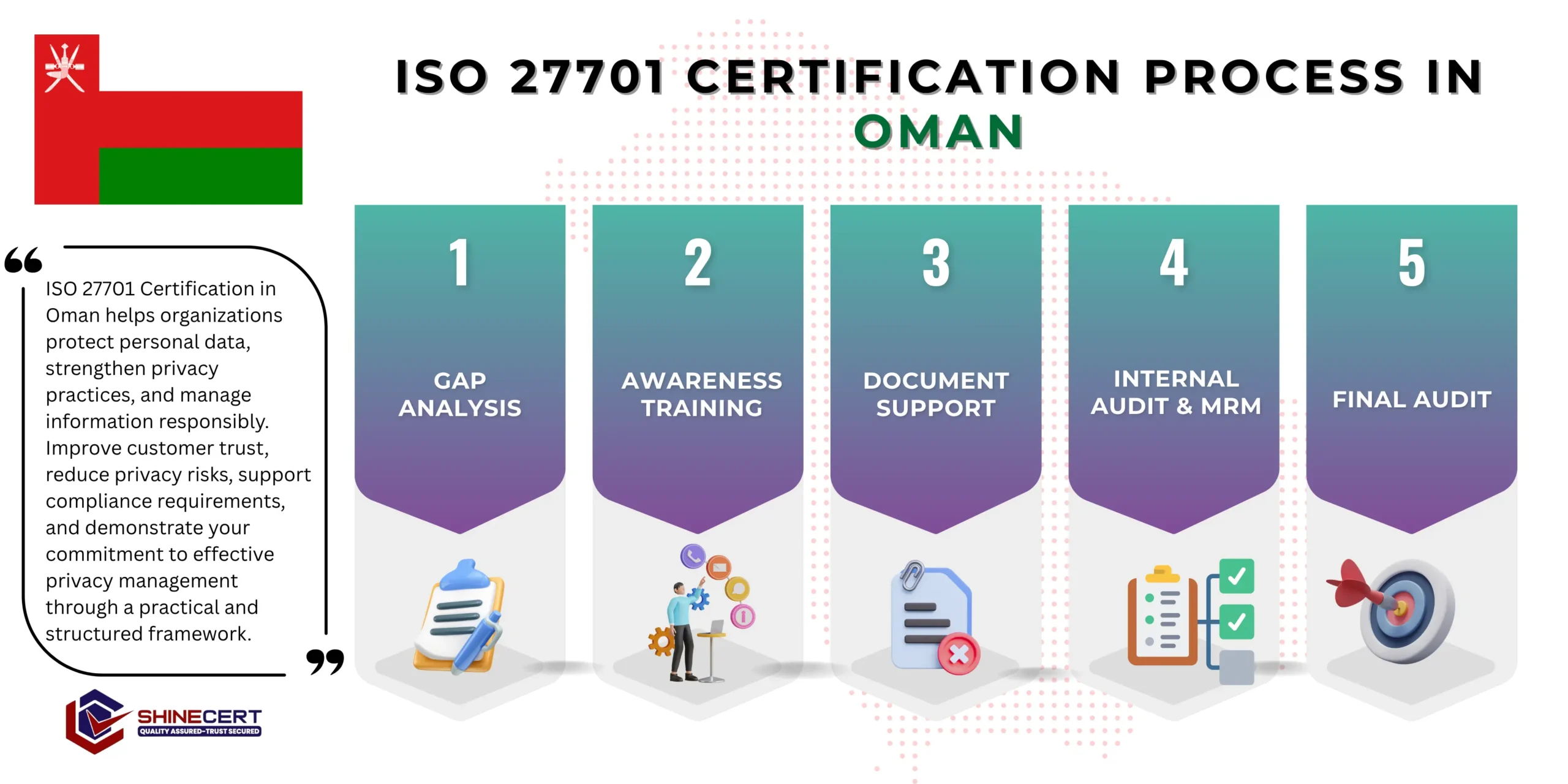
What are the steps to get ISO 27701 Certification in Oman?
our services
- ISO Certification Oman
- ISO 9001 Certification Oman
- ISO 14001 Certification Oman
- ISO 27001 Certification Oman
- ISO 22000 Certification Oman
- ISO 45001 Certification Oman
- ISO 13485 Certification Oman
- ISO 17025 Certification Oman
- ISO 31000 Certification Oman
- ISO 22301 Certification Oman
- ISO 27701 Certification Oman
- CE Mark Certification Oman
- GMP Certification Oman
- Halal Certification Oman
- SOC Certification Oman
major citys
Our Five-Step Certification Process: What to Actually Expect
Gap Assessment
We check your current privacy practices against ISO 27701's requirements, and confirm exactly where your ISO 27001 status stands.
Clarity on whether you need both standards together or just the extension, before any budget commitment.
A gap assessment covering both your ISO 27001 foundation and privacy-specific requirements.
Documentation Development
Your PII processing register, consent mechanisms, and data subject rights procedures get built around how your organization actually handles personal data.
Documentation reflecting your genuine data flows, not a generic privacy template disconnected from reality.
A complete ISO 27701 documentation set.
Implementation and Training
Controls roll out with staff trained specifically on privacy responsibilities distinct from general security awareness.
Your team understands the difference between securing data and handling it lawfully — two related but genuinely different disciplines.
Training records and evidence of privacy controls functioning.
Internal Audit and Management Review
We test the system internally, catching weaknesses before the real audit does.
Gaps between documented privacy policy and actual practice get closed in a low-stakes setting.
Internal audit report and management review minutes.
Certification Audit
Combined with your ISO 27001 audit if pursuing both together, or as a standalone extension audit if ISO 27001 is already certified.
A certificate that genuinely demonstrates operational PDPL alignment, not just documented intent.
Your ISO 27701 certificate and a surveillance audit schedule.
Gap Assessment
We check your current privacy practices against ISO 27701's requirements, and confirm exactly where your ISO 27001 status stands.
Clarity on whether you need both standards together or just the extension, before any budget commitment.
A gap assessment covering both your ISO 27001 foundation and privacy-specific requirements.
Documentation Development
Your PII processing register, consent mechanisms, and data subject rights procedures get built around how your organization actually handles personal data.
Documentation reflecting your genuine data flows, not a generic privacy template disconnected from reality.
A complete ISO 27701 documentation set.
Implementation and Training
Controls roll out with staff trained specifically on privacy responsibilities distinct from general security awareness.
Your team understands the difference between securing data and handling it lawfully — two related but genuinely different disciplines.
Training records and evidence of privacy controls functioning.
Internal Audit and Management Review
We test the system internally, catching weaknesses before the real audit does.
Gaps between documented privacy policy and actual practice get closed in a low-stakes setting.
Internal audit report and management review minutes.
Certification Audit
Combined with your ISO 27001 audit if pursuing both together, or as a standalone extension audit if ISO 27001 is already certified.
A certificate that genuinely demonstrates operational PDPL alignment, not just documented intent.
Your ISO 27701 certificate and a surveillance audit schedule.
What Is ISO 27701, Technically Speaking?
- An extension, structurally and legally : ISO 27701 doesn’t duplicate ISO 27001’s Information Security Management System requirements, it adds a Privacy Information Management System layer on top of an existing ISMS, meaning your organization needs ISO 27001 conformity as the base before ISO 27701’s additional controls make sense. This isn’t a technicality; it reflects the standard’s actual design, since privacy management genuinely depends on the security controls ISO 27001 already requires.
- Two distinct roles, two distinct sets of obligations : The standard’s real technical substance sits in distinguishing PII Controllers from PII Processors, organizations determining the purposes and means of processing personal data face different specific requirements than organizations processing personal data on another organization’s behalf. Annex A covers controller-specific requirements; Annex B covers processor-specific ones. Getting this classification right matters enormously, because implementing the wrong annex means building controls that don’t actually address your organization’s genuine legal exposure.
- Consent and purpose limitation, made auditable : The standard requires organizations to determine and document the specific legal basis for processing personal information for each identified purpose, not a blanket justification covering everything, but purpose-by-purpose accountability. Where consent is the basis, ISO 27701 requires genuinely verifiable evidence that consent was properly obtained, is current, and can be withdrawn as easily as it was given.
- Data subject rights, operationalized rather than described : The standard requires actual, functioning mechanisms for individuals to exercise their rights, access, correction, deletion, objection, within defined, trackable timeframes. A privacy policy that mentions these rights exists is not the same thing as a working intake and response process that can demonstrate it handles real requests within a real deadline.
Why This Matters So Much in Oman Specifically?
- MTCIT’s enforcement role under Royal Decree 6/2022 means PDPL compliance in Oman is not a theoretical obligation, there’s an active regulator behind it, and Executive Regulations from February 2024 gave that obligation concrete operational detail. Companies treating their privacy policy as a document rather than a functioning system are increasingly exposed as MTCIT’s enforcement posture matures.
- One pattern that shows up repeatedly with Oman clients: a company has genuinely done the legal work, engaged counsel, drafted policies, updated contracts, but none of that legal work translates into an operational system a third party can independently verify. ISO 27701 closes exactly that gap, converting legal compliance work that currently exists as documents into a functioning, auditable management system. This matters even more for Oman companies handling any EU personal data, where certification provides tangible evidence supporting broader GDPR accountability obligations alongside domestic PDPL compliance.
What Actually Drives Your Cost?
There’s no flat number, because two Oman organizations’ actual data processing complexity looks genuinely different. Here’s what actually moves it.
- Whether you already hold ISO 27001 : Organizations with existing ISO 27001 certification face a meaningfully smaller, faster project than those pursuing both standards together from scratch.
- Controller versus processor status, or both : Organizations acting as both controller and processor across different activities need broader documentation covering both roles’ distinct requirements.
- Volume and sensitivity of personal data processed : Higher volumes, or categories involving more sensitive personal data, need deeper rights-management and consent infrastructure.
- Number of third-party data relationships : Each processor or sub-processor relationship needs its own documented safeguards and agreements.
- Existing documentation maturity : Organizations with genuine prior PDPL legal work, like the case study above, aren’t starting from nothing, though converting that legal work into operational systems still takes real effort.
- Internal capacity to help : A privacy or compliance lead who can own parts of the documentation work directly reduces consultant hours needed.
- Riyada funding eligibility : Where the project qualifies for co-funding, real out-of-pocket cost drops meaningfully.
- Timeline urgency : A partner deadline or tender requirement sometimes needs more concentrated hours in a shorter window.
Riyada Funding: Does Your ISO 27701 Project Qualify for Support?
Riyada’s training and business development financing can, depending on eligibility, apply to privacy information management implementation, particularly cost-effective when bundled with a new ISO 27001 certification rather than pursued as a later standalone addition. Worth checking before finalizing your budget.
Mandatory Documents Required for Certification
- PII processing inventory : What it should contain: every category of personal data processed, its source, its purpose, and the specific legal basis relied on.
- Privacy policy and PIMS scope : What it should contain: your organization’s genuine privacy commitments and exactly which processing activities and locations the management system covers.
- Consent records (where applicable) : What it should contain: evidence of how, when, and for what purpose consent was obtained, and how it can be withdrawn.
- Data subject rights procedures : What it should contain: the intake process, verification steps, and response timeframe for each type of rights request.
- PII transfer and third-party processing agreements : What it should contain: the specific safeguards governing any transfer of personal data to processors or across borders.
- Privacy breach response procedure : What it should contain: detection, assessment, and notification steps specific to personal data incidents, distinct from general security incident response.
What Happens When an Oman Organization Skips This Extension
- Here’s the honest picture. An organization can be genuinely PDPL-compliant in the sense that matters legally, proper legal advice, correct policies, appropriate contracts, and still have no way to independently demonstrate that compliance to a partner, client, or regulator who wants third-party evidence rather than a self-assessment. That gap becomes a real, practical problem specifically in competitive procurement or partnership scenarios where certified privacy management is explicitly requested, not just generally preferred.
- Organizations that discover this gap only when a specific opportunity requires proof they don’t have tend to lose that opportunity to a certified competitor, or scramble under real time pressure to build in weeks what would have taken a comfortable few months done proactively. We’d generally recommend Oman organizations handling meaningful volumes of personal data, especially those with international client relationships, treat this as standing infrastructure rather than something to build reactively.
Privacy Information Management Requirements, Explained
- PII Processing Purpose and Legal Basis : Documented justification for every category of personal data processing, tied to a specific, identifiable purpose rather than a general catch-all.
- Consent Management (Where Applicable) : Genuinely verifiable mechanisms for obtaining, recording, and allowing withdrawal of consent, wherever consent is the legal basis relied on.
- Data Subject Rights Fulfillment : Working, timed processes for access, correction, deletion, and objection requests, tested, not just described.
- Privacy by Design : Building privacy consideration into new systems and processes from the design stage, rather than retrofitting it after something’s already been built.
- PII Transfer Controls : Documented, controlled processes for any transfer of personal data to third parties or across borders.
- Breach Notification for Personal Data : Specific, PDPL-aligned procedures for detecting and reporting incidents involving personal data, distinct from general ISO 27001 incident response.
Case Study: An Oman Professional Services Firm’s ISO 27701 Journey
The following is an illustrative, composite example based on the kind of project ShineCert typically runs, not a specific named client. An Oman-based professional services firm serving both domestic and international clients had already achieved ISO 27001 certification and had genuinely invested in PDPL compliance following legal counsel’s advice, updated contracts, a published privacy policy, staff briefed on the basics. What was missing became clear when a European client’s procurement team specifically requested evidence of a certified Privacy Information Management System as a condition of a larger engagement.
The gap assessment found the legal groundwork was genuinely solid, but almost none of it had been converted into operational, testable processes, there was no functioning intake system for data subject rights requests, no documented consent trail for personal data collected through the firm’s own operations, and no formal classification of the firm’s role as controller versus processor across its different client engagements. The bulk of implementation work went into building that classification clearly, standing up a real rights-request intake and response process, and formalizing consent documentation where it applied. Certification landed in time to support the European client relationship, and the pattern that followed matched what we typically see: because ISO 27001’s infrastructure was already in place, the incremental privacy-specific build was faster and considerably less disruptive than starting a security and privacy program from scratch would have been.
Benefits at a Glance
- Independently verifiable evidence of genuine PDPL alignment, not just a compliance claim
- Government and institutional tender eligibility for data-sensitive contracts
- Stronger footing for partner due-diligence conversations, including EU-facing ones
- International recognition supporting cross-border data processing relationships
- Reduced breach and enforcement risk through genuinely operational controls
- Direct efficiency gains from building on existing ISO 27001 infrastructure
Benefits: What Certification Actually Changes
Certification converts privacy policies and legal sign-off into a functioning system with independent, third-party verification behind it, a genuinely different conversation with a regulator or auditor.
Organizations handling sensitive personal data increasingly find certification specifically requested in procurement and partnership evaluation, not just generally appreciated.
A certified Privacy Information Management System gives partners and clients concrete evidence to point to, cutting down the back-and-forth that uncertified companies face when proving privacy maturity.
International recognition supports Oman organizations processing personal data across borders, including in EU-facing contexts where accountability evidence matters.
The extension leverages your existing risk assessment, controls, and audit infrastructure directly, making the incremental cost and effort considerably lower than building privacy management from scratch.
Applicable Standards by Industry
Professional and financial services
Firms handling client personal data across cross-border engagements find certification increasingly expected in international partnership conversations.
Read moreTechnology and SaaS providers
Companies processing customer personal data, particularly at scale, use ISO 27701 to formalize privacy management alongside existing security certification.
Read moreHealthcare and insurance
Organizations handling especially sensitive personal data use the standard to demonstrate rigorous, verifiable privacy controls.
Read moreFintech
Companies processing financial and identity data face genuine regulatory and partner pressure to demonstrate operational privacy maturity, not just policy-level compliance.
Read moreGovernment-linked entities
Organizations handling citizen data use certification to support public accountability and governance transparency expectations.
Read moreWhy Choose ShineCert for ISO 27701 Certification Oman?
Ten years of ISO consulting and certification experience backs every Oman engagement, run from our Riyadh and Lebanon offices with genuine, current familiarity with Royal Decree 6/2022, MTCIT’s enforcement role, and Riyada’s funding programs. We’ve guided more than 10,000 organizations through ISO certification globally, and we build every Oman ISO 27701 engagement around your actual data processing activities and existing ISO 27001 status, never a generic template stretched to fit.
Choosing a Certification Body in Oman?
What to Check | Why It Matters |
Accreditation under the GAC framework | Confirms genuine, internationally recognized certification |
Genuine understanding of the ISO 27001 dependency | An auditor unfamiliar with how the extension relates to the base ISMS will miss genuine gaps |
Familiarity with PDPL and MTCIT’s enforcement approach | Ensures your certification genuinely maps to real Oman regulatory expectations |
Experience distinguishing controller and processor requirements | Critical for organizations playing both roles across different activities |
Common Pitfalls We See in Oman ISO 27701 Projects
- Assuming this can be pursued without ISO 27001 : It cannot, ISO 27701 is structurally an extension, and any provider suggesting otherwise doesn’t understand how the standard is built.
- Confusing legal compliance with operational compliance : Solid legal work, good policies, proper contracts, doesn’t automatically translate into the working, testable processes ISO 27701 actually requires; the two need to be deliberately connected.
- Misclassifying controller versus processor status : Getting this wrong means building controls against the wrong annex, leaving genuine legal exposure unaddressed even after certification.
- Treating consent as a checkbox rather than a genuine, revocable record : Consent that can’t be demonstrated as specific, current, and withdrawable doesn’t satisfy the standard’s actual requirements, regardless of what a privacy policy claims.
Ready to Get Started?
If your privacy compliance currently lives in a policy document rather than a working system, let’s talk about closing that gap before a client or partner forces the question. As the best ISO consultant in Oman, book a free consultation or contact us directly, and we’ll walk through your data processing activities and cost factors before proposing a fixed-scope plan.
Frequently Asked Questions
An extension to ISO 27001 adding Privacy Information Management System requirements, helping organizations manage personal data as a controller, processor, or both, in a way that’s independently verifiable.
Yes, ISO 27701 cannot be certified standalone. You need ISO 27001 conformity in place, either alongside or already held.
It genuinely depends on your ISO 27001 status, data processing complexity, and controller/processor classification, we scope every project individually.
Typically three to five months bundled with ISO 27001, or six to eight weeks as a standalone extension if you already hold ISO 27001.
Potentially, particularly cost-effective when bundled with new ISO 27001 certification.
No, it complements legal compliance by converting it into an operational, auditable system; you still need proper legal advice on your PDPL obligations.
A controller determines the purposes and means of processing personal data; a processor processes it on another organization’s behalf. The standard has distinct requirements for each.
Yes, for organizations handling any EU personal data, certification provides concrete evidence supporting broader GDPR accountability obligations alongside domestic PDPL compliance.
Yes, organizations playing both roles across different activities need broader documentation covering both sets of distinct requirements.
We run Oman engagements from our Riyadh and Lebanon offices, with consultants traveling on-site as needed.