
ISO 22301 Certification in Oman
Quick Answer
ISO 22301 is the international standard for business continuity management systems, and in Oman it has genuine and growing regulatory relevance, the Central Bank of Oman’s 2026 banking law reforms introduce a formal Recovery and Resolution Planning framework, requiring licensed institutions to demonstrate exactly the kind of structured, tested continuity capability ISO 22301 formalizes. Get certified through a body accredited under the Global Accreditation Cooperation (GAC) framework. Plan for three to five months from kickoff to certificate. Cost depends on genuine factors, critical process complexity, number of sites, recovery time requirements, not a flat number.
ISO 22301, Explained Simply
Strip away the technical language, and ISO 22301 is a structured way of making sure your business can keep running, or recover quickly, when something genuinely disruptive happens, a system outage, a fire, a supplier collapse, a natural event. Rather than hoping a written plan will work if the day ever comes, you actually test it through realistic exercises, so you know with real evidence what will and won’t work before a genuine crisis forces you to find out.
For a client trying to decide whether it’s worth pursuing: it’s the difference between a continuity plan that exists only on paper and one that’s genuinely been rehearsed and proven to work, a difference that becomes enormously important the moment a real disruption actually happens.
Oman Market Snapshot: Key Facts for ISO 22301
- Regulatory momentum: the Central Bank of Oman’s 2026 banking law reforms introduce a Recovery and Resolution Planning framework, requiring licensed institutions to demonstrate structured continuity and recovery capability.
- Systemically important bank designation: the Central Bank’s framework includes a Domestic Systemically Important Bank designation, adding heightened continuity expectations for the institutions that carry it.
- Zone-based operational risk: businesses operating in Duqm, Sohar, and Salalah carry genuine continuity exposure from concentrated industrial and logistics infrastructure, making structured continuity planning particularly relevant there.
- SME funding available: Riyada offers financing and training support that can offset certification-related costs for eligible companies.
What are the steps to get ISO 22301 Certification in Oman?
our services
- ISO Certification Oman
- ISO 9001 Certification Oman
- ISO 14001 Certification Oman
- ISO 27001 Certification Oman
- ISO 22000 Certification Oman
- ISO 45001 Certification Oman
- ISO 13485 Certification Oman
- ISO 17025 Certification Oman
- ISO 31000 Certification Oman
- ISO 22301 Certification Oman
- CE Mark Certification Oman
- GMP Certification Oman
- Halal Certification Oman
- SOC Certification Oman
major citys
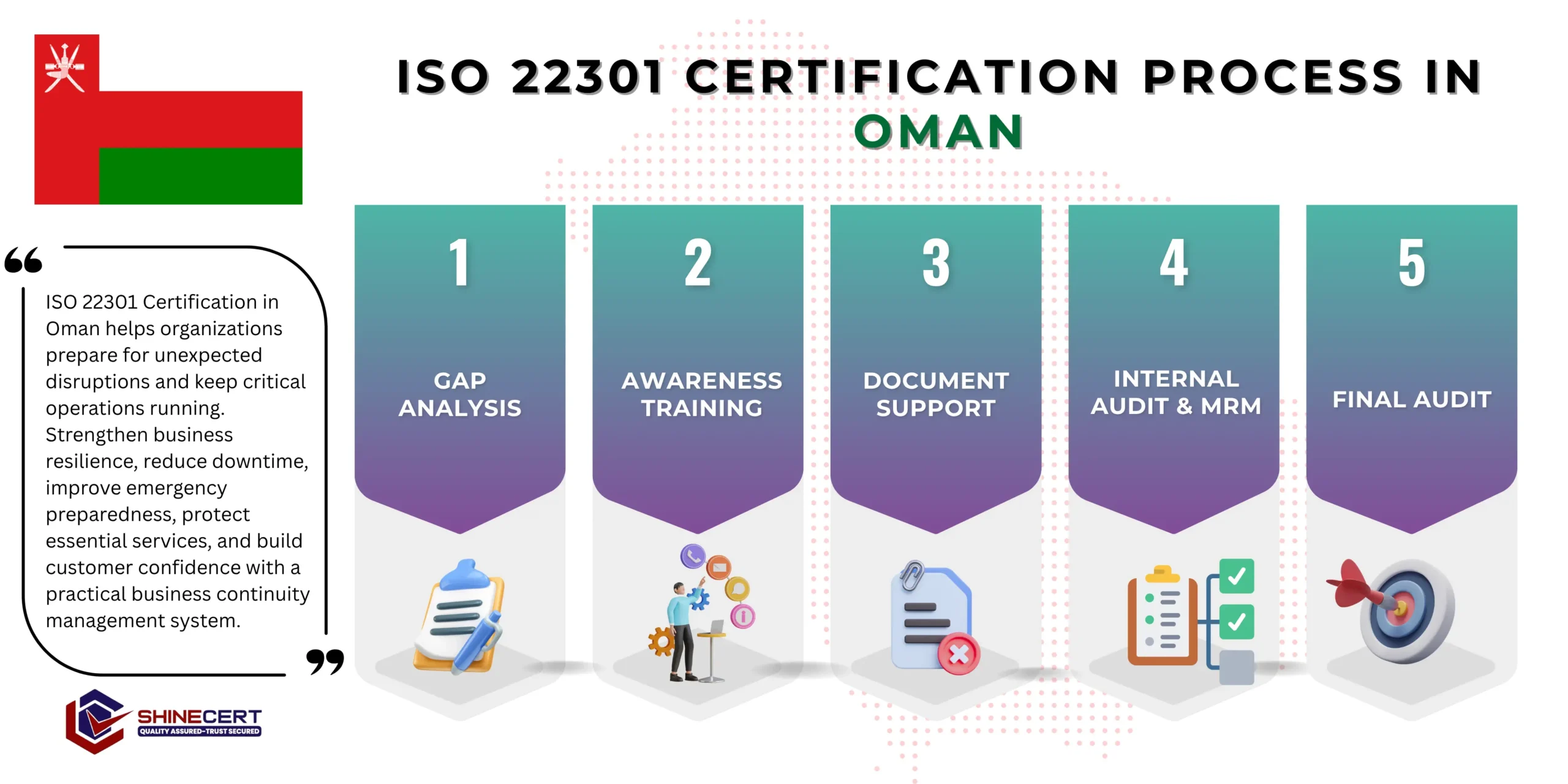
Our Five-Step Certification Process: What to Actually Expect
Gap Assessment
We evaluate your current continuity practices, including any existing regulatory compliance work, against ISO 22301's requirements.
A clear picture of the real gap, avoiding duplicate effort against work already done for other regulatory obligations.
A gap assessment report specific to your operations and critical activities.
Business Impact Analysis and Documentation
We identify your genuinely critical activities and establish defensible RTOs and RPOs for each, then build continuity strategies calibrated to meet them.
Recovery infrastructure investment that's proportionate to genuine business need, not over- or under-built.
A complete Business Impact Analysis and continuity strategy documentation set.
Implementation and Training
Continuity plans and recovery arrangements roll out, with staff trained on their specific roles during a disruption.
Your team knows genuinely what to do during a real incident, not just where to find a document.
Training records and documented continuity plans for each critical activity.
Exercising, Internal Audit, and Management Review
We run genuine exercises, tabletop through simulation, testing whether the plan actually works, then internally audit before the real certification audit.
Gaps between the plan on paper and genuine capability get caught and closed before they matter.
Exercise reports, internal audit report, and management review minutes.
Certification Audit
Stage 1 and Stage 2 audits with a GAC-accredited certification body.
Stage 1 checks documentation readiness; Stage 2 verifies the system, including exercise evidence, genuinely functions.
Your ISO 22301 certificate and a surveillance audit schedule.
Gap Assessment
We evaluate your current continuity practices, including any existing regulatory compliance work, against ISO 22301's requirements.
A clear picture of the real gap, avoiding duplicate effort against work already done for other regulatory obligations.
A gap assessment report specific to your operations and critical activities.
Business Impact Analysis and Documentation
We identify your genuinely critical activities and establish defensible RTOs and RPOs for each, then build continuity strategies calibrated to meet them.
Recovery infrastructure investment that's proportionate to genuine business need, not over- or under-built.
A complete Business Impact Analysis and continuity strategy documentation set.
Implementation and Training
Continuity plans and recovery arrangements roll out, with staff trained on their specific roles during a disruption.
Your team knows genuinely what to do during a real incident, not just where to find a document.
Training records and documented continuity plans for each critical activity.
Exercising, Internal Audit, and Management Review
We run genuine exercises, tabletop through simulation, testing whether the plan actually works, then internally audit before the real certification audit.
Gaps between the plan on paper and genuine capability get caught and closed before they matter.
Exercise reports, internal audit report, and management review minutes.
Certification Audit
Stage 1 and Stage 2 audits with a GAC-accredited certification body.
Stage 1 checks documentation readiness; Stage 2 verifies the system, including exercise evidence, genuinely functions.
Your ISO 22301 certificate and a surveillance audit schedule.
What Is ISO 22301, Technically Speaking?
- Built on the Harmonized Structure : ISO 22301 is the certifiable standard for business continuity management systems, following the same Harmonized Structure as ISO 9001, ISO 27001, and ISO 14001, which means organizations already running other management systems can integrate business continuity into shared governance infrastructure rather than building an isolated program.
- The Business Impact Analysis : What makes ISO 22301 technically distinct is its central analytical tool: the Business Impact Analysis (BIA), required under Clause 8.2.2, which systematically identifies an organization’s critical activities and the maximum tolerable period of disruption each can withstand before causing unacceptable harm.
- RTO and RPO : The BIA produces two genuinely important technical metrics for each critical activity: Recovery Time Objective (RTO), how quickly the activity must be restored after disruption, and Recovery Point Objective (RPO), how much data loss, measured in time, is tolerable for activities involving data processing. A payment processing function with a four-hour RTO needs meaningfully different, more expensive recovery infrastructure than a marketing function that can tolerate a week of disruption.
- Continuity strategies calibrated to real need : Building on the BIA, Clause 8.3 requires organizations to develop business continuity strategies and solutions specifically calibrated to meet the RTOs and RPOs identified, this is where genuine technical decisions get made about backup site strategy, data replication, alternate staffing, and supplier continuity requirements. A critical technical distinction the standard makes clear is between business continuity plans and disaster recovery plans, and ISO 22301 explicitly requires both dimensions to be addressed and connected.
- Testing is the whole point : Perhaps the standard’s most operationally significant requirement is Clause 8.5’s mandate for exercising and testing, a business continuity plan that exists only on paper and has never been tested against a realistic scenario is, in practice, an unverified assumption, not a genuine capability. The standard expects organizations to conduct exercises ranging from tabletop discussions through full-scale simulations, formally capturing lessons learned into plan improvement.
- Direct relevance to Oman’s financial reforms : For Oman financial institutions specifically, the Central Bank’s Recovery and Resolution Planning framework references exactly the kind of structured continuity and recovery capability ISO 22301 formalizes, meaning a properly built ISO 22301 system does double duty, satisfying the international standard’s certification requirements while directly supporting emerging regulatory expectations.
Why This Matters So Much in Oman Specifically?
- Oman’s financial sector is entering a genuinely more demanding continuity and resolution planning period. The Central Bank of Oman’s 2026 reforms, including the Recovery and Resolution Planning framework and the Domestic Systemically Important Bank designation, expect licensed institutions, particularly those carrying systemic importance, to demonstrate real, tested recovery capability, not an assumption sitting in a drawer. ISO 22301 gives these institutions a recognized, internationally consistent framework for building and evidencing that capability.
- Beyond financial services, Oman’s concentration of industrial and logistics infrastructure in Duqm, Sohar, and Salalah creates genuine continuity exposure for companies operating there, a disruption at a single port, processing facility, or logistics hub can cascade through supply chains quickly. One pattern we frequently see in Oman: companies write a continuity plan once, during a compliance push, and never genuinely test it again, leaving them with exactly the kind of untested assumption that fails when a real disruption actually occurs.
What Actually Drives Your Cost?
We don’t quote a flat number, because a flat number would misrepresent how different two Oman organizations’ actual continuity requirements can be. Here’s what genuinely drives cost.
- Number and complexity of critical activities : An organization with a handful of straightforward critical functions needs meaningfully less BIA and strategy work than one with dozens of interdependent critical processes.
- Recovery time requirements : Activities requiring near-immediate recovery need more sophisticated, expensive recovery infrastructure than those tolerating longer disruption windows, directly affecting both implementation and ongoing cost.
- Number of sites and data centers : Each additional location, including operations spread across Duqm, Sohar, or Salalah, generally needs its own continuity strategy and testing.
- Regulatory overlay : Central Bank of Oman-regulated institutions, particularly those with systemic importance designation, need deeper documentation and alignment with the Recovery and Resolution Planning framework.
- How mature your existing continuity practices already are : Organizations with some existing plans and infrastructure, even outdated ones, aren’t starting from zero. Organizations with no documented plan need more foundational work.
- Exercise and testing scope : Full-scale simulation exercises are more resource-intensive to plan and run than tabletop discussions, though both have genuine value at different program maturity stages.
- Whether you’re bundling with other standards : Pursuing ISO 27001 alongside ISO 22301 shares meaningful risk assessment and incident response infrastructure.
- Your internal capacity to lead parts of the work : An internal business continuity coordinator who can own documentation and exercise planning reduces consultant hours needed.
- Riyada funding eligibility : Where your project qualifies for co-funding, your genuine out-of-pocket cost can be meaningfully lower.
- Timeline urgency : A compressed timeline driven by a regulatory readiness deadline sometimes needs more concentrated consultant hours in a shorter window.
Riyada Funding: Does Your ISO 22301 Project Qualify for Subsidy?
Riyada’s training and business development programs can apply to business continuity management system implementation, depending on your company’s size, sector, and program eligibility. We generally recommend checking your Riyada eligibility before finalizing your certification budget.
Mandatory Documents Required for Certification
- Business continuity policy : Genuine leadership commitment specific to your organization. What it should contain: a clear statement of the organization’s commitment to continuity, board-level accountability, and a framework for setting and reviewing continuity objectives.
- Scope of the business continuity management system : Documented, defining exactly which activities and sites are covered. What it should contain: the specific critical activities, processes, and locations included, with justification for any exclusions.
- Business Impact Analysis : Identifying critical activities, RTOs, and RPOs specific to your operations. What it should contain: each critical activity, its maximum tolerable disruption period, and defensible RTO and RPO figures.
- Risk assessment : Covering threats to your critical activities. What it should contain: identified threats, their likelihood and impact on critical activities, and existing or planned controls.
- Business continuity plans and strategies : Calibrated to genuinely meet identified RTOs and RPOs. What it should contain: specific recovery procedures, responsible personnel, and required resources for each critical activity.
- Exercise and testing records : Evidence that plans have been genuinely tested, not just written. What it should contain: exercise type, scenario tested, findings, and documented improvements made as a result.
What Happens When an Oman Institution Operates Without a Genuinely Tested Plan?
- This is worth understanding concretely. An untested business continuity plan creates a dangerous illusion of preparedness, the document exists, so leadership assumes the organization is covered, right up until an actual disruption reveals the gap between documented assumption and genuine capability. For Central Bank of Oman-regulated institutions, this gap is exactly what the Recovery and Resolution Planning framework is designed to surface, and remediation under regulatory pressure tends to be more costly and reputationally damaging than proactive, planned testing.
- We generally recommend Oman financial institutions and critical service providers treat genuine exercising and testing as the actual point of ISO 22301, not a formality en route to a certificate, the certificate matters less than knowing, with real evidence, that your organization can genuinely recover when it needs to.
Business Continuity Requirements, Clause by Clause
- Context of the Organization (Clause 4) : Mapping your genuine operating environment, critical activities, and the interested parties, customers, regulators, counterparties, with a stake in your continuity capability.
- Leadership (Clause 5) : Top management accountability for business continuity, including genuine resourcing and priority, not delegation to a single business continuity coordinator disconnected from real operational decisions.
- Planning (Clause 6) : Risk-based planning specific to your genuine continuity risks, informed directly by the Business Impact Analysis.
- Support (Clause 7) : Competence and awareness requirements ensure staff genuinely understand their role during a disruption, tested through their actual knowledge of continuity procedures, not just training attendance records.
- Operation (Clause 8) : The largest and most technical clause, Business Impact Analysis, risk assessment, business continuity strategies and solutions, and the exercising and testing program that proves the plan genuinely works.
- Performance Evaluation (Clause 9) : Monitoring, measurement, and internal audit test whether continuity capability is genuinely maintained and improving, not degrading as the organization changes.
- Improvement (Clause 10) : Structured handling of continuity nonconformities, including genuine lessons-learned integration after every exercise and real incident.
Case Study: An Oman Financial Institution’s Continuity Program Buildout
The following is an illustrative, composite example based on the kind of project ShineCert typically runs, not a specific named client. An Oman-based licensed financial institution had a written business continuity plan produced several years earlier that had never been genuinely exercised, and key contact details and recovery procedures within it were significantly out of date. The trigger was preparation for the Central Bank of Oman’s Recovery and Resolution Planning framework, which specifically flagged the absence of recent testing evidence during an internal readiness review.
The gap assessment found the plan’s underlying strategy, a backup data center and alternate staffing arrangement, was reasonably sound in concept, but nobody could confirm it would genuinely work because it had never been tested, and several key personnel referenced in the plan had since left the organization. The bulk of implementation work went into rebuilding the Business Impact Analysis with current, defensible RTOs and RPOs, updating the continuity strategies to reflect the organization’s current structure, and running a genuine tabletop exercise followed by a partial simulation of the backup data center failover. The simulation revealed a previously unknown gap: the backup data center’s failover process took nearly three times longer than the documented RTO assumed. Certification was achieved after remediating this gap, and the pattern we typically see afterward held: the discovered failover gap, caught during a controlled exercise, would have caused a genuine, costly service disruption had it first been discovered during an actual crisis.
Benefits at a Glance
- Direct alignment with the Central Bank of Oman’s Recovery and Resolution Planning framework
- Genuinely tested recovery capability, not an unverified document
- Government tender eligibility and stronger positioning with critical infrastructure clients
- Increased client and counterparty trust in your operational resilience
- Access to potential Riyada funding support
- A foundation that shares infrastructure with ISO 27001 and ISO 27701
Benefits: What Certification Actually Changes
The mandatory exercising and testing program means certified organizations have actually rehearsed disruption scenarios, not just written a plan that’s never been stress-tested.
ISO 22301’s structure maps closely onto the Recovery and Resolution Planning framework’s requirements, reducing the gap between certification and regulatory readiness.
Organizations with genuinely tested RTOs and RPOs recover measurably faster and more predictably from actual incidents than those relying on improvised responses.
Certification gives correspondent banks, large corporate clients, and regulators independent evidence of institutional resilience, rather than asking them to take your word for it.
Depending on eligibility, certification-related training and consulting costs may be partially offset through Riyada’s programs.
Applicable Standards by Industry
Banking and financial services
Central Bank of Oman-regulated institutions use ISO 22301 to directly support the Recovery and Resolution Planning framework and demonstrate genuine operational resilience.
Read moreOil, gas, and industrial operations
Companies operating in Duqm and Sohar use business continuity management to protect against genuine disruption risk in concentrated industrial infrastructure.
Read moreLogistics and port operations
Companies operating through Salalah's port use ISO 22301 to protect against genuine supply chain disruption risk.
Read moreTelecommunications
Companies operating critical communications infrastructure use ISO 22301 to demonstrate resilience expected by both regulators and enterprise customers.
Read moreGovernment-adjacent and utility services
Organizations delivering essential services use structured continuity management given the broad public impact of disruption.
Read moreWhy Choose ShineCert for ISO 22301 Certification Oman?
ShineCert brings 10 years of ISO consulting and certification experience to every Oman engagement, coordinated from our Riyadh and Lebanon offices with direct familiarity with the Central Bank of Oman’s regulatory direction and Riyada’s funding programs. Our team has guided more than 10,000 organizations through ISO certification globally, and we build every Oman business continuity engagement around your actual critical activities, recovery requirements, and funding eligibility, with genuine emphasis on testing that proves your capability rather than paperwork that merely claims it.
Choosing a Certification Body in Oman?
What to Check | Why It Matters |
Accreditation under the GAC framework | Confirms genuine, internationally recognized certification |
Experience with Central Bank of Oman-regulated institutions | Ensures the auditor understands the Recovery and Resolution Planning framework’s specific expectations |
Genuine expertise in exercise design and evaluation | Ensures your testing program produces real, defensible evidence, not a superficial checkbox exercise |
Sector-specific continuity audit experience | Banking, industrial, and logistics each involve meaningfully different continuity risk profiles |
Common Pitfalls We See in Oman ISO 22301 Projects
- Writing a plan and never testing it : This is the single most common and most dangerous gap, a plan’s real value only becomes clear when it’s genuinely exercised, and organizations that skip this step carry an untested assumption, not a real capability.
- Setting RTOs and RPOs that don’t reflect genuine business needs : Overly conservative RTOs waste money on unnecessary infrastructure; overly relaxed RTOs leave the organization genuinely exposed, both stem from a BIA that wasn’t rigorously conducted.
- Confusing business continuity plans with disaster recovery plans : Treating IT system recovery as the entirety of business continuity misses the broader organizational, staffing, and supplier dimensions the standard explicitly requires.
- Letting plans go stale after organizational change : Plans referencing outdated contact details, departed staff, or discontinued systems fail exactly when needed most.
Ready to Get Started?
ShineCert supports Oman organizations from initial gap assessment through certification audit, including checking whether your project qualifies for Riyada funding support. As the best ISO consultant in Oman, we book a free consultation or contact us directly, and we’ll walk through your specific critical activities and cost factors before proposing a fixed-scope plan.
Frequently Asked Questions
It’s the international standard for business continuity management systems, setting requirements for identifying critical activities and building genuinely tested capability to maintain or recover them during disruption.
It genuinely depends on factors like the number and complexity of critical activities, recovery time requirements, and existing continuity maturity, we scope every project individually.
Not as a blanket mandate by name, but the Recovery and Resolution Planning framework introduced under the 2026 reforms expects exactly the kind of structured, tested continuity capability ISO 22301 formalizes.
Typically three to five months.
Potentially, Riyada’s training and development programs can apply to certification-related costs depending on eligibility.
Business continuity covers how the whole organization keeps operating or resumes critical activities; disaster recovery specifically covers restoring IT systems and infrastructure;ISO 22301 requires both to be addressed and connected.
Testing is mandatory under Clause 8.5, an untested plan is an unverified assumption, not a genuine capability, and auditors specifically look for exercise evidence.
Yes, each critical activity generally needs its own Business Impact Analysis, RTO/RPO determination, and continuity strategy.
We coordinate Oman engagements from our Riyadh and Lebanon offices, with consultants traveling on-site as needed.