
ISO 13485 Certification in Oman
Quick Answer
ISO 13485 is the international standard for medical device quality management systems, and in Oman it operates within a genuinely distinctive regulatory model: the Directorate General of Pharmaceutical Affairs and Drug Control (DGPADC), under the Ministry of Health, uses a notification-based system for medical devices rather than the full, lengthy registration processes some neighboring markets require, meaning devices can generally reach the Oman market faster, provided the underlying quality documentation, including ISO 13485 certification, is genuinely in order. Get certified through a body accredited under the Global Accreditation Cooperation (GAC) framework. Plan for three to five months from kickoff to certificate. Cost depends on genuine factors, device classification, manufacturing versus distribution role, product range, not a flat number.
ISO 13485, Explained Simply
Strip away the technical language, and ISO 13485 is a structured way of proving that the medical devices your business manufactures, imports, or distributes are designed, produced, and tracked with the rigor patient safety genuinely demands. From raw materials through to the specific device a patient receives, the system requires you to be able to trace exactly where things came from and, if something goes wrong, exactly how to find and recall the affected devices quickly.
For a client trying to decide whether it’s worth pursuing: it’s proof, verified by an outside party, that your business manages medical device quality to the standard regulators, hospitals, and patients genuinely need, proof that’s frequently a practical precondition for getting a device notified and onto the Oman market at all.
Oman Market Snapshot: Key Facts for ISO 13485
- Regulatory authority: the Directorate General of Pharmaceutical Affairs and Drug Control (DGPADC), under the Ministry of Health, oversees medical device market access in Oman.
- Notification-based system: unlike jurisdictions requiring lengthy full registration for every device, DGPADC operates a notification-based approach, generally allowing faster market entry where documentation, including ISO 13485 evidence, is complete and well-organized.
- Local presence considerations: foreign manufacturers typically work through a locally appointed representative or distributor to manage the notification process and post-market obligations inside Oman.
- SME funding available: Riyada offers financing and training support that can offset certification-related costs for eligible companies.
What are the steps to get ISO 13485 Certification in Oman?
our services
- ISO Certification Oman
- ISO 9001 Certification Oman
- ISO 14001 Certification Oman
- ISO 27001 Certification Oman
- ISO 22000 Certification Oman
- ISO 45001 Certification Oman
- ISO 13485 Certification Oman
- ISO 17025 Certification Oman
- ISO 31000 Certification Oman
- ISO 22301 Certification Oman
- CE Mark Certification Oman
- GMP Certification Oman
- Halal Certification Oman
- SOC Certification Oman
major citys
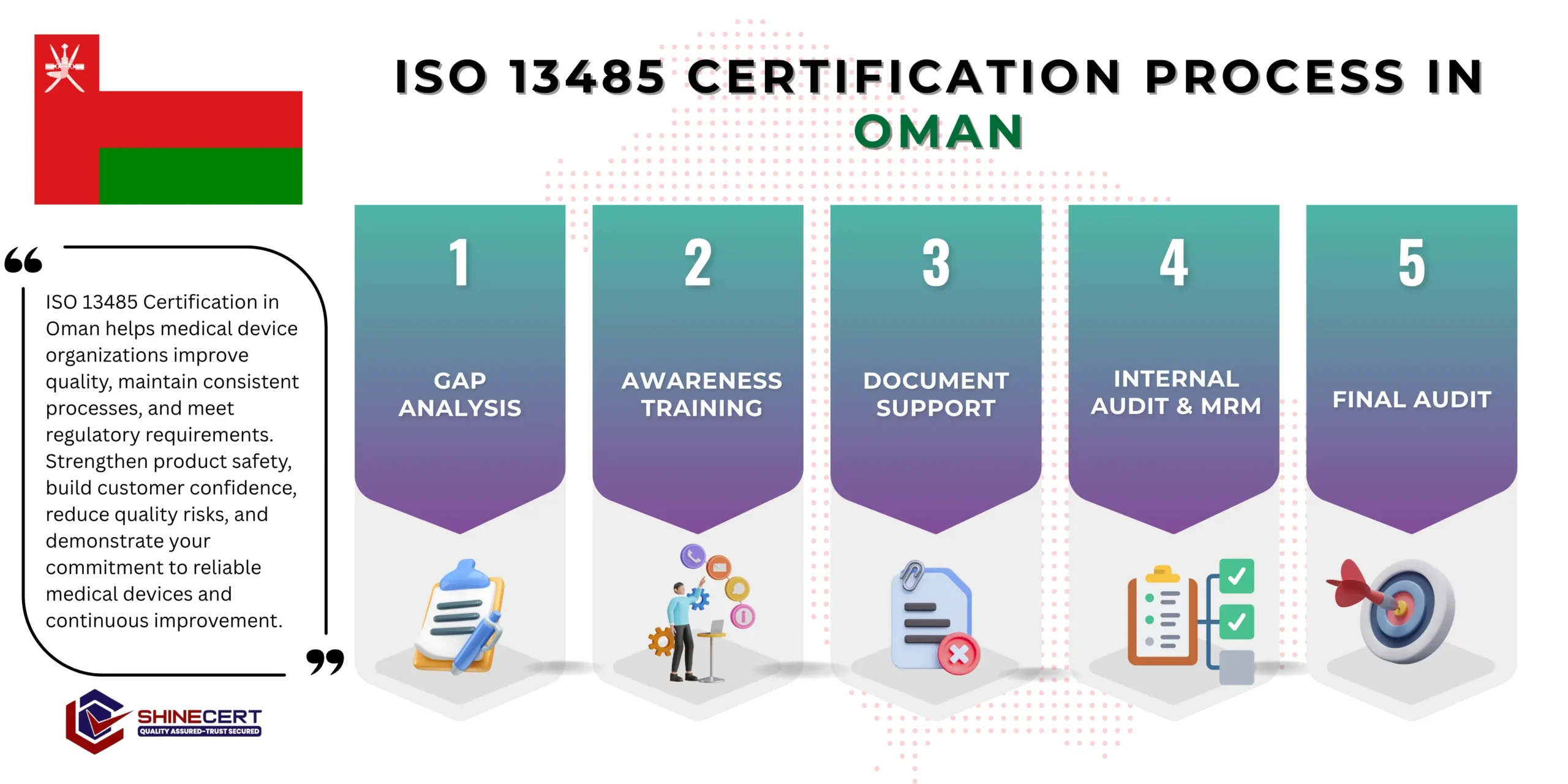
Our Five-Step Certification Process: What to Actually Expect
Gap Assessment
We evaluate your current quality practices, design documentation, and risk management against ISO 13485's requirements.
A clear picture of exactly what DGPADC's notification process will expect to see, before you submit anything.
A gap assessment report specific to your device range and role (manufacturer, distributor, or representative).
Documentation Development
Your quality manual, device history records, design history files, and risk management documentation get built around your actual device portfolio.
Documentation structured the way DGPADC and international regulators actually expect to review it.
A complete ISO 13485 documentation set.
Implementation and Training
Controls roll out across design, production, and post-market surveillance processes, with staff trained on traceability and complaint-handling procedures.
Your team builds genuine habits around device traceability, not a compliance exercise that falls apart under real recall pressure.
Training records and evidence of controls functioning across your device lifecycle.
Internal Audit and Management Review
We test the system internally, surfacing weaknesses before the real audit.
Documentation gaps get caught and fixed before they can delay your DGPADC notification.
Internal audit report and management review minutes.
Certification Audit
Stage 1 and Stage 2 audits with a GAC-accredited certification body.
Stage 1 checks documentation readiness; Stage 2 verifies the system genuinely functions, positioning you for a smooth DGPADC notification immediately after.
Your ISO 13485 certificate, ready to support DGPADC notification.
Gap Assessment
We evaluate your current quality practices, design documentation, and risk management against ISO 13485's requirements.
A clear picture of exactly what DGPADC's notification process will expect to see, before you submit anything.
A gap assessment report specific to your device range and role (manufacturer, distributor, or representative).
Documentation Development
Your quality manual, device history records, design history files, and risk management documentation get built around your actual device portfolio.
Documentation structured the way DGPADC and international regulators actually expect to review it.
A complete ISO 13485 documentation set.
Implementation and Training
Controls roll out across design, production, and post-market surveillance processes, with staff trained on traceability and complaint-handling procedures.
Your team builds genuine habits around device traceability, not a compliance exercise that falls apart under real recall pressure.
Training records and evidence of controls functioning across your device lifecycle.
Internal Audit and Management Review
We test the system internally, surfacing weaknesses before the real audit.
Documentation gaps get caught and fixed before they can delay your DGPADC notification.
Internal audit report and management review minutes.
Certification Audit
Stage 1 and Stage 2 audits with a GAC-accredited certification body.
Stage 1 checks documentation readiness; Stage 2 verifies the system genuinely functions, positioning you for a smooth DGPADC notification immediately after.
Your ISO 13485 certificate, ready to support DGPADC notification.
What Is ISO 13485, Technically Speaking?
- A deliberately different structure : ISO 13485 is the internationally recognized quality management system standard specifically for medical devices, and it deliberately diverges from the generic Harmonized Structure that ISO 9001, ISO 14001, and ISO 27001 share. Medical device regulation worldwide, including the EU Medical Device Regulation, the US FDA’s Quality System Regulation, and Oman’s DGPADC framework, expects a specific, harmonized structure that regulators can map directly against their own regulatory clauses. Regulatory conformity is built into the standard’s core purpose, not treated as an external add-on.
- Risk management woven throughout : The standard’s technical backbone is risk management integrated throughout the device lifecycle, formally referencing ISO 14971 rather than building its own separate risk framework. A genuinely compliant ISO 13485 system requires risk management activity at every lifecycle stage: design and development, production, post-market surveillance, and complaint handling. Clause 7.3 (Design and Development) is particularly technical, requiring design inputs, outputs, verification, validation, and a formal design history file.
- Traceability that goes further than most standards : A distinguishing technical feature compared to ISO 9001 is the depth of traceability requirements. ISO 13485 requires organizations to maintain device history records enabling traceability from raw materials and components through to the specific finished device and, where applicable, to the specific patient or customer who received it, essential for medical device recalls where patient safety is directly at stake.
- Post-market surveillance as an active feedback loop : Clause 8.2.1 requires a systematic process for gathering and reviewing information about the device once it’s in use, feeding genuine field performance data back into risk management and, where necessary, triggering corrective action or recall procedures. For Oman-based manufacturers and distributors, this technical requirement supports the ongoing monitoring DGPADC’s notification-based system relies on to catch problems that a full pre-market registration model might otherwise front-load into a lengthy initial review.
Why This Matters So Much in Oman Specifically?
- Oman’s notification-based approach is a genuinely distinctive characteristic worth understanding properly, it’s not a lighter-touch system that lets weaker documentation slide through, it’s a faster system that puts more weight on the quality and completeness of what you submit upfront. A device backed by genuinely solid ISO 13485 documentation moves through notification smoothly; a device backed by incomplete or poorly organized documentation faces exactly the delays and follow-up queries the notification model was designed to avoid.
- One pattern we frequently see in Oman: companies familiar with full-registration markets assume Oman’s notification system means less documentation rigor is needed, when in practice the opposite is closer to true, because there’s less of a formal, staged review process to catch gaps before market entry, the quality and completeness of your ISO 13485 system carries even more weight than it might in a jurisdiction with a longer, multi-stage registration review.
Riyada Funding: Does Your ISO 13485 Project Qualify for Subsidy?
Riyada’s financing and training programs can apply to medical device quality management system implementation, depending on your company’s size, sector, and program eligibility. Given how directly documentation quality affects notification speed, checking Riyada eligibility early is worthwhile to manage the genuine cost of getting this right.
What Actually Drives Your Cost?
We don’t quote a flat number, because a flat number would misrepresent how different two Oman medical device companies’ actual scope can be. Here’s what genuinely drives cost.
- Your role in the supply chain : A manufacturer designing and producing devices faces meaningfully deeper documentation requirements, design history files, full risk management files, than a distributor handling already-manufactured devices.
- Device risk classification : Higher-risk device classes generally need deeper risk management documentation than lower-risk classes, reflecting the genuinely higher stakes of a failure.
- Number of distinct devices in your portfolio : Each device generally needs its own design history file and risk management file, so a company notifying a handful of devices is a genuinely smaller project than one notifying dozens.
- Number of facilities : Each manufacturing or storage site generally needs its own assessment and audit time.
- How mature your existing quality and traceability practices already are. Companies with established design control and traceability aren’t starting from zero. Companies with informal practices need more foundational work.
- Existing certifications from other markets : Companies already holding a valid ISO 13485 certificate or CE marking often need meaningfully less work to add the Oman-specific documentation interface.
- Whether you’re bundling with other standards : Companies pursuing GMP alongside ISO 13485, common for combination product manufacturers, share meaningful implementation and audit infrastructure.
- Your internal capacity to lead parts of the work : An internal regulatory affairs or quality lead who can own documentation reduces consultant hours needed.
- Riyada funding eligibility : Where your project qualifies for co-funding, your genuine out-of-pocket cost can be meaningfully lower.
- Timeline urgency : A compressed timeline driven by a market-entry deadline sometimes needs more concentrated consultant hours in a shorter window.
Mandatory Documents Required for Certification
- Quality policy and manual. Genuine leadership commitment specific to your device portfolio. What it should contain: a clear statement of your commitment to quality and regulatory conformity, and a framework for setting and reviewing quality objectives.
- Scope of the quality management system : Documented, defining exactly which devices, processes, and sites are covered. What it should contain: the specific devices, processes, and locations included, with justification for any exclusions.
- Design history files : Documenting design inputs, outputs, verification, and validation for each device. What it should contain: the full design record from initial requirements through to final verified and validated output.
- Risk management file per device : Aligned with ISO 14971, covering the full device lifecycle. What it should contain: identified hazards, risk estimation, risk control measures, and residual risk evaluation for each device.
- Device history records and traceability documentation : Supporting genuine, fast traceability for potential recalls. What it should contain: how each device or batch is tracked from raw material through to the end customer.
- Post-market surveillance and complaint-handling procedures : Evidence of a genuine feedback loop from field performance back into the quality system. What it should contain: how complaints are logged, investigated, and fed back into risk management, with defined escalation triggers.
What Happens When an Oman Company Tries to Sell Devices Without Proper Documentation?
This is worth understanding concretely. Without complete ISO 13485-aligned documentation, a device notification through DGPADC faces genuine delays, follow-up queries, or rejection, and because Oman’s system relies on notification rather than a lengthy formal registration review, gaps in documentation quality tend to surface as friction at exactly the point you’re trying to move fastest. Companies that discover mid-process that their QMS documentation doesn’t meet DGPADC’s expectations face delays that can push back market entry by weeks or months.
We generally recommend companies planning to bring medical devices to Oman build ISO 13485 certification into their market-entry timeline from the earliest planning stage, treating the notification system’s speed advantage as something you earn through genuine documentation quality, not something to assume by default.
Medical Device Quality Requirements, Clause by Clause
- Quality Management System (Clause 4) : Documentation control and record-keeping requirements are notably more rigorous than generic quality standards, reflecting the regulatory-submission function this documentation ultimately serves.
- Management Responsibility (Clause 5) : Leadership accountability specifically for regulatory compliance, not just general quality objectives.
- Resource Management (Clause 6) : Competence requirements for personnel involved in activities affecting product quality, including specific infrastructure and work environment controls relevant to device manufacturing.
- Product Realization (Clause 7) : The largest and most technical clause, covering design and development, purchasing controls, production and service provision, and the control of monitoring and measuring equipment, this is where device-specific risk management under ISO 14971 lives.
- Measurement, Analysis, and Improvement (Clause 8) : Post-market surveillance, complaint handling, and corrective/preventive action, the ongoing feedback loop connecting real-world device performance back into the quality system, particularly important given Oman’s notification-based reliance on genuine post-market vigilance.
Case Study: An Oman Medical Device Distributor’s Notification Journey
The following is an illustrative, composite example based on the kind of project ShineCert typically runs, not a specific named client. An Oman-based company distributing diagnostic devices for a European manufacturer needed to bring several new devices to market, but the manufacturer’s own ISO 13485 certification, while valid, didn’t clearly document how complaint handling and traceability worked across the manufacturer-distributor relationship inside Oman.
The gap assessment found the manufacturer’s core quality system was genuinely strong, but the local distributor’s own processes hadn’t formally documented how they interfaced with the manufacturer’s system; complaint handling, for instance, ran on an informal email-based process rather than a documented, auditable procedure. The bulk of implementation work went into formalizing this interface: building a documented complaint-handling and traceability procedure connecting the distributor’s local operations to the manufacturer’s global quality system, and preparing complete, well-organized documentation for each device. Notification proceeded smoothly without significant follow-up queries, and the pattern we typically see afterward held: subsequent device notifications for the same manufacturer moved noticeably faster once the interface documentation template was established.
Benefits at a Glance
- Strong supporting documentation for DGPADC’s notification-based system
- Faster, smoother market entry with complete, properly structured documentation
- Government tender eligibility for hospital and government healthcare procurement
- Reduced risk of device recalls and regulatory penalties
- Access to potential Riyada funding support
- A foundation that supports parallel registration in other GCC markets
Benefits: What Certification Actually Changes
Complete, properly structured ISO 13485 documentation submitted alongside your notification tends to move through DGPADC’s process with fewer follow-up queries than incomplete or poorly organized submissions.
Genuine, lifecycle-wide risk management and post-market surveillance reduce both the likelihood of a device safety issue and the severity of its consequences if one occurs.
A certificate gives government and private healthcare purchasers independent, third-party proof that your devices meet international quality standards, rather than asking them to take your word for it.
ISO 13485 is recognized globally, supporting registration or notification processes across other GCC markets with similar QMS evidence requirements.
Depending on eligibility, certification-related training and consulting costs may be partially offset through Riyada’s programs.
Applicable Standards by Industry
Medical device manufacturing
Manufacturers use ISO 13485 as the foundation for both international operations and Oman market notification.
Read moreMedical device distribution and import
Distributors and importers need ISO 13485-aligned quality systems to support fast, smooth notification, even where they don't manufacture devices themselves.
Read moreDiagnostic and laboratory equipment
IVD manufacturers and distributors need documentation reflecting their specific device risk profile.
Read moreDental and surgical instruments
Manufacturers and distributors of dental and surgical devices need device-specific risk management documentation reflecting their particular use cases.
Read moreHealthcare technology and combination products
Companies at the intersection of medical devices and pharmaceuticals often need ISO 13485 alongside GMP.
Read moreWhy Choose ShineCert for ISO 13485 Certification Oman?
ShineCert brings 10 years of ISO consulting and certification experience to every Oman engagement, coordinated from our Riyadh and Lebanon offices with direct familiarity with DGPADC’s notification-based system and Riyada’s funding programs. Our team has guided more than 10,000 organizations through ISO certification globally, across sectors including medical device manufacturing, distribution, and diagnostics, the same industries that make up the bulk of our Oman medical device client base. We build every Oman engagement around your specific device portfolio, market role, and notification timeline, not a one-size-fits-all package.
Choosing a Certification Body in Oman?
What to Check | Why It Matters |
Accreditation under the GAC framework | Confirms genuine, internationally recognized certification DGPADC will accept |
Genuine medical device sector experience | ISO 13485 auditing requires understanding of design controls and risk management specific to devices |
Familiarity with DGPADC’s notification-based system | Ensures your certificate and documentation package are structured to move smoothly through notification |
Experience with manufacturer-distributor QMS interfaces | Particularly relevant for companies representing foreign manufacturers |
Common Pitfalls We See in Oman ISO 13485 Projects
- Assuming the notification system means less documentation rigor is needed. It’s a faster system, not a lighter one, incomplete documentation surfaces as friction precisely because there’s less staged review to catch it early.
- Assuming a foreign manufacturer’s existing certificate is sufficient on its own. DGPADC expects a genuine local interface for complaint handling and traceability, a valid international certificate alone doesn’t automatically satisfy this.
- Underestimating design history file depth for higher-risk devices. Companies sometimes apply the same documentation depth across their entire device portfolio regardless of risk classification.
- Treating post-market surveillance as passive record-keeping. Both DGPADC and the standard expect an active feedback loop from field data back into risk management, a system that only stores complaints without analyzing them misses the point.
Ready to Get Started?
ShineCert supports Oman medical device companies from initial gap assessment through certification audit and DGPADC notification support, including checking whether your project qualifies for Riyada funding support. Book a free consultation or contact us directly, and we’ll walk through your specific device portfolio and cost factors before proposing a fixed-scope plan.
Frequently Asked Questions
It’s the international standard for medical device quality management systems, required for regulatory market access in most markets worldwide, including Oman.
It genuinely depends on factors like your supply chain role, device risk classification, and number of devices, we scope every project individually.
DGPADC’s notification-based system relies heavily on complete, credible QMS documentation, and ISO 13485 certification is the standard way of providing that evidence in practice.
DGPADC uses a notification-based approach rather than a lengthy formal registration review, generally allowing faster market entry where documentation is complete and well-organized.
Foreign manufacturers typically work through a locally appointed representative or distributor to manage notification and post-market obligations inside Oman.
It provides a strong foundation, but DGPADC expects genuine local documentation of complaint handling and traceability interfacing with your Oman operations.
ISO 13485 focuses on strict regulatory conformity, mandatory risk management under ISO 14971, and deeper traceability and design control documentation.
Yes, higher-risk device classes need meaningfully deeper risk management and design documentation.
We coordinate Oman engagements from our Riyadh and Lebanon offices, with consultants traveling on-site as needed.