
ISO 22000 Certification in Oman
Quick Answer
ISO 22000 is the international standard for food safety management systems, and in Oman it operates alongside a genuinely active regulatory structure: Royal Decree 84/2008, the Food Safety Law, and Ministerial Resolution 2/2010, the Food Safety Regulations, are administered by the Ministry of Agriculture, Fisheries and Water Resources, with a 2026 amendment adding Article 30 bis, a new pre-licensing verification power for imported food. Because Oman imports a substantial share of its food supply, food safety credentials carry genuine commercial weight with international suppliers and buyers, not just local regulators. Get certified through a body accredited under the Global Accreditation Cooperation (GAC) framework. Plan for three to five months from kickoff to certificate. Cost depends on genuine factors, production complexity, product range, facility size, not a flat number.
ISO 22000, Explained Simply
Strip away the technical language, and ISO 22000 is a structured way of making sure the food your business produces, imports, or serves is genuinely safe to eat, identifying exactly where things could go wrong, from raw ingredients through to the customer’s plate, and putting real controls in place at each critical point. Rather than relying on informal hygiene habits, you build a documented system that gets independently checked by an auditor to confirm it actually works, not just that a policy exists somewhere.
For a client weighing whether it’s worth pursuing: it’s proof, verified by an outside party, that your business manages food safety systematically, proof that matters enormously the moment a supplier, a regulator, or a customer asks you to demonstrate it, and proof that becomes critical the moment something genuinely goes wrong and a fast, precise recall is the difference between a minor incident and a major one.
Oman Market Snapshot: Key Facts for ISO 22000
- Primary food safety legislation: Royal Decree 84/2008 (the Food Safety Law) and Ministerial Resolution 2/2010 (the Food Safety Regulations), administered by the Ministry of Agriculture, Fisheries and Water Resources.
- Recent regulatory tightening: a 2026 amendment added Article 30 bis, granting new pre-licensing verification power for imported food, reflecting an active, evolving regulatory environment.
- Import dependency: Oman imports a substantial share of its food supply, making food safety credentials a genuine trading requirement with international suppliers, not just a domestic compliance matter.
- SME funding available: Riyada offers financing and training support that can offset certification-related costs for eligible companies.
What are the steps to get ISO 22000 Certification in Oman?
our services
- ISO Certification Oman
- ISO 9001 Certification Oman
- ISO 14001 Certification Oman
- ISO 27001 Certification Oman
- ISO 22000 Certification Oman
- ISO 45001 Certification Oman
- ISO 13485 Certification Oman
- ISO 17025 Certification Oman
- ISO 31000 Certification Oman
- ISO 22301 Certification Oman
- CE Mark Certification Oman
- GMP Certification Oman
- Halal Certification Oman
- SOC Certification Oman
major citys
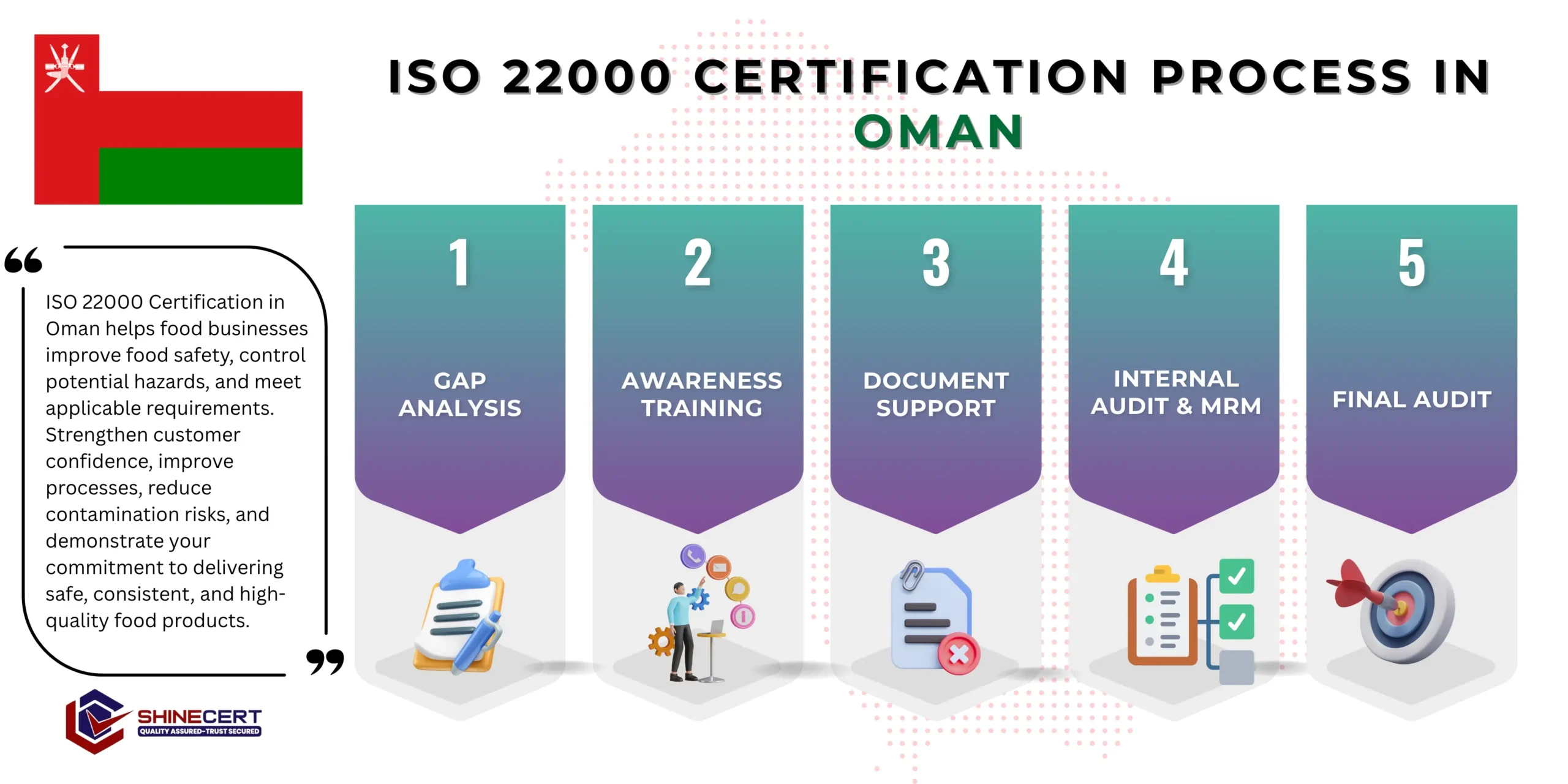
Our Five-Step Certification Process: What to Actually Expect
Gap Assessment
We evaluate your current food safety practices and existing licensing compliance against ISO 22000's requirements.
A gap assessment report specific to your products and facility.
Documentation Development
Your food safety policy, PRPs, hazard analysis, and HACCP plan get built around your actual product range and processes.
A complete ISO 22000 documentation set.
Implementation and Training
Controls roll out across production, handling, and storage, with staff trained on hygiene practices and critical control point monitoring.
Training records and evidence of controls functioning in daily operations.
Internal Audit and Management Review
We test the system internally, surfacing weaknesses before the real audit.
Internal audit report and management review minutes.
Certification Audit
Stage 1 and Stage 2 audits with a GAC-accredited certification body.
Your ISO 22000 certificate and a surveillance audit schedule.
Gap Assessment
We evaluate your current food safety practices and existing licensing compliance against ISO 22000's requirements.
A gap assessment report specific to your products and facility.
Documentation Development
Your food safety policy, PRPs, hazard analysis, and HACCP plan get built around your actual product range and processes.
A complete ISO 22000 documentation set.
Implementation and Training
Controls roll out across production, handling, and storage, with staff trained on hygiene practices and critical control point monitoring.
Training records and evidence of controls functioning in daily operations.
Internal Audit and Management Review
We test the system internally, surfacing weaknesses before the real audit.
Internal audit report and management review minutes.
Certification Audit
Stage 1 and Stage 2 audits with a GAC-accredited certification body.
Your ISO 22000 certificate and a surveillance audit schedule.
What Is ISO 22000, Technically Speaking?
- Two traditions combined : ISO 22000 is the international food safety management system standard, and its technical architecture is genuinely distinctive among management system standards because it deliberately combines two different traditions: the Harmonized Structure’s generic PDCA management system framework (shared with ISO 9001 and ISO 14001) and the food-industry-specific HACCP (Hazard Analysis and Critical Control Points) methodology that has underpinned food safety science for decades.
- PRPs, Operational PRPs, and HACCP : The standard’s technical core is the interaction between Prerequisite Programmes (PRPs), Operational PRPs, and the HACCP plan itself. PRPs are the foundational hygiene and operational conditions every food business needs regardless of specific hazards, pest control, cleaning and sanitation, personnel hygiene, water supply quality. Operational PRPs address specific hazards identified through hazard analysis that PRPs alone don’t adequately control. The HACCP plan then addresses the remaining hazards genuinely significant enough to require a Critical Control Point, monitored with defined critical limits.
- Communication throughout the food chain : A structurally important addition ISO 22000 makes over generic HACCP is the requirement for genuine interactive communication throughout the food chain, Clause 5.6 requires organizations to establish, implement, and maintain communication with suppliers, customers, regulatory authorities, and other parties about food safety issues. For an Oman food business dependent on imports, this technical requirement translates directly into practice: your food safety management system needs to genuinely track and communicate with international suppliers about hazards, not just manage what happens after ingredients arrive at your facility.
- Codex Alimentarius alignment : ISO 22000 also formally incorporates the Codex Alimentarius principles, the internationally recognized food code developed jointly by the FAO and WHO, giving the standard genuine alignment with the food safety science base that most national food regulations, including Oman’s, draw from.
Why This Matters So Much in Oman Specifically?
- Oman’s food supply is meaningfully import-dependent, which creates a genuinely distinct commercial dynamic: food safety credentials function as much as a trading requirement with international suppliers and export markets as a domestic compliance matter. International suppliers and buyers increasingly expect documented food safety management from Oman-based importers, distributors, and manufacturers as a condition of doing business, independent of what local inspection alone might require.
- The 2026 amendment adding Article 30 bis is a genuinely meaningful regulatory signal, a new pre-licensing verification power for imported food means the Ministry of Agriculture, Fisheries and Water Resources is actively tightening oversight of exactly the import channel most Oman food businesses depend on. One pattern we frequently see: companies treat this kind of regulatory update as background noise rather than a reason to formalize their food safety documentation now, before verification requirements tighten further and catch them unprepared.
Riyada Funding: Does Your ISO 22000 Project Qualify for Subsidy?
Riyada’s financing and training programs can apply to food safety management system implementation, depending on your company’s size, sector, and program eligibility. We generally recommend checking your Riyada eligibility before finalizing your certification budget.
What Actually Drives Your Cost?
We don’t quote a flat number, because a flat number would misrepresent how different two Oman food businesses’ actual operations can be. Here’s what genuinely drives cost.
- Nature of your food business : A distributor handling pre-packaged goods needs meaningfully less documentation depth than a manufacturer processing raw ingredients into finished products.
- Number of products and process complexity : A business with a narrow, simple product range is a genuinely smaller project than one with dozens of distinct products and process steps, each needing its own hazard analysis.
- Number of facilities : Each additional site, production facility, cold storage, distribution center, generally needs its own hazard analysis and audit time.
- Import versus domestic sourcing mix : Heavily import-dependent operations need deeper supplier communication and traceability documentation than those sourcing primarily domestically, particularly given Article 30 bis’s new verification requirements.
- How mature your existing hygiene and traceability practices already are : Companies with functioning cold-chain discipline and some traceability aren’t starting from zero. Companies with informal, undocumented practices need more foundational work.
- Whether you’re bundling with other standards : Pursuing Halal certification or GMP alongside ISO 22000 shares meaningful implementation and audit infrastructure.
- Your internal capacity to lead parts of the work : An internal quality or food safety officer who can own documentation reduces consultant hours needed.
- Riyada funding eligibility : Where your project qualifies for co-funding, your genuine out-of-pocket cost can be meaningfully lower.
- Timeline urgency : A compressed timeline driven by a supplier or buyer deadline sometimes needs more concentrated consultant hours in a shorter window.
Mandatory Documents Required for Certification
- Food safety policy : Genuine leadership commitment specific to your products and operations. What it should contain: a clear statement of your commitment to food safety, compliance with applicable legal requirements, and a framework for setting and reviewing food safety objectives.
- Scope of the food safety management system : Documented, defining exactly which products, processes, and sites are covered. What it should contain: the specific products, processes, and locations included, with justification for any exclusions.
- Hazard analysis and HACCP plan : Reflecting your actual products, ingredients, and process steps. What it should contain: identified hazards, critical control points, critical limits, and monitoring procedures for each.
- Prerequisite Programmes documentation : Covering hygiene, pest control, cleaning, and other foundational controls. What it should contain: specific procedures for each PRP area, responsible staff, and monitoring frequency.
- Traceability procedures : Documented ability to trace products through your supply chain, critical for import-dependent operations. What it should contain: how each ingredient batch is tracked from receipt through to finished product, and the process for a rapid recall if needed.
- Records of internal audits, management reviews, and corrective actions : Evidence of genuine, ongoing oversight. What it should contain: audit findings, management review decisions, and documented corrective actions with verification of effectiveness.
What Happens When an Oman Food Business Operates Without Certification
- This is worth understanding concretely. Operating without a certified food safety management system doesn’t necessarily mean a business can’t operate legally, Ministry licensing has its own baseline requirements, but it does mean facing genuine commercial friction with international suppliers increasingly requiring certification as a supply condition, and genuine operational risk from an incident response system that hasn’t been formally tested. A recall handled through informal, scattered traceability records takes meaningfully longer and costs meaningfully more than one handled through a properly documented ISO 22000 system, and that difference shows up exactly when it matters most, during an actual incident.
- Businesses that discover these gaps only after losing a supplier relationship or struggling through a real recall often end up building proper food safety management under real pressure. We generally recommend Oman food businesses, particularly import-dependent ones, treat ISO 22000 as standing infrastructure rather than something to build only once a specific supplier, incident, or the new Article 30 bis verification process forces the issue.
Food Safety Requirements, Clause by Clause
- Context of the Organization (Clause 4) : Mapping your genuine food safety context, your specific products, processes, and the full food chain from suppliers through to end consumers.
- Leadership (Clause 5) : Top management accountability for food safety, plus the interactive communication requirements connecting suppliers, customers, and regulators.
- Planning (Clause 6) : Risk-based planning specific to food safety hazards genuinely relevant to your operations.
- Support (Clause 7) : Competence and hygiene training requirements, food handlers need genuine, evidenced understanding of hygiene practices relevant to their specific role.
- Operation (Clause 8) : This is the largest clause in practice, covering PRPs, hazard analysis, Operational PRPs, the HACCP plan, and traceability, the genuine technical heart of the food safety system. One pattern we frequently see in Oman implementations: import-dependent businesses build strong traceability for their own production but leave a genuine gap at the point ingredients cross the border, precisely where Article 30 bis now adds a new verification layer.
- Performance Evaluation (Clause 9) : Monitoring, measurement, and internal audit test whether critical control points and PRPs are genuinely functioning, not just documented.
- Improvement (Clause 10) : Structured handling of food safety incidents, including product withdrawal and recall procedures where genuinely necessary.
Case Study: An Oman Food Importer and Distributor’s Certification Journey
- The following is an illustrative, composite example based on the kind of project ShineCert typically runs, not a specific named client. An Oman-based food importer and distributor supplying restaurants and retailers had reasonably solid cold-chain handling practices, but no formal hazard analysis, no documented supplier communication protocol, and traceability records scattered across informal spreadsheets. The trigger was a request from a new international supplier requiring evidence of a certified food safety management system before agreeing to a long-term supply contract.
- The gap assessment found the company’s actual cold-chain and storage practices were genuinely sound, but its traceability system couldn’t reliably answer “which specific shipment did this product come from” within the timeframe a genuine recall would require. The bulk of implementation work went into building a proper hazard analysis specific to the company’s import and distribution process, formalizing supplier communication protocols, and rebuilding traceability into a system that could genuinely trace any product back to its source shipment within hours, not days. Certification was achieved in time to secure the new supplier relationship, and the pattern we typically see afterward held: the improved traceability system proved its value within months when a minor, unrelated product quality issue required a fast, precise partial recall rather than a broad, costly one.
Benefits at a Glance
- Structured alignment with Ministry of Agriculture, Fisheries and Water Resources expectations
- Government tender eligibility and stronger footing with international food suppliers and export markets
- Increased client and regulator trust in your food safety management
- International recognition that supports export deals
- Access to potential Riyada funding support
- Reduced risk of product recalls and associated cost
- A foundation that transfers cleanly into ISO 9001 or Halal certification
Benefits: What Certification Actually Changes
Given Oman’s import dependency, a certified food safety management system gives international suppliers and buyers genuine confidence in your operation, often smoothing supplier negotiations and contract terms.
A functioning HACCP plan and PRP structure genuinely reduces the likelihood of a food safety incident, and the resulting cost, recalled product, regulatory penalties, and reputational damage, that follows one.
A documented, auditable food safety system gives Ministry inspectors exactly the kind of evidence they’re looking for during inspections and the new pre-licensing verification process for imports.
A certificate gives customers, regulators, and partners independent, third-party proof that your business manages food safety systematically.
Certification supports access to export markets where documented food safety management is a genuine entry requirement.
Depending on eligibility, certification-related training and consulting costs may be partially offset through Riyada’s programs.
Applicable Standards by Industry
Food manufacturing and processing
Manufacturers use ISO 22000 as the technical backbone for hazard control across production.
Read moreFood import and distribution
Given Oman's import dependency, distributors use ISO 22000 to satisfy international supplier requirements and support fast, precise traceability, and to navigate Article 30 bis's new verification process.
Read moreHospitality and food service
Restaurants and hotel food operations, particularly across Muscat and Salalah's tourism corridor, use ISO 22000 to formalize hygiene and hazard control practices beyond baseline licensing requirements.
Read moreRetail
Supermarkets and food retailers use ISO 22000 to demonstrate structured food safety management across their supply chain.
Read moreCatering and institutional food service
Operations serving large volumes, schools, hospitals, corporate catering, use ISO 22000 given the genuine consequences of a food safety failure at scale.
Read moreWhy Choose ShineCert for ISO 22000 Certification Oman?
ShineCert brings 10 years of ISO consulting and certification experience to every Oman engagement, coordinated from our Riyadh and Lebanon offices with direct familiarity with the Food Safety Law, Ministry of Agriculture, Fisheries and Water Resources requirements, and Riyada’s funding programs.
Our team has guided more than 10,000 organizations through ISO certification globally, across sectors including food manufacturing, distribution, and hospitality, the same industries that make up the bulk of our Oman food safety client base. We build every Oman engagement around your actual products, supply chain, and funding eligibility, not a one-size-fits-all package.
Choosing a Certification Body in Oman?
What to Check | Why It Matters |
Accreditation under the GAC framework | Confirms genuine, internationally recognized certification |
Experience with Ministry of Agriculture, Fisheries and Water Resources requirements | Ensures the auditor understands Oman’s actual regulatory landscape |
Familiarity with import-dependent supply chains and Article 30 bis | Helps ensure your traceability and supplier communication systems are genuinely audit-ready |
Sector-specific food audit experience | Manufacturing, distribution, and hospitality each involve meaningfully different hazard profiles |
Common Pitfalls We See in Oman ISO 22000 Projects
- Building a HACCP plan disconnected from actual production reality : A generic HACCP plan that doesn’t reflect your specific ingredients and process steps doesn’t survive genuine audit scrutiny and doesn’t actually control real hazards.
- Underestimating traceability requirements given import dependency and Article 30 bis : Companies that don’t build genuine, fast traceability into their system discover the gap exactly when a recall or an import verification check makes it most costly.
- Treating supplier communication as a formality : Clause 5.6’s interactive communication requirements are meant to be genuine, ongoing dialogue with suppliers about hazards, not a one-time contract clause.
- Confusing baseline licensing compliance with full ISO 22000 conformity : Baseline local licensing and full ISO 22000 certification aren’t the same thing, companies sometimes assume passing local inspection means they’re audit-ready, missing the deeper hazard analysis and management system requirements.
Ready to Get Started?
ShineCert supports Oman food businesses from initial gap assessment through certification audit, including checking whether your project qualifies for Riyada funding support. Book a free consultation or contact us directly, and we’ll walk through your specific products and cost factors before proposing a fixed-scope plan.
Frequently Asked Questions
It’s the international standard for food safety management systems, combining generic management system requirements with food-industry-specific HACCP methodology.
It genuinely depends on factors like product complexity, number of facilities, and existing hygiene and traceability maturity, we scope every project individually.
Not as a blanket legal mandate beyond baseline licensing, but it’s increasingly expected by international suppliers given Oman’s import dependency, and it supports the new Article 30 bis verification requirements.
Typically three to five months.
Potentially, Riyada’s training and development programs can apply to certification-related costs depending on eligibility.
HACCP is a food safety methodology embedded within ISO 22000; ISO 22000 wraps HACCP inside a full, certifiable management system with additional requirements like interactive communication and management review.
No, ISO 22000 addresses food safety broadly, while Halal certification addresses religious dietary compliance; the two are complementary and frequently pursued together.
A 2026 amendment to Oman’s food safety regulations granting the Ministry new pre-licensing verification power specifically for imported food.
Yes, each facility generally needs its own hazard analysis and audit time given different equipment and process conditions.
We coordinate Oman engagements from our Riyadh and Lebanon offices, with consultants traveling on-site as needed.