
ISO 39001 Certification
Road Traffic Safety Management
Quick Answer
ISO 39001:2012 is the international standard for road traffic safety (RTS) management systems, certifying that an organization has implemented structured measures to reduce death and serious injury related to road traffic crashes involving its vehicles, drivers, and operations. It’s most relevant to logistics companies, public transport operators, and any organization with a significant vehicle fleet or workforce regularly driving for work purposes. Certification is issued by an accredited certification body after an audit, and most organizations complete implementation and certification in four to six months.
Why ISO 39001 Matters for Fleet and Logistics Operators?
Road traffic incidents remain one of the most significant, and most preventable, sources of workplace death and serious injury for any organization whose staff regularly drive as part of their job, a risk category that’s often under-addressed relative to more visible workplace hazards like machinery or falls from height, despite frequently causing more serious harm. This pressure shows up differently across sectors: a logistics company faces it through driver fatigue and delivery schedule pressure, a public transport operator faces it through passenger safety accountability, and a construction firm faces it through the often-overlooked risk of staff driving between multiple project sites throughout the day.
The honest picture: ISO 39001 doesn’t eliminate road traffic risk entirely, no system can control every variable involving public roads and other drivers, but it demonstrates a structured, evidence-based approach to the risk factors an organization genuinely can control: vehicle condition, driver competence and fitness, journey planning, and post-incident learning.
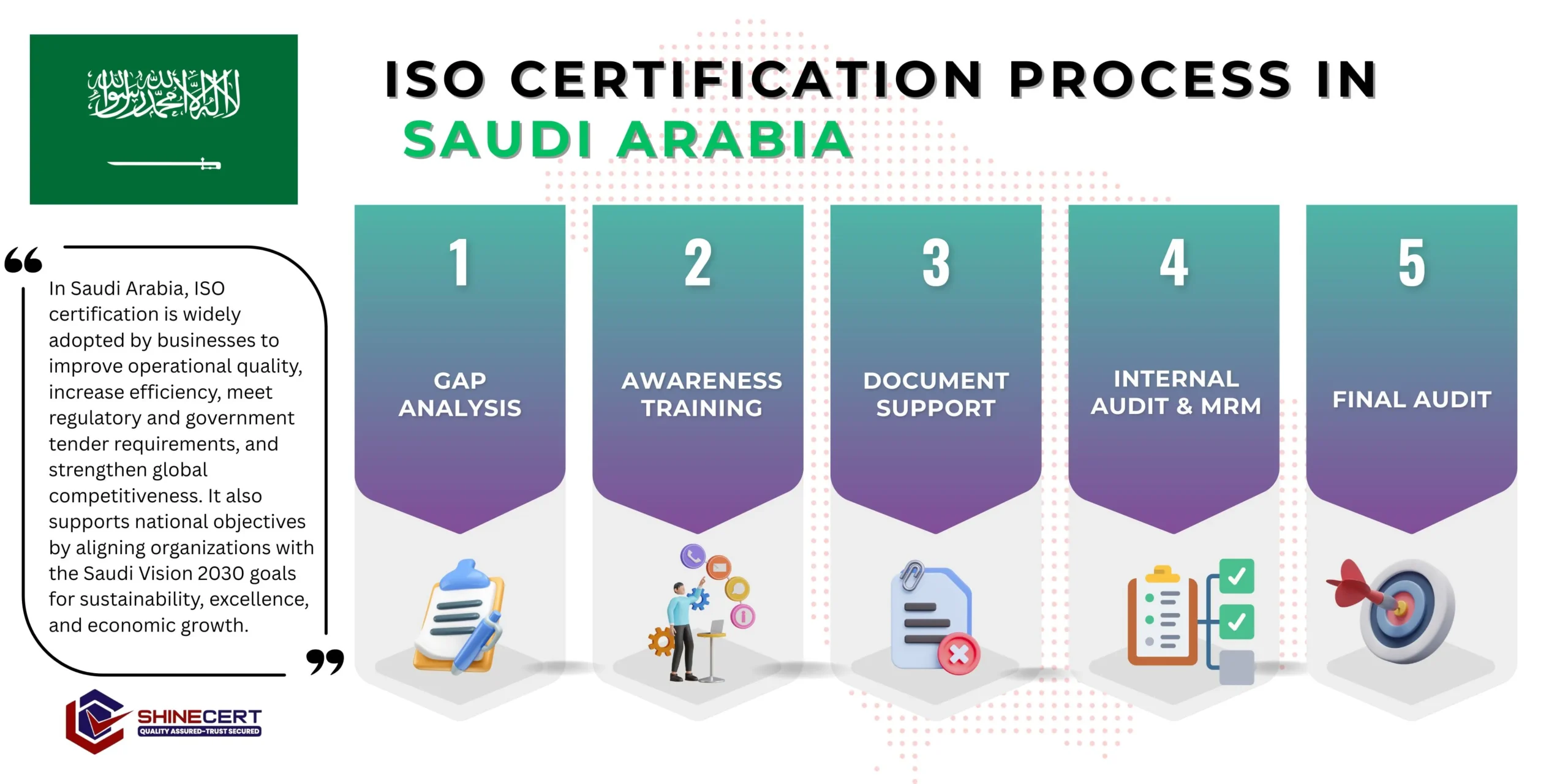
What are the steps to get ISO Certification?
our services
- ISO 9001 Certification
- ISO 14001 Certification
- ISO 27001 Certification
- ISO 22000 Certification
- ISO 45001 Certification
- ISO 13485 Certification
- ISO 20000 Certification
- ISO 17025 Certification
- CE Mark Certification
- GMP Certification
- Halal Certification
- SOC Certification
ShineCert’s 5-Step ISO 39001 Certification Process
A road safety policy that exists as a poster in the depot office doesn’t change driver behavior on the actual road, it needs to be a genuinely functioning system reaching every driver, every journey. Here’s how we build one that does.
Gap Analysis and Safety Performance Factor Review
ShineCert reviews current fleet operations, driver management practices, and incident history against ISO 39001's safety performance factors.
Gap assessment report and safety performance factor baseline.
RTS Policy, Objectives, and Documentation
The road traffic safety policy, measurable RTS objectives, and required procedures across journey planning, vehicle standards, and driver competence are developed.
Complete RTS management system documentation and driver competence framework.
Implementation and Driver Training
Safe system elements are rolled out, vehicle inspection regimes, journey planning tools, driver fitness monitoring, and drivers are trained on specific safety expectations.
Training records and safe system implementation evidence.
Internal Audit and Incident Trend Review
An internal audit against ISO 39001 requirements is conducted alongside incident and near-miss trend analysis, followed by Management Review.
Internal audit report, incident trend analysis, and management review minutes.
Certification Audit Support
ShineCert supports Stage 1 and Stage 2 audits with your chosen accredited certification body, including review of driver records and vehicle maintenance evidence.
ISO 39001:2012 certificate and surveillance audit schedule.
Gap Analysis and Safety Performance Factor Review
ShineCert reviews current fleet operations, driver management practices, and incident history against ISO 39001's safety performance factors.
Gap assessment report and safety performance factor baseline.
RTS Policy, Objectives, and Documentation
The road traffic safety policy, measurable RTS objectives, and required procedures across journey planning, vehicle standards, and driver competence are developed.
Complete RTS management system documentation and driver competence framework.
Implementation and Driver Training
Safe system elements are rolled out, vehicle inspection regimes, journey planning tools, driver fitness monitoring, and drivers are trained on specific safety expectations.
Training records and safe system implementation evidence.
Internal Audit and Incident Trend Review
An internal audit against ISO 39001 requirements is conducted alongside incident and near-miss trend analysis, followed by Management Review.
Internal audit report, incident trend analysis, and management review minutes.
Certification Audit Support
ShineCert supports Stage 1 and Stage 2 audits with your chosen accredited certification body, including review of driver records and vehicle maintenance evidence.
ISO 39001:2012 certificate and surveillance audit schedule.
What Is ISO 39001?
ISO 39001:2012 specifies requirements for a road traffic safety management system, enabling an organization that interacts with the road traffic system to reduce death and serious injury related to road traffic crashes. It applies to any organization involved in road traffic, whether as a vehicle operator, employer of drivers, or infrastructure-related entity, and it follows a management system approach similar to ISO 9001 and ISO 45001, addressing both organizational safety culture and specific technical risk factors.
Contractor and Third-Party Driver Risk
Many organizations with significant road transport exposure rely partly on contracted or third-party drivers, and ISO 39001’s management system needs to extend meaningful oversight into this population, since road safety accountability doesn’t disappear simply because a driver isn’t on the direct payroll. This requires verifying contracted drivers meet the same competence and fitness standards as employees, extending vehicle standards to contracted vehicles, and including contractor incident data in trend analysis. Organizations excluding contracted drivers often discover this gap only after a serious incident, when consequences rarely distinguish employed from contracted drivers.
Mandatory Documented Information for ISO 39001
At minimum: RTS policy and objectives, safety performance factor assessment, driver competence and fitness records, vehicle maintenance and inspection records, incident and near-miss records, and internal audit and management review records.
The Structure of ISO 39001: Clauses Explained
- Clause 4 — Context of the Organization : Requires defining RTS management system scope and identifying road traffic safety performance factors specific to the organization’s operations.
- Clause 5 — Leadership : Requires top management commitment to road traffic safety objectives and a documented RTS policy.
- Clause 6 — Planning : Requires identifying safety performance factors (speed, driver fitness, vehicle condition, journey planning) and setting measurable RTS objectives.
- Clause 7 — Support : Covers driver competence, training, and communication requirements around road safety expectations.
- Clause 8 — Operation : The technical core, covering safe system design elements — safe vehicles, safe speeds, safe road users, safe journeys — and emergency preparedness for road traffic incidents.
- Clause 9 — Performance Evaluation : Requires monitoring RTS performance indicators, internal audit, and management review, including analysis of incidents and near-misses.
- Clause 10 — Improvement : Requires corrective action following incidents and continual improvement of the RTS management system.
ISO 39001 and ISO 45001 — How They Connect
ISO 39001 addresses road traffic safety specifically, while ISO 45001 addresses occupational health and safety broadly, and road traffic risk is often a significant but underrepresented category within a general OH&S risk assessment. Organizations already certified to ISO 45001 typically find integrating ISO 39001 straightforward given the shared management system structure, and many choose to fold road traffic safety performance factors directly into their existing OH&S risk register rather than running two entirely separate systems, provided the road-specific technical detail ISO 39001 requires is genuinely preserved rather than diluted into generic safety language.
Benefits of ISO 39001 Certification
The core, non-commercial benefit, a genuinely functioning RTS system reduces the frequency and severity of road traffic incidents affecting employees and the public.
Logistics and transport contracts increasingly specify road safety management maturity as an evaluation criterion, particularly for public sector and passenger transport tenders.
Documented road safety management can meaningfully affect fleet insurance terms and provides a stronger legal position following an incident.
Structured journey planning and vehicle maintenance programs frequently reduce fuel cost and vehicle downtime alongside the primary safety benefit.
ISO 39001 Certification Cost Explained
- Company size and fleet scale : An organization operating hundreds of vehicles across multiple depots faces a larger scope and higher audit man-day requirement than a small fleet operation.
- Nature of the business and driving exposure : A long-haul freight operation with high-mileage drivers faces different, often more complex risk factors than a local delivery service with short urban routes.
- Number of departments and sites in scope : Certification covering multiple depots or regional operations as distinct units costs more than a single-site certification.
- Existing safety management maturity : Organizations already certified to ISO 45001 typically integrate ISO 39001 faster and at lower incremental cost.
- Incident history and data quality : Organizations with poor historical incident recording face more remediation work building a genuine baseline before RTS objectives can be meaningfully set.
ISO 39001 Certification Timeline
Phase | Typical Duration |
Gap analysis and safety performance factor review | 2–3 weeks |
RTS policy, objectives, and documentation | 4–7 weeks |
Implementation and driver training | 5–8 weeks |
Internal audit and incident trend review | 1–2 weeks |
Certification body Stage 1 + Stage 2 audit | 2–4 weeks |
Total for a typical implementation | 4–6 months |
Driver Behavior: The Human Factor Behind Most Road Incidents
Vehicle condition and route planning matter, but the majority of road traffic incidents ultimately trace back to driver behavior and decision-making in the moment, which is why ISO 39001 places real weight on driver competence, fitness, and ongoing behavioral monitoring rather than treating road safety purely as an engineering or maintenance problem. Telematics and driver monitoring technology have made behavioral data, harsh braking events, speeding patterns, phone use while driving, far more accessible than it once was, but the genuine safety value comes from how an organization responds to that data, not merely from collecting it. Organizations that use driver data purely for punitive action often see drivers find ways to mask risky behavior rather than change it, while organizations that pair data with coaching and genuine engagement tend to see more durable behavioral improvement, a distinction ShineCert works through explicitly during RTS system design.
Vehicle Technology and the Changing Safe System Approach
- Advanced driver assistance systems, telematics-based monitoring, and dashcam technology have genuinely changed what’s achievable in road traffic safety management, but ISO 39001 implementation needs to treat these as tools supporting the safe system approach rather than substitutes for it. A fleet equipped with the latest collision-avoidance technology still needs the underlying management system elements, driver competence verification, journey planning, fatigue management, since technology reduces but doesn’t eliminate the underlying risk factors the standard addresses.
- Organizations sometimes over-invest in vehicle technology while under-investing in the driver management and organizational culture elements that determine whether that technology is actually used correctly and consistently; a lane-departure warning system provides limited protection if drivers habitually silence or ignore its alerts because they find them distracting. ShineCert helps fleet operators integrate technology investment into a genuinely balanced RTS management system, ensuring technology complements rather than substitutes for the human and organizational factors that ultimately determine road safety outcomes.
Emergency Preparedness and Post-Incident Learning
- A genuinely mature RTS management system doesn’t stop at prevention, it also plans for what happens immediately after an incident occurs, since how an organization responds in the first hours after a serious road traffic event materially affects both the outcome for those involved and the organization’s ability to learn from it. This means having clear protocols for driver and passenger welfare, family notification, media handling where relevant, and preserving evidence such as telematics data and vehicle condition before it’s lost or overwritten.
- Equally important is treating every serious incident, and every meaningful near-miss, as a genuine learning opportunity rather than a liability to be minimized or quietly closed out administratively. Organizations that conduct honest, blame-aware-but-not-blame-driven incident investigations consistently identify systemic contributing factors, a route that’s consistently driven fatigued, a vehicle maintenance interval that’s proven inadequate for actual usage patterns, that a purely compliance-focused investigation focused on individual driver fault would miss entirely. ShineCert builds this dual focus, prevention and genuine post-incident learning, into every ISO 39001 implementation, since a system that only prevents but never learns from what still gets through eventually plateaus in its safety performance.
Who Needs ISO 39001? Industries and Reverse Suitability
Sector | Why ISO 39001 Is Relevant |
Logistics & Freight Transport Companies | Driver fatigue, delivery schedule pressure, and vehicle fleet condition are core operational risks |
Public Transport Operators | Passenger safety accountability applies directly to road traffic safety management |
Construction & Field Service Companies | Staff regularly driving between multiple sites face underrecognized road risk exposure |
Oil & Gas and Mining Companies | Remote site access often involves significant road travel through higher-risk terrain and conditions |
Emergency Services & Utility Fleet Operators | High-mileage, time-pressured driving conditions carry elevated crash risk |
Sales and Field Service Organizations | Employees driving significant mileage for client visits face cumulative exposure often unaddressed by generic safety programs |
The reverse question: organizations with minimal work-related driving exposure, primarily office-based operations without a significant fleet or field workforce, generally don’t need ISO 39001, since the standard’s value depends specifically on managing genuine road traffic risk exposure at meaningful scale.
Ready to scope your ISO 39001 certification project? Book your free consultation or contact ShineCert directly.
Book Free ConsultationReady to scope your ISO 39001 certification project? Book your free consultation or contact ShineCert directly.
Book Free ConsultationChoosing an Accredited Certification Body
What to Check | Why It Matters |
Current IAF-recognized accreditation for ISO 39001 | Confirms the certificate carries genuine international recognition |
Transport and logistics sector experience | Auditors familiar with fleet operations assess safe system elements more effectively |
Multi-depot audit capability | Relevant for organizations operating across multiple sites or regions |
Familiarity with local road safety regulatory context | Helps align RTS management system design with regional road safety expectations |
Why Choose ShineCert for ISO 39001 Certification
ShineCert has guided more than 10,000 organizations through international certification from genuine operating offices in Riyadh, Lebanon, and India, with practical experience across logistics, public transport, and field service fleet operations.
Common Implementation Challenges
- Incident data that undercounts near-misses. Organizations that only track incidents resulting in damage or injury miss the leading indicators near-miss data provides for genuine risk reduction.
- Driver fatigue management treated superficially. Compliance with legal driving hour limits alone doesn’t fully address fatigue risk, particularly for operations with early starts or irregular shift patterns.
- Journey planning that ignores real route risk. Generic route planning without accounting for known high-risk road sections, weather patterns, or time-of-day traffic conditions.
- Vehicle maintenance records disconnected from the safety system. Maintenance scheduling is handled purely as a cost function without integration into the broader RTS risk picture.
Start Your ISO 39001 Certification Journey
ShineCert provides end-to-end ISO 39001 certification support, from safety performance factor assessment through certification audit, for logistics, transport, and fleet-operating organizations. Book your free consultation or contact ShineCert directly, and our team will review your fleet operations, driver exposure, and incident history before proposing a fixed-scope engagement plan.
Frequently Asked Questions
It certifies a structured system for managing road traffic safety risk. It’s most valuable for logistics, transport, and any organization with significant driving exposure.
No, road traffic involves variables no organization fully controls. Certification demonstrates a structured, evidence-based approach to the risk factors that can be managed.
It depends on fleet size, number of depots, and driving exposure profile. ShineCert provides a fixed quote after gap analysis.
Typically four to six months.
Yes, its shared management system structure makes integration with occupational health and safety systems straightforward.
Logistics and freight companies, public transport operators, construction and field service companies, and any organization with significant work-related driving.
A genuine RTS management system should extend oversight to contracted drivers as well as employees, since organizational safety accountability doesn’t stop at the boundary of direct employment.