
ISO 41001 Certification
Facility Management Systems
Quick Answer
ISO 41001:2018 is the international standard for facility management systems (FMS), certifying that an organization delivers workplace and facility services, maintenance, cleaning, security, space management, through a structured, auditable management system rather than ad hoc service delivery. It follows the same Harmonised Structure as ISO 9001 and ISO 14001, making it straightforward to integrate for organizations already certified to those standards. Certification is issued by an accredited certification body after an audit, and most organizations complete implementation and certification in three to five months.
Why ISO 41001 Matters for Facility Management Providers?
Facility management contracts increasingly go to providers who can demonstrate structured service delivery, not just competitive pricing, since a facility failure, a security lapse, a maintenance backlog, a cleaning standard slip, reflects directly on the client organization occupying the space. This pressure shows up differently across the sector: an integrated facility management (IFM) provider managing multiple corporate campuses faces it as a multi-site consistency requirement, a security services firm faces it through the risk management dimension of Clause 6, and a real estate management company faces it through tenant satisfaction and lease compliance expectations that a structured FMS is built to support.
The honest picture: ISO 41001 is voluntary, but for FM providers bidding on large corporate, government, or healthcare facility contracts, it has become close to a practical prerequisite rather than a differentiator, since procurement teams evaluating multiple bidders increasingly use certification status as a shortlisting filter.
What are the steps to get ISO Certification?
our services
- ISO 9001 Certification
- ISO 14001 Certification
- ISO 27001 Certification
- ISO 22000 Certification
- ISO 45001 Certification
- ISO 13485 Certification
- ISO 20000 Certification
- ISO 17025 Certification
- CE Mark Certification
- GMP Certification
- Halal Certification
- SOC Certification
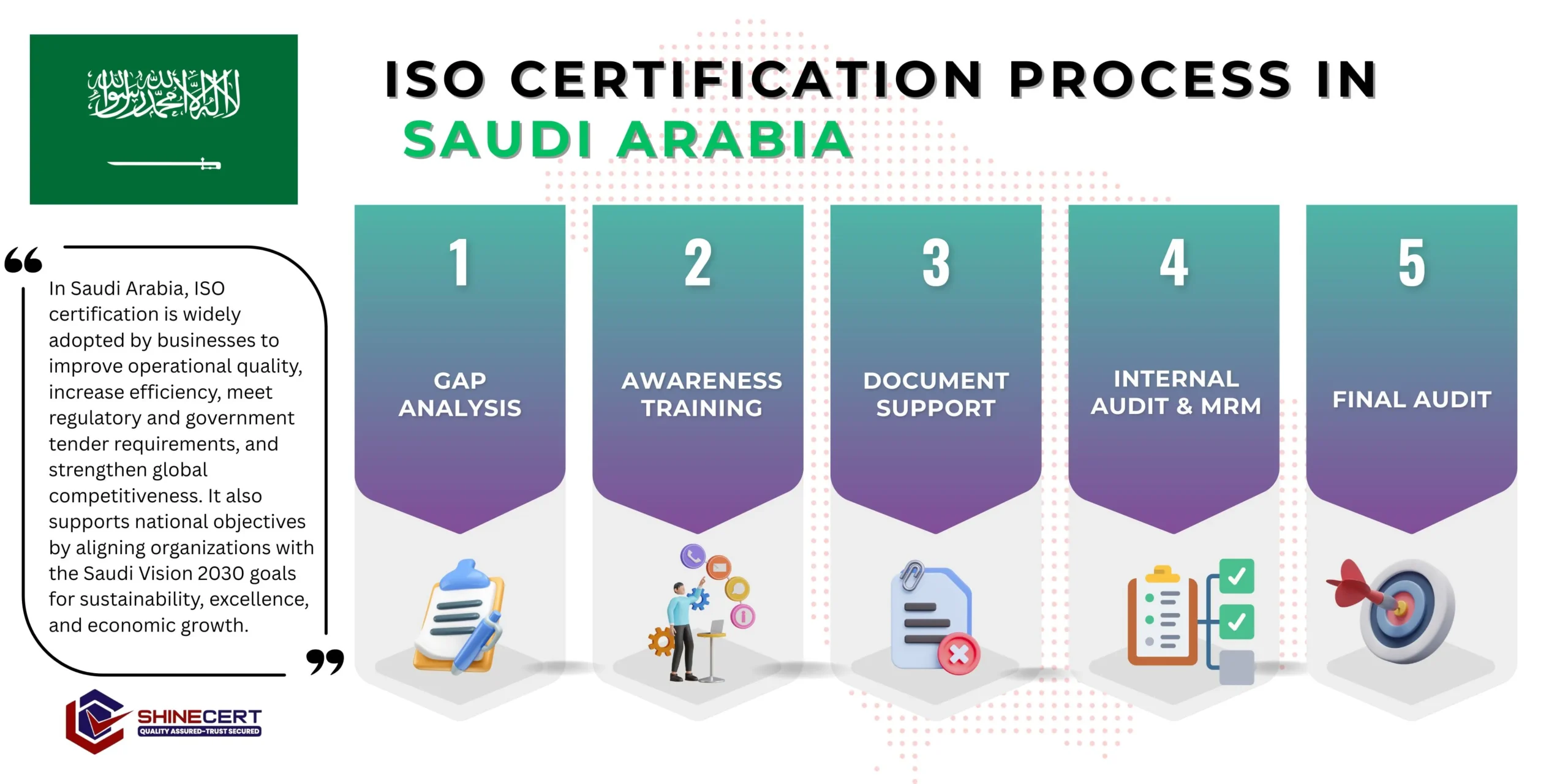
ShineCert’s 5-Step ISO 41001 Certification Process
A facility management system that exists only as a service level agreement document doesn’t prevent the 2am equipment failure or the security gap, it needs to be a genuinely functioning system. Here’s how we build one that holds up under real operating pressure.
Gap Analysis and Scope Definition
ShineCert reviews current facility management practices and defines FMS scope, which facilities, services, and client relationships are included, against ISO 41001 requirements.
Gap assessment report and defined FMS scope.
Documentation and Risk Assessment
The Facility Management Policy, risk assessments covering service delivery risks, and required procedures across Clauses 4 through 10 are developed.
Complete FMS documentation set and facility risk register.
Implementation and Staff Training
Operational controls, demand and response management processes, business continuity procedures, are rolled out, and facility staff are trained on their specific responsibilities.
Training records and operational implementation evidence.
Internal Audit and Management Review
An internal audit against ISO 41001 requirements is conducted, followed by a formal Management Review evaluating facility service performance and risk register accuracy.
Internal audit report and management review minutes.
Certification Audit Support
ShineCert supports Stage 1 and Stage 2 audits with your chosen accredited certification body, including site visits to facilities in scope.
ISO 41001:2018 certificate and surveillance audit schedule.
Gap Analysis and Scope Definition
ShineCert reviews current facility management practices and defines FMS scope, which facilities, services, and client relationships are included, against ISO 41001 requirements.
Gap assessment report and defined FMS scope.
Documentation and Risk Assessment
The Facility Management Policy, risk assessments covering service delivery risks, and required procedures across Clauses 4 through 10 are developed.
Complete FMS documentation set and facility risk register.
Implementation and Staff Training
Operational controls, demand and response management processes, business continuity procedures, are rolled out, and facility staff are trained on their specific responsibilities.
Training records and operational implementation evidence.
Internal Audit and Management Review
An internal audit against ISO 41001 requirements is conducted, followed by a formal Management Review evaluating facility service performance and risk register accuracy.
Internal audit report and management review minutes.
Certification Audit Support
ShineCert supports Stage 1 and Stage 2 audits with your chosen accredited certification body, including site visits to facilities in scope.
ISO 41001:2018 certificate and surveillance audit schedule.
What Is ISO 41001? Understanding the Standard
ISO 41001:2018 specifies requirements for establishing, implementing, maintaining, and continually improving a facility management system, covering the full range of services that support the primary activities of an organization, space and infrastructure, people and organization, health and safety, and business continuity considerations tied to the physical workplace. It applies equally to in-house facility management teams and outsourced FM service providers, and its Harmonised Structure makes integration with ISO 9001, ISO 14001, or ISO 45001 relatively straightforward for organizations pursuing multiple certifications.
ISO 41001 and Client Service Level Agreements
A certified FMS gives facility management providers a structured internal system, but the client-facing service level agreement remains a separate commercial document, the two need to align, since an SLA promising response times the internal FMS can’t actually support creates a credibility gap the moment performance is measured. ShineCert reviews client SLAs alongside FMS design specifically to confirm the internal system can genuinely deliver on what’s being commercially promised, since a beautifully documented FMS that doesn’t match real contractual commitments satisfies an auditor but not a client.
Mandatory Documented Information for ISO 41001
At minimum: FMS scope and facility management policy, facility risk register, demand and response management procedures, business continuity procedures for the physical workplace, and internal audit and management review records.
The Structure of ISO 41001: Clauses Explained
- Clause 4 — Context of the Organization: Requires defining FMS scope, which facilities, services, and locations are covered and identifying stakeholder requirements, including both the client organization and facility occupants.
- Clause 5 — Leadership : Requires top management commitment to facility service quality and a documented facility management policy.
- Clause 6 — Planning : Requires identifying risks to service delivery (equipment failure, staffing gaps, security incidents) and setting facility management objectives.
- Clause 7 — Support : Covers resources, competence of facility staff, and documented information requirements.
- Clause 8 — Operation : The technical core, covering demand and response management for facility services, project management for facility changes, and business continuity planning for the physical workplace.
- Clause 9 — Performance Evaluation : Requires monitoring facility service performance, internal audit, and management review.
- Clause 10 — Improvement : Requires corrective action for service failures and continual improvement of the FMS.
ISO 41001 and Integrated Management Systems — How They Connect
ISO 41001 shares the Harmonised Structure with ISO 9001, ISO 14001, and ISO 45001, meaning organizations already certified to those standards can integrate facility management requirements into an existing management system framework rather than building a parallel one. This matters practically for IFM providers who often need to demonstrate quality, environmental, safety, and facility-specific competence simultaneously to win large contracts, a single integrated audit cycle covering all applicable standards is both more efficient and more coherent for auditors evaluating the whole operation than separate, disconnected certification projects.
Benefits of ISO 41001 Certification
Certification is increasingly used as a shortlisting filter in large corporate and government FM tender evaluations.
Structured demand and response management reduces the reactive, firefighting mode many FM operations default to without a formal system.
Formal risk assessment applied to facility operations catches equipment failure and security gaps before they escalate into service failures.
A documented FMS gives both provider and client a shared, measurable basis for service level conversations, reducing disputes over what “good service” actually means.
ISO 41001 Certification Cost Explained
- Company size and number of facilities managed. A provider managing dozens of client sites faces a larger FMS scope and higher audit man-day requirements than a single-site operation.
- Nature of the business and service complexity. An integrated FM provider delivering security, cleaning, and maintenance simultaneously faces more complex scope than a single-service cleaning contractor.
- Number of departments and service lines in scope. Certification covering multiple service lines as distinct operational functions costs more than a single-service certification.
- Existing management system maturity. Organizations already certified to ISO 9001 or ISO 14001 typically integrate ISO 41001 faster and at lower incremental cost.
- Client contract requirements. Some client contracts specify particular audit scope or reporting requirements that add to baseline certification cost.
Multi-Site Consistency: The Core FM Certification Challenge
Providers managing facilities across multiple cities or countries face a distinct certification challenge that single-site operations don’t: demonstrating that service quality, staff competence, and risk management are genuinely consistent across every location in scope, not just at the flagship site an auditor happens to visit first.
This requires standardized training programs, common reporting templates, and centralized oversight that still accommodates genuine local differences, a security risk profile in one city may differ substantially from another, and a rigid, identical procedure applied everywhere regardless of local context often fails in practice even when it looks good on paper. ShineCert helps multi-site FM providers design this balance explicitly, since certification bodies increasingly sample across multiple sites during Stage 2 audits specifically to test whether consistency claims hold up beyond the site initially presented.
Outsourced FM Contracts and Subcontractor Management
- Many facility management operations rely on a layer of subcontractor, specialist HVAC maintenance firms, pest control providers, landscaping contractors and a certified FMS needs to extend meaningful oversight into that subcontractor layer rather than treating it as outside the system’s boundary. A facility management provider can have impeccable internal processes and still fail a client’s expectations if a subcontracted security or maintenance function underperforms, since the client experiences the overall service outcome, not the internal contractual structure behind it.
- ISO 41001 certification audits increasingly probe how subcontractor performance is monitored, how service level commitments flow down into subcontractor agreements, and what happens when a subcontractor underperforms repeatedly. ShineCert helps FM providers build a subcontractor oversight framework that’s proportionate to risk, a mission-critical system like fire safety maintenance warrants tighter oversight than routine landscaping, rather than either ignoring subcontractor risk entirely or applying identical, resource-intensive oversight uniformly regardless of actual risk level. Getting this balance right is often what separates a facility management system that merely looks complete on paper from one that genuinely protects service quality across the full delivery chain, including the parts of it the certified organization doesn’t directly employ.
Technology and Facility Management Systems
- Modern facility management increasingly relies on computerized maintenance management systems (CMMS), IoT sensors monitoring equipment condition, and digital work order platforms, and ISO 41001 certification needs to account for how these technology systems fit within the broader FMS rather than treating them as a separate IT concern. A CMMS that tracks maintenance schedules is only as valuable as the discipline behind actually closing out work orders promptly and accurately, and auditors increasingly ask to see genuine system data, completion rates, average response times, recurring fault patterns, rather than accepting a policy document’s description of how the system is supposed to work.
- Organizations investing in facility management technology without the underlying process discipline to use it consistently often find the technology investment doesn’t translate into the service quality improvement it promised, which is exactly the gap a well-designed FMS is meant to close by tying technology adoption to genuine operational accountability.
Who Needs ISO 41001? Industries and Reverse Suitability
Sector | Why ISO 41001 Is Relevant |
Integrated Facility Management (IFM) Providers | Multi-service, multi-site consistency is the core commercial promise being certified |
Corporate Real Estate & Workplace Services | Tenant and occupant satisfaction depends on structured service delivery |
Healthcare Facility Management | Patient and staff safety intersect directly with maintenance and cleaning discipline |
Security Services Firms Managing Facilities | Risk-based facility security planning maps directly onto FMS risk management clauses |
Cleaning & Janitorial Service Providers | Consistent service quality across multiple client sites is directly auditable |
Educational Campus & Government Building Operators | Public accountability and safety expectations align closely with FMS discipline |
The reverse question: single-site organizations managing their own premises directly, without external client relationships or multi-site consistency demands, often find a simpler internal maintenance management approach sufficient, and pursue ISO 41001 only if bidding for external FM contracts specifically requires it.
Ready to scope your ISO 41001 certification project? Book your free consultation or contact ShineCert directly.
Book Free ConsultationReady to scope your ISO 41001 certification project? Book your free consultation or contact ShineCert directly.
Book Free ConsultationChoosing an Accredited Certification Body
What to Check | Why It Matters |
Current IAF-recognized accreditation for ISO 41001 | Confirms the certificate carries genuine international recognition |
Facility management sector experience | Auditors familiar with FM operations assess demand/response processes more effectively |
Multi-site audit capability | Providers with facilities across multiple cities need auditors who can efficiently sample across locations |
Integration experience with ISO 9001/14001/45001 | Relevant if pursuing an integrated management system audit |
Why Choose ShineCert for ISO 41001 Certification
ShineCert has guided more than 10,000 organizations through international certification from genuine operating offices in Riyadh, Lebanon, and India, with practical facility management sector experience across integrated FM providers and single-service operators alike.
Common Implementation Challenges
- Facility risk registers that don’t reflect real operational risk : A generic risk list disconnected from the specific equipment, staffing, and security realities of each site.
- Inconsistent service delivery across multiple sites : A common finding for providers managing several client locations without a genuinely standardized approach.
- Business continuity planning is treated as an afterthought : Facility-specific continuity planning, what happens if a critical system fails, is often underdeveloped relative to the rest of the FMS.
- Demand and response processes that exist on paper only : Auditors test whether service requests are actually logged, tracked, and resolved according to the documented process, not just whether the process exists.
Frequently Asked Questions
It certifies a facility management system covering how you deliver workplace services. It’s increasingly valuable for FM providers bidding on large corporate or government contracts.
No, it scales to organizations of any size, though the FMS scope and audit man-days reflect how many services and sites are covered.
It depends on the number of facilities and service lines in scope. ShineCert provides a fixed quote after gap analysis.
Most organizations complete certification in three to five months.
Yes, its Harmonised Structure makes integration straightforward for organizations already certified to other ISO management standards.
Integrated facility management providers, corporate real estate services, healthcare facility operators, and security services firms managing facilities.