
ISO 45001 Certification in Nigeria
Quick Answer
ISO 45001 is the international standard for occupational health and safety management systems, and in Nigeria it fills a genuine structural gap: the Factories Act of 1990 remains the primary workplace safety legislation for many sectors, predating modern industrial practices by decades, while the Employees’ Compensation Act 2010 governs compensation for workplace injury through the Nigeria Social Insurance Trust Fund (NSITF) rather than setting detailed, sector-specific prevention requirements. ISO 45001 doesn’t wait for legislation to modernize, it gives your organization an internationally recognized, systematic way to identify workplace hazards and manage worker safety proactively, rather than reactively after an incident triggers an NSITF compensation claim. Certification typically takes three to five months, and cost depends on genuine factors, workforce size, hazard profile, existing safety practices, never a flat figure quoted upfront.
What Is ISO 45001, Actually?
ISO 45001 is an international standard, published by the International Organization for Standardization, that sets out requirements for an occupational health and safety management system, a structured way an organization identifies workplace hazards, assesses and controls risk to workers, and continually improves its safety performance. It replaced the older OHSAS 18001 standard and applies to any organization regardless of sector or size, from a manufacturing floor with genuine physical hazards to an office environment with less obvious but still real risks. Getting certified means an independent, accredited body has formally verified your organization’s safety management system meets the standard’s requirements, and continues verifying it through ongoing audits, giving employees, regulators, insurers, and business partners confidence that safety is managed systematically, not left to chance or individual supervisor judgment.
Why ISO 45001 OH&S Matters So Much in Nigeria Right Now?
- Nigeria’s core workplace safety legislation predates most modern industrial hazards : The Factories Act 1990 remains a foundational piece of workplace safety law for many sectors, but it was written for an industrial landscape considerably different from today’s, meaning businesses genuinely committed to worker safety often need to build management practices well beyond what the letter of existing legislation specifically requires, simply because the legislation hasn’t kept pace with actual workplace risk.
- Compensation exists, but genuine prevention infrastructure is a separate and often weaker layer : The Employees’ Compensation Act 2010 and the Nigeria Social Insurance Trust Fund provide a compensation mechanism after a workplace injury occurs, funded through employer contributions, a genuinely important safety net, but one that operates after the fact. It doesn’t itself mandate the kind of systematic hazard identification, risk assessment, and proactive control that actually prevents the injury from happening in the first place. ISO 45001 addresses exactly that gap.
- Multinational partners and international contracts increasingly expect it as standard due diligence : Nigerian businesses working with multinational clients, on international-standard construction and engineering projects, or seeking investment from safety-conscious institutional partners increasingly find ISO 45001 treated as baseline evidence of genuine safety management, not a nice-to-have differentiator, particularly in sectors with elevated injury risk like construction, manufacturing, and oil and gas services.
- Insurance and liability exposure genuinely favor documented systems : Insurers increasingly factor structured safety management into how they price liability and workers’ compensation-adjacent coverage, and a certified system gives your organization a documented, defensible position if a workplace incident ever leads to a legal or insurance dispute, evidence that safety was actively and systematically managed, not simply assumed.
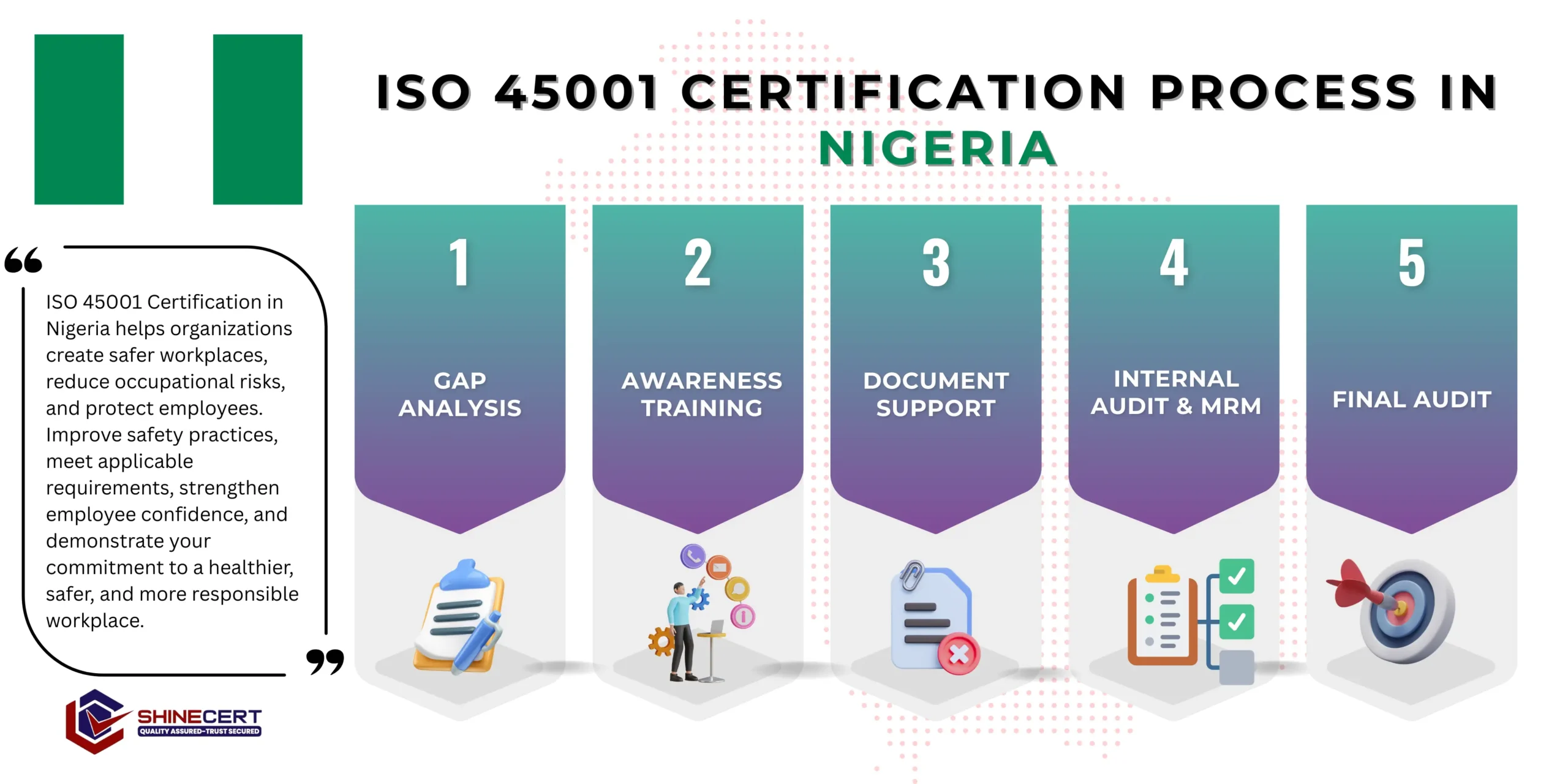
What are the steps to get ISO 45001 Certification in Nigeria?
our services
- ISO Certification Nigeria
- ISO 9001 Certification Nigeria
- ISO 14001 Certification Nigeria
- ISO 27001 Certification Nigeria
- ISO 22000 Certification Nigeria
- ISO 20000-1 Certification Nigeria
- ISO 45001 Certification Nigeria
- ISO 13485 Certification Nigeria
- ISO 17025 Certification Nigeria
- ISO 31000 Certification Nigeria
- ISO 22301 Certification Nigeria
- ISO 27701 Certification Nigeria
- ISO 37001 Certification Nigeria
- ISO 50001 Certification Nigeria
- CE Mark Certification Nigeria
- GMP Certification Nigeria
- GDPR Certification Nigeria
- Halal Certification Nigeria
- SOC Certification Nigeria
Our Five-Step Certification Process, in Depth
Gap Assessment
We walk your actual work sites, production floor, construction site, warehouse, whatever genuinely applies, and talk directly with workers, not just supervisors, about real hazards they encounter, since frontline staff often know about risks that never make it into a management-level safety discussion. We map what we find against ISO 45001's requirements and your genuine Factories Act and NSITF-related legal obligations together.
A gap report identifying your real hazard profile, current legal compliance status, and exactly where formal ISO 45001 documentation is missing.
Documentation
We build your OH&S policy, hazard identification and risk assessment records, and legal register around your actual operations, a construction site's hazard profile looks nothing like a warehouse's, and the documentation reflects that specifically.
A complete, version-controlled OH&S documentation set, with worker consultation genuinely built into how it was developed, not added afterward as a formality.
Implementation
Operational controls for identified hazards go into real daily practice, permit systems actually get used for high-risk work, protective equipment requirements actually get enforced, workers get trained on the specific hazards relevant to their role rather than a generic safety orientation everyone sits through once.
A functioning OH&S system with real hazard controls in active use and worker consultation genuinely happening.
Internal Audit and Management Review
We audit against every ISO 45001 clause and every applicable legal requirement, surfacing gaps while stakes are low. Findings go to formal management review where leadership makes documented decisions on safety priorities and resourcing.
An internal audit report, management review minutes with concrete decisions, and corrective actions closed out before the certification audit.
Certification Audit
Stage 1 confirms your documentation is genuinely audit-ready; Stage 2 has the auditor visit your site, observe safety controls in practice, and interview workers directly about their understanding of hazards and procedures, not just management. We stay engaged through both stages.
Your ISO 45001 certificate, valid for three years, plus a surveillance audit schedule.
Gap Assessment
We walk your actual work sites, production floor, construction site, warehouse, whatever genuinely applies, and talk directly with workers, not just supervisors, about real hazards they encounter, since frontline staff often know about risks that never make it into a management-level safety discussion. We map what we find against ISO 45001's requirements and your genuine Factories Act and NSITF-related legal obligations together.
A gap report identifying your real hazard profile, current legal compliance status, and exactly where formal ISO 45001 documentation is missing.
Documentation
We build your OH&S policy, hazard identification and risk assessment records, and legal register around your actual operations, a construction site's hazard profile looks nothing like a warehouse's, and the documentation reflects that specifically.
A complete, version-controlled OH&S documentation set, with worker consultation genuinely built into how it was developed, not added afterward as a formality.
Implementation
Operational controls for identified hazards go into real daily practice, permit systems actually get used for high-risk work, protective equipment requirements actually get enforced, workers get trained on the specific hazards relevant to their role rather than a generic safety orientation everyone sits through once.
A functioning OH&S system with real hazard controls in active use and worker consultation genuinely happening.
Internal Audit and Management Review
We audit against every ISO 45001 clause and every applicable legal requirement, surfacing gaps while stakes are low. Findings go to formal management review where leadership makes documented decisions on safety priorities and resourcing.
An internal audit report, management review minutes with concrete decisions, and corrective actions closed out before the certification audit.
Certification Audit
Stage 1 confirms your documentation is genuinely audit-ready; Stage 2 has the auditor visit your site, observe safety controls in practice, and interview workers directly about their understanding of hazards and procedures, not just management. We stay engaged through both stages.
Your ISO 45001 certificate, valid for three years, plus a surveillance audit schedule.
Certification Validity, Surveillance Audits, and Recertification
An ISO 45001 certificate is valid for three years from the date it’s issued. During years one and two, your certification body conducts an annual surveillance audit, narrower in scope, typically checking previously identified nonconformities were genuinely closed and sampling a portion of your operational safety controls and incident records. Before the three-year mark, a full recertification audit, comparable in depth to your original Stage 2 audit, confirms your system has continued functioning throughout the cycle. Passing recertification issues a new three-year certificate.
Cost of ISO 45001 Certification in Nigeria, What Actually Drives It
| Organization Profile | Relative Investment Level | Why |
|---|---|---|
| Small, low-hazard operation | Lower | Narrower hazard register, fewer operational controls to document and implement |
| Medium, manufacturing or moderate-hazard operation | Moderate | Broader hazard profile, more extensive training and worker consultation requirements |
| Larger, high-hazard operation | Higher | Extensive hazard identification, complex permit systems, larger-scale training rollout |
| Bundled with ISO 9001 or ISO 14001 | Moderate-to-higher combined, lower than separate engagements | Shared implementation infrastructure reduces combined cost |
- Nature and severity of your genuine hazard profile : A construction or heavy manufacturing operation with real fall, machinery, and chemical exposure hazards needs a meaningfully more extensive hazard register and control system than an office-based or light-assembly operation.
- Workforce size : More workers means more people requiring competence records, role-specific training, and genuine consultation on hazard identification, the training rollout and documentation scale meaningfully with headcount.
- Number of sites : Each additional physical location typically has its own distinct hazard profile requiring separate assessment, control documentation, and eventually internal audit coverage.
- Existing safety practice maturity : Businesses with some documented safety procedures already in place, even informal ones, aren’t starting from zero, those relying entirely on undocumented practice face more foundational work.
- Certification body fees, tracked separately from our consulting fees : The certification audit itself is conducted and invoiced directly by an independently accredited certification body, separate from ShineCert’s implementation work.
- Whether you’re bundling standards : Building ISO 45001 alongside ISO 9001 or ISO 14001 shares meaningful implementation infrastructure, reducing combined cost.
- Internal capacity to contribute : A health and safety officer or operations manager who can genuinely own documentation, training coordination, and internal audit logistics reduces the consulting hours required.
ISO 45001 Benefits Nigerian Businesses Actually Get
Systematic hazard identification and risk-based control catches dangerous conditions before they cause injury, rather than relying on incidents themselves to reveal where safety gaps exist.
ISO 45001 is understood and respected by multinational partners, international contractors, and institutional investors worldwide, giving them a credential they can trust without needing to independently assess your safety practices.
Both public infrastructure tenders and private sector contracts, particularly in construction, manufacturing, and oil and gas, increasingly weigh occupational safety credentials directly in evaluation criteria.
A documented, systematic safety management system provides real evidence of proactive risk management if an incident ever leads to a compensation dispute, legal claim, or insurance review, strengthening your position considerably compared to having no formal system to point to.
ISO 45001 requires genuinely identifying hazards specific to your actual operations, equipment-specific risks, chemical exposure, manual handling injuries, confined space work, and building real, documented controls, rather than generic safety posters that don’t reflect actual workplace conditions.
Workers who see genuine, systematic investment in their safety report higher trust in leadership and lower turnover, particularly in sectors where injury risk is a real, known concern among the workforce.
A functioning system requires genuine root-cause investigation of incidents and near-misses, meaning the organization actually learns from what happens rather than treating each incident as an isolated, unfortunate event.
ISO 45001’s Harmonized Structure makes pursuing ISO 9001 or ISO 14001 alongside or after it meaningfully more efficient, since core management review and internal audit infrastructure carries directly across all three.
While ISO 45001 doesn’t replace Factories Act or NSITF obligations, a certified system gives you a stronger, more organized position if regulatory or compensation-related questions ever arise.
Beyond compensation payments, workplace incidents carry real indirect costs, lost production time, equipment damage, reputational harm, replacement staffing, that systematic prevention reduces meaningfully over time.
Mandatory Documents Required for ISO 45001 Implementation
A documented statement defining which facilities, activities, and worker populations the system covers, including contractors and visitors where relevant to your actual operations.
A documented policy, formally approved by top management, expressing genuine commitment to providing safe working conditions, preventing injury and ill health, and continual improvement, connected to your organization’s actual hazard profile, not generic safety language.
A documented, actively maintained process for identifying workplace hazards specific to your operations and assessing the genuine risk each one poses, forming the foundation the rest of the system builds on.
A documented list of applicable occupational safety legal requirements, Factories Act provisions, Employees’ Compensation Act obligations, any sector-specific safety regulations, along with evidence of how you’re meeting each one.
Measurable safety objectives set at relevant functions and levels, with documented, actionable plans for achieving them.
Evidence that workers themselves are genuinely consulted on hazard identification and safety decisions, not just informed of decisions made without their input, this is a specific, distinct requirement ISO 45001 places real weight on.
Evidence that workers, particularly those in higher-risk roles, have received the safety training relevant to their specific hazards and responsibilities.
Documented procedures controlling identified hazards, permit-to-work systems for high-risk tasks, personal protective equipment requirements, machine guarding standards, confined space entry protocols, whichever genuinely apply to your operations.
Documentation showing your organization has planned for genuine workplace emergencies and, critically, has tested that plan through real drills, not just written it down.
Documentation showing incidents and near-misses get genuinely investigated for root cause, a planned internal audit cycle covers the whole system, and leadership formally reviews overall safety performance on a real schedule.
Challenges Organizations Face, Implementation, Risk Management, Audit, and Ongoing Certification
- Challenges during implementation : The most common obstacle is inconsistent enforcement of safety controls across shifts or supervisors, a protective equipment requirement enforced strictly by one supervisor and loosely by another undermines the whole system’s credibility with workers, who quickly learn which rules are genuinely enforced and which aren’t.
- Challenges in risk management : Businesses sometimes build a hazard register that captures obvious, visible risks while missing less obvious but genuinely significant ones, repetitive strain from manual handling, chemical exposure from cleaning agents, or ergonomic issues that don’t cause dramatic injuries but accumulate real harm over time.
- Challenges during internal and certification audits : Worker interviews during Stage 2 often reveal gaps between documented procedures and actual practice, a permit-to-work system that exists on paper but gets skipped under production pressure is exactly the kind of gap auditors are specifically trained to surface through direct worker conversation.
- Challenges maintaining certification after the initial audit : Safety performance tends to drift once the pressure of initial certification passes, near-miss reporting slows down, protective equipment enforcement loosens, and the hazard register stops getting updated as operations or equipment change. This drift rarely causes immediate certification loss, but it does mean real injury risk creeps back up well before a surveillance audit eventually catches it.
Case Study
A mid-size steel fabrication workshop in the Lagos metropolitan area came to us following a workplace incident that resulted in a worker injury requiring an NSITF compensation claim, not a catastrophic event, but serious enough that leadership recognized their safety practices, while reasonably good in principle, had never been formally documented or systematically reviewed. Supervisors enforced protective equipment use inconsistently depending on who was on shift, and hazard identification lived almost entirely in the experience of a few long-tenured floor supervisors rather than in any documented, transferable system.
Our gap assessment found genuine safety awareness among staff, but no formal hazard register, no documented permit-to-work system for higher-risk fabrication tasks, and no structured process for workers to actually report near-misses before they became real incidents. We built the hazard identification and risk assessment framework directly around the workshop’s real operations, welding, cutting, material handling, and established a genuine near-miss reporting system that workers were specifically consulted on and trained to use.
Implementation ran across roughly four months, and the certification audit found the near-miss reporting system was already generating real data within weeks of rollout, evidence the underlying safety culture was stronger than the previous lack of documentation suggested. The business has since used its certified system as part of its response to NSITF-related inquiries and as a genuine selling point in bids for larger fabrication contracts requiring documented safety management.
This reflects a pattern we see often, a real workplace incident prompting formalization of safety practices that were partially there already, rather than a single specific engagement.
Industries and Sectors We Certify in Nigeria, and Which Standards Each Actually Needs
Construction and civil engineering
ISO 45001 is close to essential given genuinely elevated fall, machinery, and site-hazard risk; pair with ISO 9001 and ISO 14001 given both quality and environmental obligations construction projects typically face.
Read moreManufacturing (plastics, chemicals, cement, processed goods)
ISO 45001 addresses real machinery, chemical, and manual handling hazards; pair with ISO 9001 and ISO 14001 for a complete integrated management system.
Read moreOil and gas services
ISO 45001 is close to essential given genuinely severe hazard exposure in this sector; pair with ISO 14001 for environmental management and ISO 9001 for quality management.
Read moreLogistics and warehousing
ISO 45001 addresses manual handling, vehicle movement, and equipment-related hazards specific to warehouse and distribution operations; pair with ISO 9001 for service consistency.
Read morePower, energy, and utilities
ISO 45001 addresses genuine electrical and equipment hazards; pair with ISO 50001 for energy management and ISO 14001 for environmental obligations.
Read moreAgriculture and agro-processing
ISO 45001 addresses equipment, chemical exposure, and manual labor hazards in processing facilities; pair with ISO 22000 for food safety in processing operations specifically.
Read moreWhy Choose ShineCert for ISO 45001 Certification Nigeria?
ShineCert brings 10 years of ISO consulting and certification experience to Nigeria’s market, coordinated through our Riyadh and India offices with services delivered remotely or on-site depending on what your engagement genuinely needs. We’ve guided more than 10,000 organizations through ISO certification worldwide, and we build every Nigeria occupational safety engagement around your actual hazard profile and workforce, not a generic template lifted from a different regulatory environment. ShineCert is the best ISO consultant in Nigeria.
Choosing a Certification Body in Nigeria?
What to Check | Why It Matters |
Accreditation under a recognized international accreditation framework | Confirms genuine, internationally recognized certification |
Genuine familiarity with Nigeria’s Factories Act and NSITF framework | Ensures the auditor understands how your legal register connects to actual Nigerian workplace law |
Experience with your specific sector’s hazard profile | Construction, manufacturing, and oil and gas involve genuinely different safety requirements |
A genuine worker-interview-based audit approach | Confirms the auditor checks real practice through direct worker conversation, not just documentation review |
Ready to Get Started?
Whether you’re formalizing safety practices proactively or responding to an incident that revealed a genuine gap, we’ll walk through your specific hazard profile and cost factors before proposing a fixed-scope plan, delivered remotely, on-site, or however genuinely fits your project. Book a free consultation or contact us directly to get started.
Frequently Asked Questions
Look for demonstrated experience with your specific sector’s hazard profile, genuine familiarity with Nigeria’s Factories Act and NSITF framework, and transparent scoping rather than flat package pricing. ShineCert scopes every Nigeria engagement individually.
No, ISO 45001 doesn’t replace your legal obligations under the Factories Act or your NSITF contribution requirements, but it gives you the structured management system that makes preventing incidents systematic rather than reactive, and strengthens your position if compensation-related questions arise.
It genuinely depends on your workforce size, hazard profile, and number of sites, we scope every project individually.
Typically two and a half to eight months depending on organization size and hazard complexity, see our detailed timeline breakdown above.
Yes, while the depth of the hazard register differs meaningfully from a construction site, ISO 45001 applies to any organization, and even office environments carry real ergonomic, fire safety, and emergency preparedness considerations.
Certification doesn’t mean incidents never happen, it means your organization has a systematic, documented process for investigating root cause, taking corrective action, and demonstrating the incident was managed properly, which matters considerably for both internal learning and any external review.
Documentation work runs effectively over remote sessions, but hazard identification and worker consultation genuinely require in-person site visits — we scope the right mix per project.
ShineCert doesn’t maintain a standalone Nigeria office; we coordinate Nigeria engagements from our Riyadh and India offices, with services delivered remotely or on-site as your project requires.