
ISO 42001 Certification in Riyadh
Quick Answer
ISO 42001 is the world’s first international management-system standard for artificial intelligence, published by the International Organization for Standardization in December 2023. It requires organizations developing or deploying AI systems to establish governance, risk management, and continual-improvement processes specific to AI’s unique risks. Certification is issued by an accredited certification body after an independent audit.
What Is ISO 42001?
ISO 42001 requires organizations that develop, provide, or use AI systems to establish governance covering AI-specific risks, bias, transparency, explainability, and unintended harm that generic IT risk frameworks don’t naturally capture. It’s one of ISO’s newest standards, reflecting how recently AI governance became a formal management-system category, and it applies whether an organization builds its own models or simply integrates third-party AI tools into its operations.
Certification is issued by an independent, accredited certification body, never by ISO itself. In Saudi Arabia, legitimate certification bodies must hold accreditation from SASO’s Saudi Accreditation Committee (SAC), and given how new this standard is globally, businesses should specifically confirm an auditor’s genuine AI governance experience rather than assuming general ISMS auditing experience is sufficient.
What are the steps to get ISO 42001 Certification in Riyadh?
our services
- ISO Certification Riyadh
- ISO 9001 Certification Riyadh
- ISO 14001 Certification Riyadh
- ISO 27001 Certification Riyadh
- ISO 22000 Certification Riyadh
- ISO 45001 Certification Riyadh
- ISO 42001 Certification Riyadh
- ISO 20000-1 Certification Riyadh
- ISO 13485 Certification Riyadh
- ISO 17025 Certification Riyadh
- CE Mark Certification Riyadh
- GMP Certification Riyadh
- GDPR Certification Riyadh
- Halal Certification Riyadh
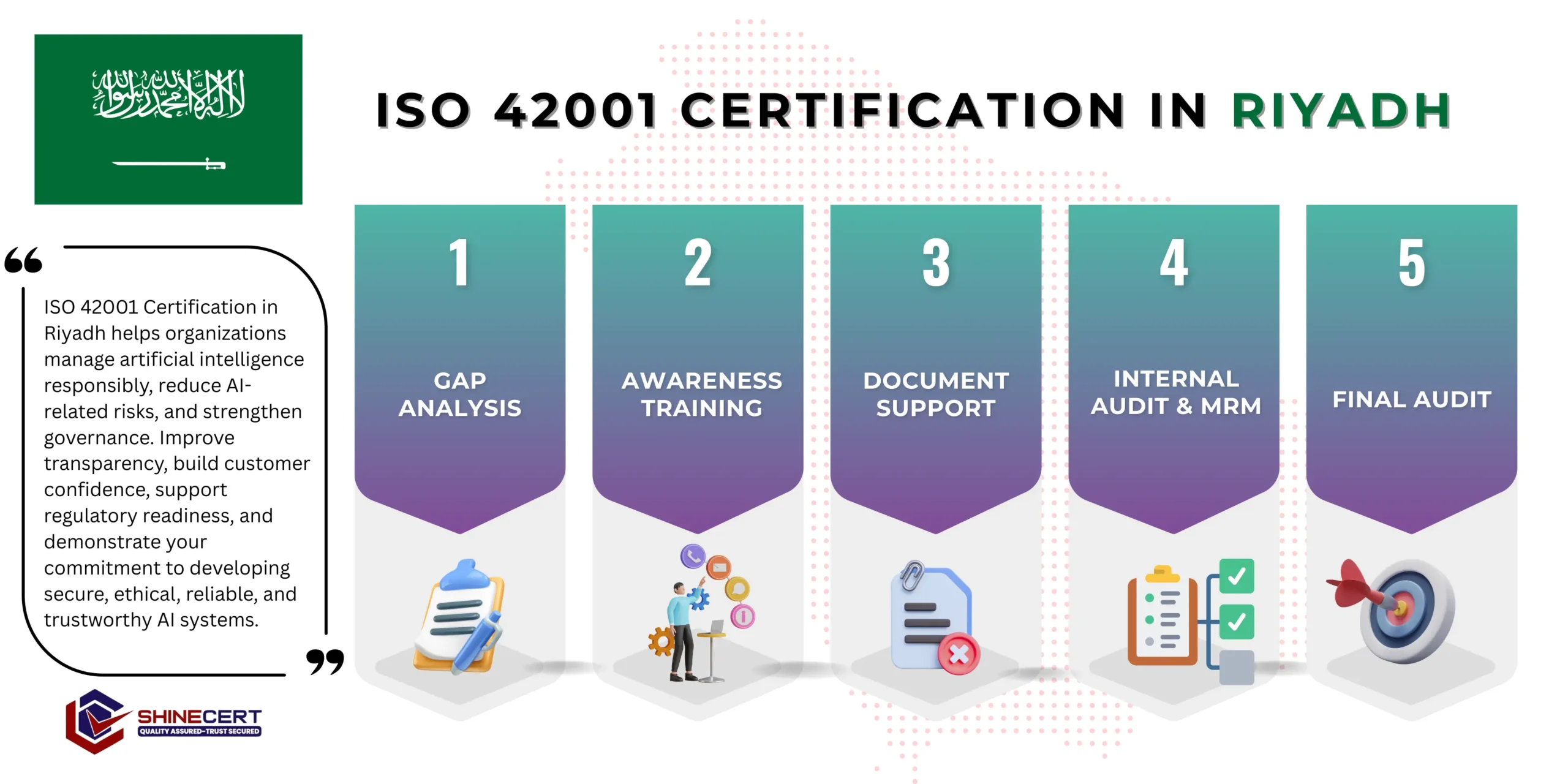
ISO 42001 Certification Process in Riyadh
Gap Assessment
We inventory every AI system your organization develops, deploys, or uses, and assess current governance against ISO 42001's requirements, covering everything from third-party AI tools to internally built models.
A documented inventory of your AI systems and a gap assessment against ISO 42001's requirements.
Documentation Development
We build the AI policy, risk assessment methodology, and impact-assessment templates your gap assessment identified as missing, tailored to the specific AI use cases your organization actually runs.
A complete AI policy, risk assessment methodology, and impact-assessment templates matched to your AI use cases.
Implementation & Training
Staff involved in AI development, procurement, or oversight are trained on the new governance requirements, including how to recognize and escalate AI-specific risks such as model drift or biased outputs.
Trained staff able to recognize and escalate AI-specific risks such as model drift or biased outputs.
Internal Audit & Management Review
We conduct a structured internal audit, followed by a formal management review of AI governance performance, closing gaps before external assessment.
A documented internal audit report and management review minutes showing findings were addressed.
Certification Audit
Your SASO-accredited certification body conducts a two-stage external audit, resulting in your ISO 42001 certificate, valid for three years with annual surveillance audits.
Your ISO 42001 certificate, valid for three years with annual surveillance audits.
Gap Assessment
We inventory every AI system your organization develops, deploys, or uses, and assess current governance against ISO 42001's requirements, covering everything from third-party AI tools to internally built models.
A documented inventory of your AI systems and a gap assessment against ISO 42001's requirements.
Documentation Development
We build the AI policy, risk assessment methodology, and impact-assessment templates your gap assessment identified as missing, tailored to the specific AI use cases your organization actually runs.
A complete AI policy, risk assessment methodology, and impact-assessment templates matched to your AI use cases.
Implementation & Training
Staff involved in AI development, procurement, or oversight are trained on the new governance requirements, including how to recognize and escalate AI-specific risks such as model drift or biased outputs.
Trained staff able to recognize and escalate AI-specific risks such as model drift or biased outputs.
Internal Audit & Management Review
We conduct a structured internal audit, followed by a formal management review of AI governance performance, closing gaps before external assessment.
A documented internal audit report and management review minutes showing findings were addressed.
Certification Audit
Your SASO-accredited certification body conducts a two-stage external audit, resulting in your ISO 42001 certificate, valid for three years with annual surveillance audits.
Your ISO 42001 certificate, valid for three years with annual surveillance audits.
Why Riyadh Businesses Need ISO 42001?
ISO 42001 matters in Riyadh because the city hosts Saudi Arabia’s national AI authority and a $40 billion national AI investment programme, making Riyadh the country’s undisputed center of AI governance expectations, both regulatory and commercial.
- SDAIA is headquartered in Riyadh : The Saudi Data and AI Authority (SDAIA), based in Riyadh, leads the National Strategy for Data and AI and enforces the Personal Data Protection Law (PDPL). With 2026 declared Saudi Arabia’s “Year of AI,” SDAIA’s expectations around responsible AI governance are only intensifying, and Riyadh-based companies deploying AI systems are increasingly expected to demonstrate structured oversight rather than informal, ad hoc controls. ISO 42001 gives Riyadh companies a structured, internationally recognized way to demonstrate governance maturity ahead of specific formal requirements that are likely to follow.
- RHQ and enterprise AI adoption : Riyadh’s rapid AI adoption across finance, government services, and giga-project technology means more companies are deploying AI systems with real decision-making impact, from credit scoring to smart-city infrastructure, increasing the practical stakes of getting AI governance right, particularly where a flawed or biased model could cause direct financial or reputational harm.
- Government and Etimad procurement : As Saudi government entities increasingly deploy or procure AI-enabled systems, demonstrable AI governance is becoming a genuine differentiator in technology-related Etimad tenders, with evaluators beginning to ask pointed questions about model oversight and bias testing that only a formal governance framework can answer convincingly.
- Genuine accreditation matters : Always verify current SAC accreditation, and given the standard’s newness, confirm your auditor has genuine AI-specific background rather than treating this as a routine extension of a generic ISMS audit.
ISO 42001 Certification Cost in Riyadh
- Nature of the business : A company using a handful of well-defined third-party AI tools costs less to certify than one developing or fine-tuning its own models, since custom model development introduces significantly more governance surface area to document and control.
- Number of employees : Audit duration scales with headcount, directly affecting the certification body’s fee, particularly where large teams are involved in AI development, oversight, or day-to-day use of AI-enabled systems.
- Number of departments and AI systems in scope : More AI systems across more business functions mean a broader inventory and more impact assessments to complete, since each distinct AI use case typically requires its own risk and impact documentation.
- Existing documentation maturity : Companies with existing data-governance work, including PDPL compliance, spend less on documentation development, since much of the underlying data mapping and risk assessment can be extended rather than rebuilt.
- DIY vs. consultant vs. end-to-end support : In-house implementation costs staff time and carries higher risk given how new the standard is, with fewer internal precedents to draw on than for more established management systems.
- Certification body chosen : Given ISO 42001’s newness, auditor availability with genuine AI expertise can affect both cost and timeline more than for established standards, making early engagement with a qualified certifier particularly valuable.
- Bundling with ISO 27001 : Companies pursuing both can share risk-assessment infrastructure, reducing overall cost since data security and AI governance risk assessments overlap substantially.
Mandatory Documents Required (By Clause)
- Clause 4 — Context of the Organization : Requires identifying AI-relevant issues and defining scope. Document needed: a written Scope Statement covering all AI systems in scope.
- Clause 5 — Leadership : Requires top-management ownership of AI governance. Document needed: a signed AI Policy.
- Clause 6 — Planning : Requires AI-specific risk assessment. Document needed: a Risk Assessment and AI System Impact Assessment for each system.
- Clause 7 — Support : Covers competence and awareness. Document needed: training records for staff involved in AI development or oversight.
- Clause 8 — Operation : Covers operational controls for AI systems. Document needed: an AI System Inventory and data-governance records.
- Clause 9 — Performance Evaluation : Requires monitoring and internal audit. Document needed: internal audit reports and management review minutes.
- Clause 10 — Improvement : Requires handling nonconformities. Document needed: Nonconformity and Corrective Action records specific to AI system failures.
Industries in Riyadh That Need ISO 42001
Financial Services & Fintech
Companies using AI for credit scoring or fraud detection face heightened scrutiny from SAMA and increasingly from SDAIA's data-governance expectations, particularly around explainability of automated decisions affecting customers.
Read moreGovernment Technology Providers
Companies supplying AI-enabled systems to Saudi government entities need demonstrable governance as procurement scrutiny increases, especially for systems touching citizen-facing services.
Read moreHealthcare Technology
Companies using AI for diagnostics or clinical decision support carry especially high stakes for AI-specific errors, making formal governance a genuine patient-safety consideration, not just a compliance exercise.
Read moreRHQ Multinationals
Companies establishing Regional Headquarters bring global AI products into a jurisdiction with its own data-governance framework, requiring careful alignment between group-level AI policies and Saudi-specific expectations under PDPL and SDAIA's national strategy.
Read moreRetail & E-commerce
Companies using AI for personalization or demand forecasting benefit from structured governance as data volumes grow and the commercial stakes of biased or poorly performing models increase.
Read moreSmart-City & Giga-Project Technology
Companies providing AI-driven infrastructure or analytics to RCRC-governed projects need governance credentials matching the scale and public visibility of the deployment, given how directly these systems can affect citizens and residents.
Read moreCase Study
- A Riyadh-based fintech company using AI for credit-risk scoring approached ShineCert after a partner bank’s due-diligence review flagged the absence of formal AI governance documentation. Their model was performing well, but there was no AI system inventory, no bias-testing documentation, and no clear internal ownership of AI governance, which made it difficult to answer the bank’s due-diligence questions with anything beyond informal assurances.
- Over nine weeks, a complete AI system inventory was built, bias-testing procedures were formalized, and governance ownership was formally assigned at the leadership level, with clear escalation paths for flagged model issues. Certification was achieved with one minor nonconformity around model-monitoring documentation, resolved within the standard window, and the bank’s due-diligence review was closed out successfully.
Choosing a Certification Body in Riyadh
Verify current SAC accreditation for your specific standard and industry scope before signing with any certification body, this is non-negotiable, since accreditation can be scope-limited.
| Approach | What It Involves | Best For |
|---|---|---|
| DIY | Your AI/data governance team manages documentation alone | Companies with existing AI governance expertise |
| Hiring a Consultant | External expert guides documentation and audit prep | Companies wanting guidance while choosing their own certifier |
| ShineCert End-to-End | We manage gap assessment through audit-readiness | Companies navigating a genuinely new standard |
Why Choose ShineCert?
ShineCert at a glance: 10 years of ISO consulting experience, 10,000+ organizations certified globally, with our own office based right here in Riyadh, local, on-the-ground support that understands the specific pace of Saudi Arabia’s AI agenda.
Given ISO 42001’s newness, we’re deliberately transparent about where global audit precedent is still developing, and we build your AI governance framework with SDAIA’s actual expectations in mind, not a generic international template that ignores the local regulatory context.
Frequently Asked Questions
No, it’s voluntary. It becomes valuable given SDAIA’s intensifying AI governance expectations and the increasing scrutiny of AI systems in Etimad technology tenders.
Look for genuine local presence, specific familiarity with SDAIA’s data-governance expectations, and verified AI-specific auditor experience given the standard’s newness.
It depends on how many AI systems are in scope and whether your organization develops or purely deploys AI tools, see the cost breakdown above.
Not automatically, but there’s substantial practical overlap since most AI systems process personal data, and ISO 42001’s governance structure complements PDPL compliance work.
Confirm current accreditation under SASO’s Saudi Accreditation Committee (SAC) for ISO 42001 specifically.