
GMP Certification in Riyadh
Quick Answer
GMP (Good Manufacturing Practice) certification verifies that a facility manufactures pharmaceuticals, medical devices, food products, or cosmetics under controlled, hygienic, and consistently documented conditions. In Saudi Arabia, GMP compliance is enforced by the Saudi Food and Drug Authority and is mandatory for regulated manufacturers and, for higher-risk medical device classes, verified through on-site GMP inspection.
What Is GMP Certification?
GMP, or Good Manufacturing Practice, is a set of requirements governing how products are manufactured to ensure they are consistently produced and controlled to appropriate quality standards. It covers facility design and cleanliness, equipment qualification, raw material control, personnel hygiene and training, batch documentation, and quality control testing, minimizing the risk of contamination, mix-ups, and errors that a finished-product test alone cannot catch.
In Saudi Arabia, GMP compliance is enforced by the Saudi Food and Drug Authority (SFDA) for pharmaceutical manufacturers, and for medical devices it is verified through on-site GMP inspection as part of the device registration pathway, particularly for Class III and Class IV devices carrying higher patient risk. For Riyadh businesses, GMP certification or verified GMP compliance is often a precondition for market access, not simply a quality differentiator, especially for regulated pharmaceutical, medical device, and certain food manufacturing categories.
What are the steps to get GMP Certification in Riyadh?
our services
- ISO Certification Riyadh
- ISO 9001 Certification Riyadh
- ISO 14001 Certification Riyadh
- ISO 27001 Certification Riyadh
- ISO 22000 Certification Riyadh
- ISO 45001 Certification Riyadh
- ISO 42001 Certification Riyadh
- ISO 20000-1 Certification Riyadh
- ISO 13485 Certification Riyadh
- ISO 17025 Certification Riyadh
- CE Mark Certification Riyadh
- GMP Certification Riyadh
- GDPR Certification Riyadh
- Halal Certification Riyadh
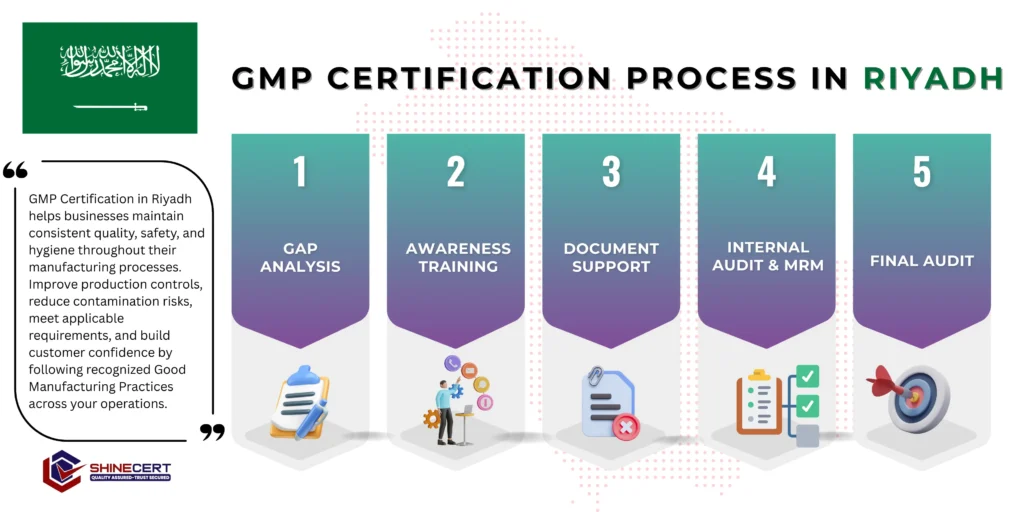
GMP Certification Process in Riyadh
Facility and Process Gap Assessment
We assess your manufacturing facility, equipment, and processes against applicable GMP requirements for your product category, identifying gaps in cleanliness, equipment qualification, and documentation.
A documented gap assessment covering facility, equipment, and documentation readiness.
Quality System and Documentation Development
We help build the standard operating procedures, batch record templates, and quality control documentation GMP requires, tailored to your specific manufacturing processes and product risk level.
Complete SOPs, batch record templates, and quality control documentation.
Implementation and Staff Training
GMP procedures are rolled out across production, quality control, and warehousing staff, with training on hygiene practices, documentation discipline, and deviation reporting.
Trained staff able to follow hygiene, documentation, and deviation reporting practices.
Internal Audit and Readiness Review
We conduct a mock GMP inspection covering facility conditions, batch documentation, and quality control records to identify and close any remaining gaps before the formal inspection.
A mock inspection report confirming readiness for the formal GMP inspection.
GMP Inspection
SFDA or an approved inspection body conducts an on-site GMP inspection of your facility, reviewing documentation, equipment qualification, and production practices, before confirming GMP compliance status for your registered products.
Confirmed GMP compliance status for your registered products.
Facility and Process Gap Assessment
We assess your manufacturing facility, equipment, and processes against applicable GMP requirements for your product category, identifying gaps in cleanliness, equipment qualification, and documentation.
A documented gap assessment covering facility, equipment, and documentation readiness.
Quality System and Documentation Development
We help build the standard operating procedures, batch record templates, and quality control documentation GMP requires, tailored to your specific manufacturing processes and product risk level.
Complete SOPs, batch record templates, and quality control documentation.
Implementation and Staff Training
GMP procedures are rolled out across production, quality control, and warehousing staff, with training on hygiene practices, documentation discipline, and deviation reporting.
Trained staff able to follow hygiene, documentation, and deviation reporting practices.
Internal Audit and Readiness Review
We conduct a mock GMP inspection covering facility conditions, batch documentation, and quality control records to identify and close any remaining gaps before the formal inspection.
A mock inspection report confirming readiness for the formal GMP inspection.
GMP Inspection
SFDA or an approved inspection body conducts an on-site GMP inspection of your facility, reviewing documentation, equipment qualification, and production practices, before confirming GMP compliance status for your registered products.
Confirmed GMP compliance status for your registered products.
Why Riyadh Businesses Need GMP Certification?
SFDA’s regulatory framework makes GMP compliance a market-access requirement for regulated manufacturers, while Riyadh’s growing pharmaceutical, medical device, and food manufacturing base increases the number of companies directly affected.
- SFDA’s device registration pathway requires GMP inspection for higher-risk products : Under the current Saudi device registration route, Class III and Class IV medical devices require an on-site GMP inspection as part of registration, with inspection fees running from roughly SAR 33,000 to SAR 184,000 depending on device classification and facility complexity. Without passing this inspection, these devices cannot legally be registered or sold in the Saudi market.
- Pharmaceutical manufacturing in Riyadh operates under strict SFDA oversight : Any facility manufacturing pharmaceutical products for the Saudi market must demonstrate GMP compliance to SFDA as a condition of manufacturing licensing, with regular inspection cycles to confirm ongoing compliance rather than a one-time approval.
- Riyadh’s growing life sciences and manufacturing sector increases regulatory exposure : As Vision 2030 encourages domestic pharmaceutical and medical device manufacturing to reduce import dependency, more Riyadh-based facilities are entering GMP-regulated categories for the first time and need structured compliance support.
- Food manufacturers face GMP expectations tied to food safety certification : While food GMP in Saudi Arabia is often addressed through broader food safety frameworks such as ISO 22000, SFDA-regulated food categories increasingly expect documented GMP practices as a foundational layer beneath formal food safety management systems.
GMP Certification Cost in Riyadh
- Product category and risk classification : Higher-risk categories such as Class III and IV medical devices or sterile pharmaceutical products face more extensive inspection requirements and higher fees than lower-risk categories.
- Facility size and manufacturing complexity : A larger facility with multiple production lines and more complex processes requires a more extensive inspection and typically incurs higher fees than a smaller, single-line operation.
- Current facility and documentation maturity : Facilities that already maintain strong quality systems and documentation discipline need less remediation work than those building GMP compliance from a lower baseline.
- Number of products and production lines in scope : Each additional product or line requiring its own batch documentation, validation, and quality control processes adds to the overall implementation and inspection cost.
- Inspection body fees : SFDA-published GMP inspection fees for medical devices, for example, range from approximately SAR 33,000 to SAR 184,000 depending on device classification, and pharmaceutical inspection fees follow a separate published schedule.
- Level of consulting support required : A fully guided, end-to-end engagement covering documentation, mock inspection, and remediation support costs more than a lighter advisory arrangement for facilities with strong internal quality capability.
- Remediation costs : Facilities identified with significant gaps during gap assessment may face capital costs for equipment upgrades or facility modifications, separate from consulting and inspection fees.
Mandatory Documents Required
- Quality Manual and GMP Policy : The organization must define its overarching commitment to GMP compliance and quality management. Document needed: a signed GMP Quality Policy and Quality Manual.
- Standard Operating Procedures : Every critical manufacturing and quality control step must be governed by a written, approved procedure. Document needed: SOPs covering production, cleaning, equipment use, and quality testing.
- Batch Manufacturing Records : Each production batch must be fully traceable from raw material to finished product. Document needed: completed Batch Manufacturing Records for every production run.
- Equipment Qualification and Calibration Records : Manufacturing and testing equipment must be validated as fit for purpose and regularly calibrated. Document needed: Equipment Qualification Reports and a Calibration Schedule.
- Personnel Training Records : Staff involved in manufacturing and quality control must be trained and assessed as competent for their roles. Document needed: GMP Training Records for all relevant personnel.
- Deviation and Corrective Action Records : Any departure from standard procedures must be documented, investigated, and resolved. Document needed: a Deviation Log and Corrective and Preventive Action (CAPA) Records.
- Change Control Records : Changes to processes, equipment, or materials must be assessed for quality impact before implementation. Document needed: a Change Control Register documenting approved changes and their impact assessment.
Industries in Riyadh That Need GMP Certification
Pharmaceutical manufacturers
Any facility producing medicines for the Saudi market must maintain SFDA-verified GMP compliance as a condition of manufacturing licensing and ongoing product registration.
Read moreMedical device manufacturers, particularly Class III and IV
Higher-risk device manufacturers face mandatory on-site GMP inspection as part of the SFDA registration pathway, making GMP readiness a direct precondition for market entry.
Read moreNutraceutical and dietary supplement producers
As demand for supplements grows across Riyadh's health and wellness market, manufacturers increasingly need GMP compliance to meet both regulatory expectations and retailer requirements.
Read moreCosmetics manufacturers
Facilities producing cosmetics and personal care products for the Saudi market benefit from GMP-aligned practices to meet SFDA cosmetic regulations and growing consumer expectations around product safety.
Read moreFood manufacturers in regulated categories
SFDA-regulated food producers, particularly those handling higher-risk categories such as infant formula or specialized nutrition products, need documented GMP practices underpinning their broader food safety systems.
Read moreContract manufacturing organizations
Facilities manufacturing pharmaceutical, device, or supplement products on behalf of other brands need robust GMP compliance to be commercially viable partners for regulated product owners.
Read moreWhy Choose ShineCert?
ShineCert has spent 10 years helping pharmaceutical, medical device, and manufacturing businesses build quality systems that pass real regulatory inspection, not just look good on paper. We’ve supported more than 10,000 organizations globally, and our own office based right here in Riyadh means we understand exactly how SFDA’s GMP inspection process works in practice for businesses manufacturing or registering products in this market.
Choosing a Certification Body in Riyadh
| Approach | What You Get | Typical Fit |
|---|---|---|
| DIY (Self-Managed) | Your team interprets GMP requirements, builds documentation, and prepares for inspection independently. | Best for organizations with in-house pharmaceutical or quality manufacturing expertise and time to spare. Higher risk of inspection findings if gaps are missed. |
| Consultant-Led | An external consultant guides gap assessment, documentation, and remediation, while your team owns execution. | The most common choice — balances cost against speed and reduces the risk of a failed or delayed inspection. |
| ShineCert End-to-End | We manage gap assessment, documentation, staff training, mock inspection, and coordination with SFDA or the approved inspection body from start to finish. | Best for businesses that want a single accountable partner and the fastest, lowest-risk path to GMP compliance. |
Case Study
- A medical device distributor in Riyadh preparing to register a Class III diagnostic device faced its first mandatory GMP inspection under the SFDA registration pathway and had no prior experience preparing for one. Working with ShineCert, the company conducted a facility gap assessment, built out batch documentation and equipment qualification records that had previously been handled informally, and ran a mock inspection that surfaced several documentation gaps before the real assessment.
- The company passed its SFDA GMP inspection on the first attempt and completed device registration within its target market-entry window.
Ready to Get Certified?
Contact ShineCert today for a free consultation on GMP certification in Riyadh. Our Riyadh-based team will assess your facility readiness and scope a clear path to GMP compliance.
Frequently Asked Questions
Yes, for regulated categories. Pharmaceutical manufacturers must maintain SFDA-verified GMP compliance as a licensing condition, and Class III and Class IV medical devices require a mandatory on-site GMP inspection as part of SFDA registration.
Look for a consultant with genuine local Riyadh presence, direct experience with SFDA’s inspection process, and a track record supporting pharmaceutical, device, or food manufacturers through GMP compliance. ShineCert’s Riyadh-based team has guided organizations across these sectors through the full process.
Cost depends on your product category and risk classification, facility size, and current documentation maturity. SFDA-published inspection fees for medical devices range from approximately SAR 33,000 to SAR 184,000 depending on classification; contact ShineCert for a full scoped quotation including consulting support.
Timelines vary based on facility complexity and existing quality system maturity, but most Riyadh businesses complete the process, from gap assessment through to inspection, within a committed, structured engagement.
ISO 9001 is a general quality management system standard applicable to any industry. GMP is a more prescriptive, product-safety-focused set of requirements specific to regulated manufacturing sectors such as pharmaceuticals, medical devices, and certain food categories, often enforced directly by a national regulator like SFDA rather than through voluntary certification.
GMP inspection confirms your manufacturing facility meets required quality and control standards, which is typically a mandatory component of product registration, but registration approval also depends on other technical and regulatory requirements specific to your product.