
CE Mark Certification in Riyadh
Quick Answer
CE Marking is a conformity mark indicating a product meets European Union health, safety, and environmental protection requirements. It is not a Saudi Arabian regulatory requirement, but Riyadh-based manufacturers and exporters targeting the European market need CE Marking to legally sell qualifying products there.
What Is CE Marking?
CE Marking is a conformity marking that indicates a product complies with European Union health, safety, and environmental protection legislation, covering product categories ranging from machinery and electronics to medical devices, construction products, and personal protective equipment. It is a legal requirement to place the CE mark on qualifying products before they can be sold within the European Economic Area, and it is achieved through a defined conformity assessment process specific to the product’s applicable EU directive or regulation.
It’s important for Riyadh businesses to understand precisely what CE Marking is and isn’t: it is not a Saudi Arabian legal requirement, and Saudi Arabia has its own separate conformity framework through the Saudi Standards, Metrology and Quality Organization (SASO), including the SASO Quality Mark for products sold domestically. CE Marking becomes relevant specifically when a Riyadh-based manufacturer or exporter wants to sell a qualifying product into the European market, where it functions as an export enabler rather than a domestic compliance obligation.
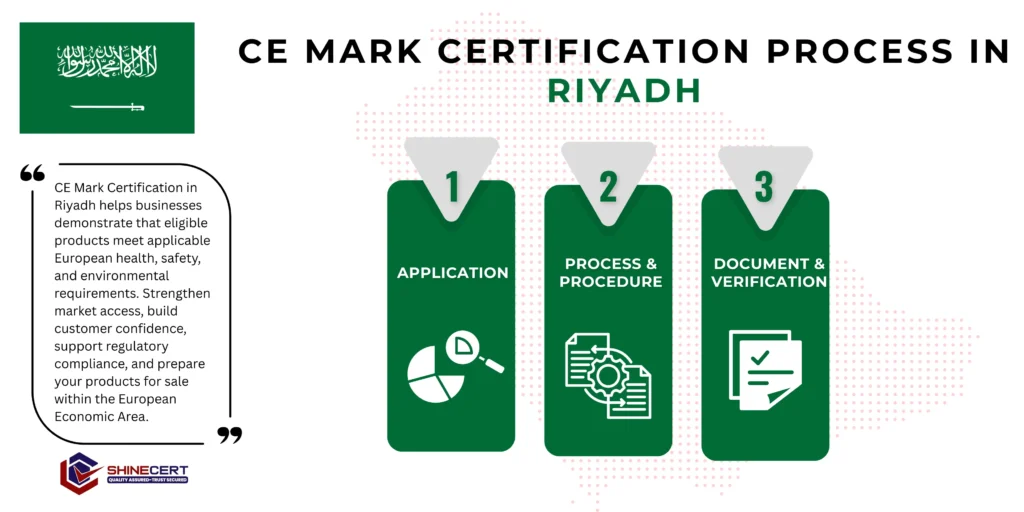
What are the steps to get CE Mark Certification in Riyadh?
our services
- ISO Certification Riyadh
- ISO 9001 Certification Riyadh
- ISO 14001 Certification Riyadh
- ISO 27001 Certification Riyadh
- ISO 22000 Certification Riyadh
- ISO 45001 Certification Riyadh
- ISO 42001 Certification Riyadh
- ISO 20000-1 Certification Riyadh
- ISO 13485 Certification Riyadh
- ISO 17025 Certification Riyadh
- CE Mark Certification Riyadh
- GMP Certification Riyadh
- GDPR Certification Riyadh
- Halal Certification Riyadh
CE Marking Process in Riyadh
Directive and Requirement Identification
We identify which EU directive or regulation applies to your specific product and determine whether self-declaration or third-party (Notified Body) assessment is required under that framework.
Identification of the applicable directive and required conformity assessment route.
Technical File and Risk Assessment
We help compile the technical documentation, risk assessment, and design records required to demonstrate your product meets the applicable essential requirements.
A complete technical file with risk assessment and design records.
Testing and Conformity Assessment
Depending on the product category, this involves laboratory testing against harmonized European standards, and for higher-risk products, formal assessment by an EU-recognized Notified Body.
Test results and, where required, a Notified Body conformity assessment.
Declaration of Conformity and Documentation Finalization
We help finalize the Declaration of Conformity, technical file, and labeling requirements, ensuring all documentation is ready to support the CE mark being legally applied.
A finalized Declaration of Conformity and compliant labeling documentation.
CE Marking Application and Ongoing Compliance
The CE mark is applied to the product and accompanying documentation, with the manufacturer retaining responsibility for maintaining ongoing conformity, including managing any post-market surveillance obligations.
The CE mark applied to your product, with ongoing conformity maintained by you.
Directive and Requirement Identification
We identify which EU directive or regulation applies to your specific product and determine whether self-declaration or third-party (Notified Body) assessment is required under that framework.
Identification of the applicable directive and required conformity assessment route.
Technical File and Risk Assessment
We help compile the technical documentation, risk assessment, and design records required to demonstrate your product meets the applicable essential requirements.
A complete technical file with risk assessment and design records.
Testing and Conformity Assessment
Depending on the product category, this involves laboratory testing against harmonized European standards, and for higher-risk products, formal assessment by an EU-recognized Notified Body.
Test results and, where required, a Notified Body conformity assessment.
Declaration of Conformity and Documentation Finalization
We help finalize the Declaration of Conformity, technical file, and labeling requirements, ensuring all documentation is ready to support the CE mark being legally applied.
A finalized Declaration of Conformity and compliant labeling documentation.
CE Marking Application and Ongoing Compliance
The CE mark is applied to the product and accompanying documentation, with the manufacturer retaining responsibility for maintaining ongoing conformity, including managing any post-market surveillance obligations.
The CE mark applied to your product, with ongoing conformity maintained by you.
Why Riyadh Businesses Need CE Marking?
As Riyadh’s manufacturing and export base grows under Vision 2030’s economic diversification goals, more local companies are looking beyond the GCC toward European and other international markets, where CE Marking becomes a genuine market-access requirement.
- Vision 2030’s export diversification agenda is pushing Riyadh manufacturers toward new markets : As Saudi Arabia works to build export-oriented manufacturing capacity beyond oil and gas, more Riyadh-based companies in electronics, machinery, and industrial equipment are targeting European buyers, where CE Marking is a non-negotiable legal precondition for market entry.
- RHQ multinationals often need CE-compliant products for group-wide distribution : Regional headquarters companies operating in Riyadh under the RHQ Program that manufacture or source products locally for distribution across a global network frequently need those products to carry CE Marking to reach European group entities or customers.
- European buyers and distributors will not import non-compliant products : For Riyadh exporters, the absence of CE Marking on a qualifying product category is typically a hard blocker in European procurement and distribution relationships, regardless of product quality or price competitiveness.
- CE Marking complements, rather than replaces, Saudi domestic conformity requirements : Riyadh manufacturers selling both domestically and to Europe typically need to maintain SASO conformity for the Saudi market alongside CE Marking for European exports, since the two frameworks address different regulatory jurisdictions with different technical requirements.
CE Marking Cost in Riyadh
- Product category and applicable directive : Products falling under directives requiring mandatory Notified Body involvement, such as many medical devices, cost significantly more to certify than products eligible for manufacturer self-declaration.
- Testing requirements and standards complexity : Products requiring extensive laboratory testing against multiple harmonized standards incur higher testing costs than simpler products with fewer applicable requirements.
- Existing technical documentation maturity : Companies with strong existing design and testing documentation need less foundational work than those building a technical file from scratch.
- Number of product variants : Each product variant or model requiring separate assessment adds to the overall scope and cost of the CE Marking project.
- Choice of Notified Body (where required) : Notified Body fees vary by organization and country, and businesses should compare quotes for equivalent accredited scope.
- Level of consulting support required : A fully guided, end-to-end engagement covering technical file preparation and Notified Body liaison costs more than a lighter advisory arrangement for companies with strong internal engineering documentation capability.
Mandatory Documents Required
- Applicable Directive Identification : The manufacturer must correctly identify which EU directive(s) or regulation(s) apply to the specific product. Document needed: a Directive Applicability Assessment.
- Risk Assessment : Products must be assessed against the essential health and safety requirements of the applicable directive. Document needed: a Product Risk Assessment aligned to the relevant EU framework.
- Technical File : A comprehensive technical file must document the product’s design, manufacturing process, and how it meets essential requirements. Document needed: a complete Technical File including design drawings, test reports, and risk analysis.
- Test Reports : Products must be tested against applicable harmonized European standards. Document needed: Laboratory Test Reports confirming compliance with relevant standards.
- Declaration of Conformity : The manufacturer must formally declare the product meets all applicable requirements. Document needed: a signed EU Declaration of Conformity.
- Notified Body Certificate (where applicable) : Higher-risk product categories require independent third-party assessment. Document needed: a Notified Body Certificate for products requiring mandatory third-party conformity assessment.
- User Instructions and Labeling : Products must carry the CE mark correctly and be accompanied by compliant instructions. Document needed: compliant User Instructions and Labeling documentation in required EU languages.
Industries in Riyadh That May Need CE Marking
Electronics and electrical equipment manufacturers
Companies producing electronic devices, appliances, or electrical components for export face detailed CE requirements under EU electromagnetic compatibility and low voltage directives.
Read moreMachinery and industrial equipment manufacturers
Industrial machinery exported to Europe falls under the EU Machinery Directive, requiring detailed risk assessment and, for many categories, third-party conformity assessment.
Read moreMedical device manufacturers
Riyadh-based device manufacturers targeting European markets face some of the most rigorous CE requirements, generally requiring Notified Body involvement under the EU Medical Device Regulation.
Read moreConstruction products manufacturers
Companies exporting building materials or construction products to Europe need CE Marking under the Construction Products Regulation to demonstrate performance characteristics.
Read morePersonal protective equipment manufacturers
PPE products exported to Europe require CE Marking demonstrating compliance with defined safety performance requirements.
Read moreToy and consumer product manufacturers
Companies exporting toys or certain consumer products to Europe must meet CE requirements addressing safety, particularly around chemical content and physical hazards.
Read moreWhy Choose ShineCert?
ShineCert has spent 10 years helping manufacturers navigate international conformity requirements, including the specific complexities of EU market access. We’ve supported more than 10,000 organizations globally, and our own office based right here in Riyadh means we understand exactly how Vision 2030’s export ambitions are pushing local manufacturers toward markets like Europe, and what it takes to get there compliantly.
Choosing a Certification Body in Riyadh
| Approach | What You Get | Typical Fit |
|---|---|---|
| DIY (Self-Managed) | Your team interprets the applicable directive, builds the technical file, and manages testing coordination independently. | Best for organizations with in-house regulatory affairs expertise familiar with EU frameworks. Higher risk of directive misapplication without specialist guidance. |
| Consultant-Led | An external consultant guides directive identification, technical file preparation, and testing coordination, while your team owns product design. | The most common choice for exporters new to the EU market — balances cost against speed and reduces the risk of compliance gaps. |
| ShineCert End-to-End | We manage directive identification, technical file preparation, testing coordination, Notified Body liaison, and documentation finalization from start to finish. | Best for businesses that want a single accountable partner and the fastest, lowest-risk path to compliant CE Marking. |
Case Study
- A Riyadh-based industrial equipment manufacturer secured its first European distribution agreement, only to discover its product required CE Marking under the EU Machinery Directive before it could legally be shipped. With no prior experience navigating EU conformity requirements, the company worked with ShineCert to identify the correct directive, complete a risk assessment, compile a full technical file, and coordinate third-party testing for the specific safety requirements that applied.
- The product achieved CE Marking within the distributor’s contractual deadline, and the company has since applied the same process to two additional product lines targeting the European market.
Ready to Explore Your Export Compliance Options?
Contact ShineCert today for a free consultation on CE Marking for your export-bound products. Our Riyadh-based team will assess your product’s requirements and scope a clear path to European market access.
Frequently Asked Questions
No. CE Marking is not a Saudi Arabian legal requirement, it is an EU market-access requirement. Riyadh businesses only need CE Marking if they intend to sell a qualifying product within the European Economic Area. For the Saudi domestic market, SASO’s own conformity framework, including the SASO Quality Mark, applies instead.
Look for a consultant with genuine experience navigating EU directives and Notified Body processes, not just general quality consulting. ShineCert’s Riyadh-based team has guided manufacturers across electronics, machinery, and industrial equipment through the CE Marking process for European market entry.
Cost depends heavily on your product category, whether third-party Notified Body assessment is required, and the extent of testing needed against applicable EU standards. Contact ShineCert for a scoped quotation.
CE Marking demonstrates compliance with EU requirements for products sold in Europe. The SASO Quality Mark demonstrates compliance with Saudi Arabian requirements for products sold domestically. They are separate frameworks serving separate markets, and a product sold in both regions typically needs to meet both sets of requirements independently.
Timelines vary significantly based on product category and whether Notified Body involvement is required, but manufacturers should plan for a multi-month process when pursuing CE Marking for the first time, particularly for higher-risk product categories.
Yes. Many Riyadh manufacturers need to maintain compliance with both frameworks simultaneously, and ShineCert supports businesses navigating SASO domestic requirements alongside CE Marking for European export.