
ISO 20000-1 Certification in Nigeria
Quick Answer
ISO 20000-1 is the international standard for IT service management systems, and it’s genuinely relevant to Nigeria’s booming tech sector: Lagos was recognized in 2025 as the world’s fastest-growing tech ecosystem, Nigeria’s ICT sector has grown to over 16% of GDP with projections reaching 21% by 2027, and the sector counts tens of thousands of active startups with tens of billions of dollars in cumulative funding raised. As this ecosystem matures, IT service providers, fintech platforms, and enterprise IT teams increasingly need to demonstrate service delivery isn’t just fast-growing but genuinely well-managed. ISO 20000-1 gives Nigerian IT service organizations a structured, internationally recognized way to formalize service management. Certification typically takes three to five months, and cost depends on genuine factors like service scope and organizational complexity, never a flat figure quoted upfront.
What Is ISO 20000-1, Actually?
ISO 20000-1 is an international standard, published by the International Organization for Standardization, that sets out requirements for an IT service management system, a structured way an organization plans, delivers, monitors, and continually improves IT services, whether delivered internally to a business or externally to clients. It covers service design and transition, incident and problem management, capacity and availability management, and supplier management together, addressing IT service delivery as a genuinely managed discipline rather than an ad hoc, reactive function. Getting certified means an independent, accredited body has formally verified your IT service management practices meet the standard’s requirements, giving clients, partners, and investors real confidence your organization delivers IT services systematically, not just capably on a good day.
Why ISO 20000-1 ITSM Matters So Much in Nigeria Right Now?
- Lagos’s explosive tech sector growth is creating genuine service delivery scaling pressure : Recognized in 2025 as the world’s fastest-growing tech ecosystem, outperforming established hubs like Istanbul and Mumbai, Lagos’s startup and IT services sector is scaling fast enough that informal, founder-dependent service delivery practices genuinely struggle to keep pace, exactly the gap a formal IT service management system is built to close.
- NITDA has explicitly identified reliable digital infrastructure as foundational to continued investment and competitiveness : With Nigeria’s ICT sector already exceeding 16% of GDP and projected to reach 21% by 2027, NITDA’s public position that strong, reliable digital infrastructure is fundamental to attracting investment reflects genuine institutional recognition that service reliability, not just growth speed, determines the sector’s long-term credibility.
- International investors and enterprise clients increasingly expect demonstrable service management maturity, not just technical capability : As Nigerian tech companies pursue Series A and later funding rounds or enterprise contracts with international clients, service management credentials increasingly factor into due diligence alongside technical and financial metrics, particularly for IT service providers and platform businesses whose entire value proposition depends on service reliability.
- Fintech’s overwhelming concentration in Lagos means service disruption carries genuinely outsized systemic impact. With the substantial majority of tracked fintech startups based in Lagos, service management failures at any significant platform carry real, concentrated impact across the ecosystem’s users and partners, making formal service management practices a genuinely material differentiator for platforms handling financial transactions specifically.
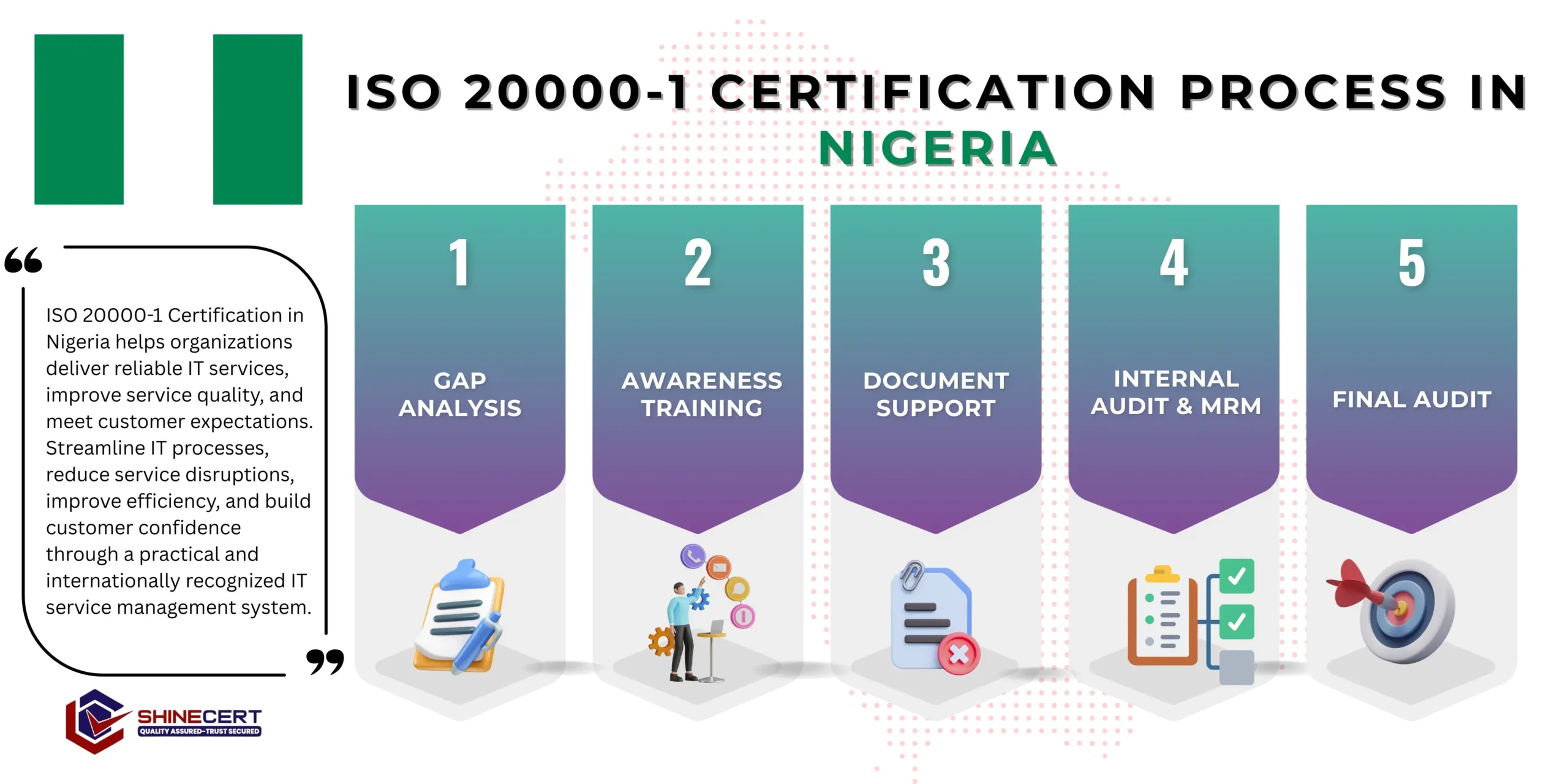
What are the steps to get ISO 20000-1 Certification in Nigeria?
our services
- ISO Certification Nigeria
- ISO 9001 Certification Nigeria
- ISO 14001 Certification Nigeria
- ISO 27001 Certification Nigeria
- ISO 22000 Certification Nigeria
- ISO 20000-1 Certification Nigeria
- ISO 45001 Certification Nigeria
- ISO 42001 Certification Nigeria
- ISO 13485 Certification Nigeria
- ISO 17025 Certification Nigeria
- ISO 31000 Certification Nigeria
- ISO 22301 Certification Nigeria
- ISO 27701 Certification Nigeria
- ISO 37001 Certification Nigeria
- ISO 50001 Certification Nigeria
- CE Mark Certification Nigeria
- GMP Certification Nigeria
- GDPR Certification Nigeria
- Halal Certification Nigeria
Our Five-Step Certification Process, in Depth
Gap Assessment
We review your actual service delivery practices, current incident handling, and existing client commitments, mapping what we find against ISO 20000-1's requirements, particularly relevant for fast-growing businesses whose informal practices may have outpaced formal documentation.
A gap report identifying your real service management maturity and exactly where formal ISO 20000-1 documentation is missing.
Documentation
We build your service catalogue, SLAs, and incident and change management procedures around your organization's actual services and client base — a fintech platform's service management priorities look meaningfully different from a B2B software provider's, and the documentation reflects that specifically.
A complete, version-controlled SMS documentation set, with service levels genuinely tied to what you actually deliver.
Implementation
Incident management, change control, and capacity planning move into genuine daily operation, with staff trained on their specific service management responsibilities.
A functioning SMS with real service management processes actively operating around your actual service delivery.
Internal Audit and Management Review
We audit against every ISO 20000-1 clause, surfacing gaps while stakes are low. Findings go to formal management review with documented decisions on service management priorities and resourcing.
An internal audit report, management review minutes, and corrective actions closed out before the certification audit.
Certification Audit
Stage 1 confirms your SMS documentation is genuinely audit-ready; Stage 2 verifies service management processes are actually operating as documented, through direct review of incident records and staff interviews. We stay engaged through both stages.
Your ISO 20000-1 certificate, valid for three years, plus a surveillance audit schedule.
Gap Assessment
We review your actual service delivery practices, current incident handling, and existing client commitments, mapping what we find against ISO 20000-1's requirements, particularly relevant for fast-growing businesses whose informal practices may have outpaced formal documentation.
A gap report identifying your real service management maturity and exactly where formal ISO 20000-1 documentation is missing.
Documentation
We build your service catalogue, SLAs, and incident and change management procedures around your organization's actual services and client base — a fintech platform's service management priorities look meaningfully different from a B2B software provider's, and the documentation reflects that specifically.
A complete, version-controlled SMS documentation set, with service levels genuinely tied to what you actually deliver.
Implementation
Incident management, change control, and capacity planning move into genuine daily operation, with staff trained on their specific service management responsibilities.
A functioning SMS with real service management processes actively operating around your actual service delivery.
Internal Audit and Management Review
We audit against every ISO 20000-1 clause, surfacing gaps while stakes are low. Findings go to formal management review with documented decisions on service management priorities and resourcing.
An internal audit report, management review minutes, and corrective actions closed out before the certification audit.
Certification Audit
Stage 1 confirms your SMS documentation is genuinely audit-ready; Stage 2 verifies service management processes are actually operating as documented, through direct review of incident records and staff interviews. We stay engaged through both stages.
Your ISO 20000-1 certificate, valid for three years, plus a surveillance audit schedule.
Certification Validity, Surveillance Audits, and Recertification
An ISO 20000-1 certificate is valid for three years from the date it’s issued. During years one and two, your certification body conducts an annual surveillance audit, narrower in scope, typically sampling incident and change management records and confirming previously identified nonconformities were genuinely closed. Before the three-year mark, a full recertification audit, comparable in depth to your original Stage 2 audit, confirms your SMS has continued functioning as your services and client base evolved. Passing recertification issues a new three-year certificate.
Cost of ISO 20000-1 Certification in Nigeria, What Actually Drives It
| Organization Profile | Relative Investment Level | Why |
|---|---|---|
| Small, single-service or early-stage startup | Lower | Narrower service catalogue and simpler incident management |
| Medium, multiple-service or scaling platform | Moderate | Broader service portfolio and SLA management |
| Larger, enterprise-scale or multi-client platform | Higher | Extensive service catalogue and complex capacity planning |
| Bundled with ISO 27001 | Moderate-to-higher combined, lower than separate engagements | Shared risk assessment infrastructure reduces combined cost |
- Number and complexity of services delivered : Each additional distinct IT service in your portfolio typically requires its own service level definition and management process coverage.
- Number of client relationships and SLA tiers : Businesses managing multiple distinct client service level commitments face more extensive documentation and monitoring work than those with a single, standardized offering.
- Existing service management maturity : Businesses with some documented incident and change management practices already in place aren’t starting from zero, those relying entirely on informal, founder-driven practices face more foundational work.
- Certification body fees, tracked separately from our consulting fees : The certification audit itself is conducted and invoiced directly by an independently accredited certification body, separate from ShineCert’s implementation work.
- Whether you’re bundling standards : Building ISO 20000-1 alongside ISO 27001 shares meaningful risk assessment infrastructure, reducing combined cost.
- Internal capacity to contribute : An operations or engineering lead who can genuinely own documentation, incident process design, and internal audit coordination reduces the consulting hours required.
ISO 20000-1 Benefits Nigerian Businesses Actually Get
A structured service management system helps fast-growing IT businesses maintain service quality as they scale, rather than service reliability degrading as growth outpaces informal management practices.
ISO 20000-1 is understood and trusted globally, giving Nigerian tech and IT service companies a credential valuable for international investors, partners, and enterprise clients conducting due diligence.
Documented, systematic service management practices strengthen your position during funding rounds where investors increasingly scrutinize operational maturity alongside growth metrics.
Systematic incident and problem management means service disruptions get resolved through a structured, rehearsed process rather than ad hoc firefighting, considerably reducing downtime impact.
Larger enterprise clients and government-adjacent contracts increasingly require documented IT service management credentials as a genuine evaluation criterion for technology suppliers.
The standard requires genuine, proactive capacity planning, helping fast-growing platforms anticipate scaling needs rather than reacting to capacity failures after they occur.
ISO 20000-1 requires structured management of third-party IT suppliers, an area many fast-growing tech businesses manage informally until formal service management forces genuine structure onto it.
ISO 20000-1 requires genuinely identifying service delivery risks specific to your actual platform and client base, and building real, documented controls and contingency plans around each one.
ISO 20000-1 shares meaningful structural overlap with ISO 27001, making combined pursuit considerably more efficient for tech businesses building both service management and information security credentials.
Mandatory Documents Required for ISO 20000-1 Implementation
A documented statement defining which IT services, clients, and business functions the service management system covers, aligned with your actual service portfolio.
A documented policy, approved by top management, expressing genuine commitment to delivering IT services systematically and continually improving service quality.
A documented, actively maintained description of the IT services you deliver, including scope, service levels, and dependencies, the foundational reference the rest of the system builds on.
Documented commitments made to clients or internal stakeholders regarding service availability, response times, and performance, along with genuine records tracking whether those commitments are actually being met.
A documented, operational procedure for detecting, responding to, and resolving service incidents, plus a separate process for identifying and addressing the underlying root causes behind recurring incidents.
A documented process for assessing and approving changes to IT services and infrastructure before deployment, reducing the risk that changes themselves cause service disruption.
Documentation showing genuine, proactive planning for service capacity and availability, particularly important for fast-scaling platforms anticipating rapid user growth.
Documentation of agreements and performance monitoring for third-party IT suppliers your service delivery depends on.
Documented plans for maintaining or recovering IT services during a significant disruption, directly relevant given Nigeria’s genuine infrastructure reliability considerations.
A planned internal audit cycle, documented management review decisions, and evidence relevant staff have received IT service management training.
Challenges Organizations Face, Implementation, Risk Management, Audit, and Ongoing Certification
- Challenges during implementation : Fast-growing tech businesses sometimes resist formal process documentation, viewing it as slowing down the pace that got them to their current growth stage, when in practice a well-scoped service management system formalizes decisions the team is already making informally without meaningfully slowing development velocity.
- Challenges in risk management : A common gap is planning for major outages while under-planning for the more frequent, smaller service degradations that cumulatively affect client trust more than the rarer catastrophic events.
- Challenges during internal and certification audits : Auditors specifically verify that incident records show consistent handling according to the documented severity classification, incidents resolved inconsistently depending on which staff member responded is a common and telling gap.
- Challenges maintaining certification after the initial audit : Service catalogues and SLAs tend to fall out of date as new services launch or existing ones evolve, particularly in fast-moving tech businesses where product changes happen considerably faster than documentation updates unless genuinely built into the release process.
Case Study
A Lagos-based B2B software company providing inventory management tools to mid-size retailers approached us after rapid user growth following a funding round began exposing gaps in their previously informal, engineering-team-driven incident response process, with a handful of service disruptions in recent months resolved inconsistently depending on which engineer happened to be available at the time.
Our gap assessment found the underlying technical infrastructure was genuinely solid, but there was no documented incident severity classification, no formal client communication protocol during outages, and no structured change management process, meaning even minor infrastructure changes occasionally introduced service disruption that a formal change review would likely have caught beforehand. The team’s technical judgment was strong; the process connecting that judgment to consistent client-facing outcomes was not.
We built a service catalogue formalizing their existing offerings, an incident management procedure with clear severity tiers and client communication triggers, and a change management process requiring peer review before production deployment. Certification took just under four months, and the formal incident process was tested in practice during a real service disruption partway through implementation, resolving considerably faster and with clearer client communication than the company’s previous informal response would have achieved.
This reflects a pattern we see often, genuinely strong technical capability that growth had outpaced from a process standpoint, rather than a single specific engagement.
Industries and Sectors We Certify in Nigeria and Which Standards Each Actually Needs
Fintech and digital payments platforms
ISO 20000-1 addresses genuine service reliability expectations central to transaction processing; pair with ISO 27001 for the sensitive financial data these platforms handle.
Read moreSoftware as a service and B2B tech companies
ISO 20000-1 directly addresses service delivery quality expected by enterprise clients; pair with ISO 27001 if handling client data.
Read moreIT outsourcing and managed service providers
ISO 20000-1 is close to essential given direct client service-level commitments; pair with ISO 9001 for broader quality management and ISO 27001 for information security.
Read moreTelecommunications and connectivity providers
ISO 20000-1 addresses core service delivery obligations; pair with ISO 22301 for business continuity given genuine infrastructure disruption risk.
Read moreE-commerce and digital marketplace platforms
ISO 20000-1 addresses platform availability and incident management central to customer trust; pair with ISO 27001 for payment and customer data security.
Read moreWhy Choose ShineCert for ISO 20000-1 Certification Nigeria?
ShineCert brings 10 years of ISO consulting and certification experience to Nigeria’s market, coordinated through our Riyadh and India offices with services delivered remotely or on-site depending on what your engagement genuinely needs. We’ve guided more than 10,000 organizations through ISO certification worldwide, and we build every Nigeria IT service management engagement around your actual services and client base, not a generic template lifted from a different regulatory environment. ShineCert is the best ISO 20000-1 consultant in Nigeria.
Choosing a Certification Body in Nigeria?
What to Check | Why It Matters |
Accreditation under a recognized international accreditation framework | Confirms genuine, internationally recognized certification |
Genuine familiarity with fast-scaling tech and startup operating realities | Ensures the auditor’s expectations are calibrated to how growth-stage tech companies genuinely operate |
Experience with your specific service delivery model | SaaS, fintech infrastructure, and managed IT services carry genuinely different service management priorities |
A genuine incident-record-verification audit approach | Confirms the auditor checks real incident handling consistency, not just documentation review |
Ready to Get Started?
Whether you’re scaling past informal service management or preparing for enterprise client due diligence, we’ll walk through your specific services and cost factors before proposing a fixed-scope plan, delivered remotely, on-site, or however genuinely fits your project. Book a free consultation or contact us directly to get started.
Frequently Asked Questions
Look for demonstrated experience with growth-stage tech operations, genuine familiarity with how fast-scaling businesses genuinely work, and transparent scoping rather than flat package pricing. ShineCert scopes every Nigeria engagement individually.
It’s relevant at any stage where service reliability matters to your clients, though most early-stage startups pursue it once growth genuinely starts outpacing informal service management practices, rather than from day one.
It genuinely depends on your number of services, client relationships, and existing service management maturity, we scope every project individually.
Typically two and a half to eight months depending on organization size and service portfolio complexity, see our detailed timeline breakdown above.
A well-scoped implementation formalizes processes without meaningfully slowing development velocity, the goal is consistent, documented service delivery, not bureaucratic overhead disconnected from how the team actually works.
Certification doesn’t mean outages never happen, it means your organization has a documented, tested incident response process, meaningfully improving how quickly and consistently outages get resolved and communicated to clients.
Much of the documentation and process design work runs effectively over remote sessions, though certain reviews benefit from in-person discussion with your engineering and operations teams, we scope the right mix per project.
ShineCert doesn’t maintain a standalone Nigeria office; we coordinate Nigeria engagements from our Riyadh and India offices, with services delivered remotely or on-site as your project requires.