
GMP Certification in Nigeria
Quick Answer
Good Manufacturing Practice, or GMP, certification confirms a pharmaceutical, food, or cosmetic manufacturer’s facilities and processes genuinely meet recognized quality control standards, and in Nigeria it sits at the center of a major national push: NAFDAC’s “Five Plus Five-Year Validity” policy now ties pharmaceutical product registration renewals to measurable progress in local manufacturing, part of a National Drug Policy target of 70% or more locally produced drugs, with local manufacturing already having risen from roughly 30% to 50% in recent years. NAFDAC itself has reached Maturity Level 3 under the WHO’s Global Benchmarking Tool, and its Central Drug Control Laboratory holds WHO prequalification status, meaning genuine GMP compliance is increasingly the baseline expectation, not an aspirational extra. Certification typically takes four to seven months, and cost depends on genuine factors like facility scale and product complexity, never a flat figure quoted upfront.
What Is GMP Certification, Actually?
GMP, or Good Manufacturing Practice, is a set of internationally recognized quality standards governing how pharmaceutical, food, and cosmetic products are manufactured, ensuring products are consistently produced and controlled according to genuine quality standards appropriate to their intended use. It covers facility design and hygiene, equipment qualification, raw material control, production process validation, quality control testing, documentation, and personnel training, addressing manufacturing quality as a systematic, verifiable discipline rather than something assumed from good intentions alone. Getting GMP certified means an independent body, or in Nigeria’s case NAFDAC’s own inspection process, has formally verified your manufacturing facility and processes meet recognized GMP standards, giving regulators, distributors, and international partners genuine confidence your products are manufactured under controlled, consistent, and traceable conditions.
Why GMP Certification Matters So Much in Nigeria Right Now?
- NAFDAC’s Five Plus Five-Year Validity policy directly ties pharmaceutical registration renewal to local manufacturing progress : Foreign pharmaceutical companies now face a defined timeline requiring partnership with Nigerian firms or establishment of local manufacturing facilities, with product registration renewals tied to measurable progress and potential de-registration as a genuine consequence of non-compliance, meaning GMP-compliant local manufacturing capability has become a genuinely strategic business requirement, not just a quality preference.
- The National Drug Policy’s 70% local production target represents a substantial, genuinely ambitious shift in Nigeria’s pharmaceutical landscape : With local manufacturing already having grown from around 30% to 50% of the market, and import restrictions on specific drug categories reinforcing the push, Nigerian and partnering manufacturers face genuine, accelerating pressure to establish GMP-compliant production capacity domestically.
- NAFDAC’s own international regulatory standing has risen substantially, raising genuine expectations for the manufacturers it regulates : Achieving Maturity Level 3 under the WHO’s Global Benchmarking Tool, and securing WHO prequalification status for its Central Drug Control Laboratory, signals NAFDAC now operates a stable, internationally benchmarked regulatory system, and increasingly expects the manufacturers under its oversight to meet correspondingly higher, internationally credible GMP standards.
- International development support has demonstrated genuine, achievable GMP progress is possible, but real gaps persist : Sustained technical support programs have helped the first Nigerian pharmaceutical manufacturer achieve WHO prequalification, proving GMP compliance at the highest international level is achievable domestically, but insufficient understanding of prequalification requirements, inadequate GMP-compliant facilities, and financial constraints remain genuine, documented barriers many manufacturers still face.
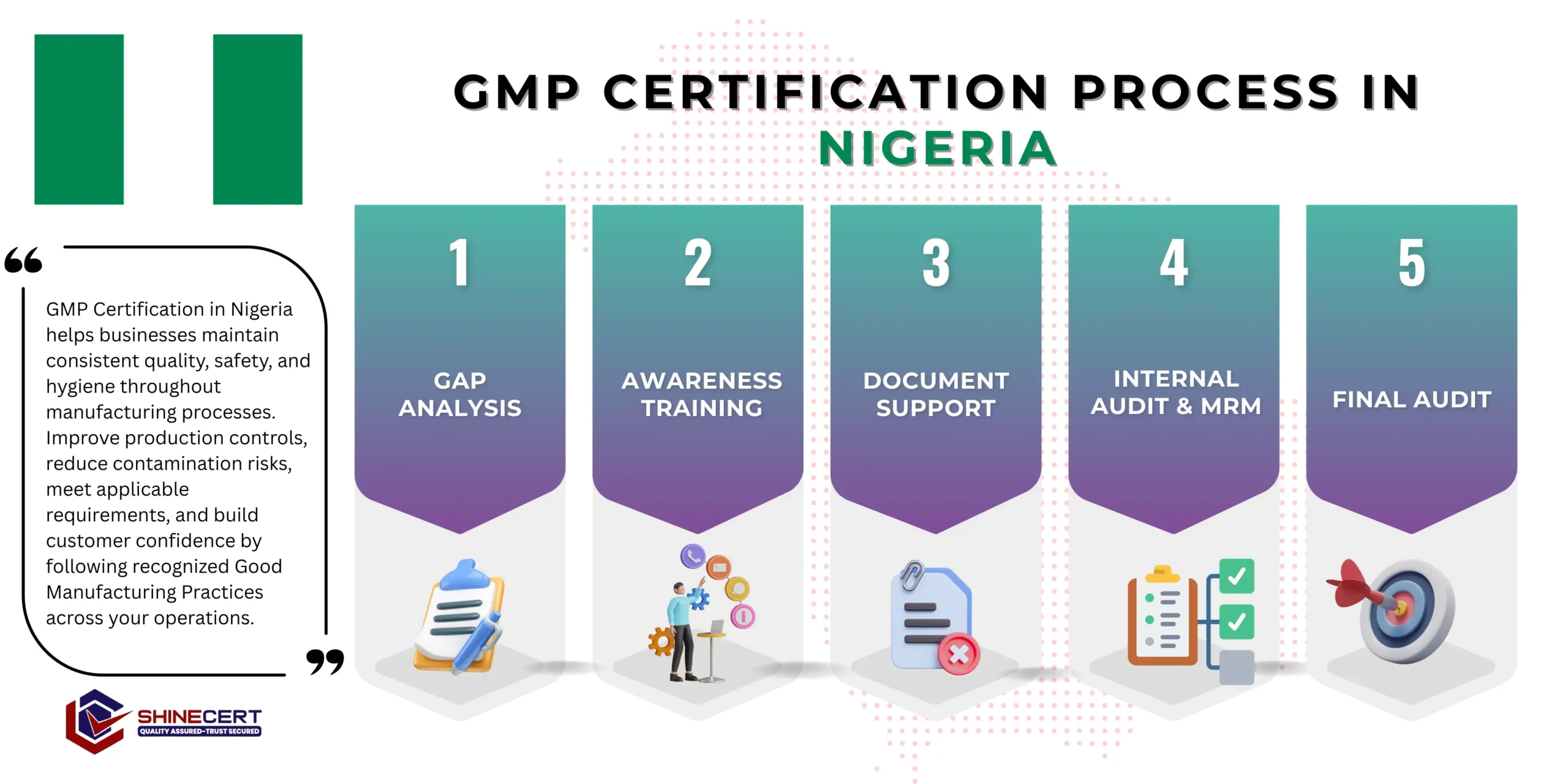
What are the steps to get GMP Certification in Nigeria?
our services
- ISO Certification Nigeria
- ISO 9001 Certification Nigeria
- ISO 14001 Certification Nigeria
- ISO 27001 Certification Nigeria
- ISO 22000 Certification Nigeria
- ISO 20000-1 Certification Nigeria
- ISO 45001 Certification Nigeria
- ISO 42001 Certification Nigeria
- ISO 13485 Certification Nigeria
- ISO 17025 Certification Nigeria
- ISO 31000 Certification Nigeria
- ISO 22301 Certification Nigeria
- ISO 27701 Certification Nigeria
- ISO 37001 Certification Nigeria
- ISO 50001 Certification Nigeria
- CE Mark Certification Nigeria
- GMP Certification Nigeria
- GDPR Certification Nigeria
- Halal Certification Nigeria
Our Five-Step Certification Process, in Depth
Gap Assessment
We walk your actual manufacturing facility, reviewing equipment, processes, and current documentation against both GMP requirements and NAFDAC’s specific expectations, including where your facility stands relative to the local manufacturing progress NAFDAC increasingly expects.
A gap report identifying your real manufacturing quality posture against GMP requirements and your NAFDAC compliance status side by side.
Documentation
We build your site master file, standard operating procedures, and batch record systems around your actual facility and products, a solid dosage form manufacturer’s documentation needs to look meaningfully different from a liquid formulation producer’s, and the documentation reflects that specifically.
A complete, version-controlled GMP documentation set, with batch records genuinely traceable from raw material through finished product.
Implementation
Standard operating procedures, equipment validation, and quality control testing move into genuine daily manufacturing practice, batch records actually get completed accurately for real production runs, not retrofitted before an audit.
A functioning GMP system with real manufacturing controls actively operating and documented.
Internal Audit and Management Review
We audit against GMP requirements and your NAFDAC-relevant obligations, surfacing gaps while stakes are low. Findings go to formal management review with documented decisions on quality priorities and resourcing.
An internal audit report, management review minutes, and corrective actions closed out before the certification audit.
Certification Audit
A facility inspection and documentation review verifies your manufacturing controls are actually operating as documented, including direct observation of production and quality control testing. We stay engaged through the process.
Your GMP certification, supporting your NAFDAC registration and broader manufacturing quality standing.
Gap Assessment
We walk your actual manufacturing facility, reviewing equipment, processes, and current documentation against both GMP requirements and NAFDAC’s specific expectations, including where your facility stands relative to the local manufacturing progress NAFDAC increasingly expects.
A gap report identifying your real manufacturing quality posture against GMP requirements and your NAFDAC compliance status side by side.
Documentation
We build your site master file, standard operating procedures, and batch record systems around your actual facility and products, a solid dosage form manufacturer’s documentation needs to look meaningfully different from a liquid formulation producer’s, and the documentation reflects that specifically.
A complete, version-controlled GMP documentation set, with batch records genuinely traceable from raw material through finished product.
Implementation
Standard operating procedures, equipment validation, and quality control testing move into genuine daily manufacturing practice, batch records actually get completed accurately for real production runs, not retrofitted before an audit.
A functioning GMP system with real manufacturing controls actively operating and documented.
Internal Audit and Management Review
We audit against GMP requirements and your NAFDAC-relevant obligations, surfacing gaps while stakes are low. Findings go to formal management review with documented decisions on quality priorities and resourcing.
An internal audit report, management review minutes, and corrective actions closed out before the certification audit.
Certification Audit
A facility inspection and documentation review verifies your manufacturing controls are actually operating as documented, including direct observation of production and quality control testing. We stay engaged through the process.
Your GMP certification, supporting your NAFDAC registration and broader manufacturing quality standing.
Certification Validity, Surveillance Audits, and Recertification
Good Manufacturing Practice (GMP) certification validity and renewal cycles are tied closely to NAFDAC’s own registration and inspection schedule, with facilities subject to periodic NAFDAC inspection to confirm continued compliance rather than operating on a fixed, independent certificate cycle in the way ISO management system standards do. Given NAFDAC’s Five Plus Five-Year Validity policy tying registration renewal to local manufacturing progress specifically, manufacturers should expect GMP compliance verification to be an increasingly integrated, ongoing part of maintaining registration standing, rather than a one-time certification event. ShineCert helps manufacturers build a GMP system genuinely designed for this ongoing scrutiny, not just a one-time audit pass.
Cost of GMP Certification in Nigeria, What Actually Drives It
| Organization Profile | Relative Investment Level | Why |
|---|---|---|
| Small, single-product-line operation | Lower | Narrower validation and documentation scope |
| Medium, multiple-product-line operation | Moderate | Broader validation across a wider product range |
| Larger, multi-dosage-form or export-focused operation | Higher | Extensive validation and WHO prequalification-track documentation depth |
| Bundled with ISO 9001 or ISO 13485 | Moderate-to-higher combined, lower than separate engagements | Shared quality management infrastructure reduces combined cost |
- Facility and equipment readiness : Facilities requiring significant equipment upgrades or infrastructure improvement to meet GMP standards face genuinely more extensive investment than those with modern, well-maintained facilities already in place.
- Number and complexity of product lines : Each additional dosage form or product line typically requires its own validation and documentation work, expanding the overall scope.
- Whether WHO prequalification is a target : Manufacturers pursuing the WHO prequalification pathway specifically face genuinely more extensive documentation and validation depth than those pursuing domestic GMP compliance alone.
- Existing quality system maturity : Businesses with some documented quality control practices already in place aren’t starting from zero, those relying entirely on informal practice face more foundational work.
- Regulatory and inspection fees, tracked separately from our consulting fees : NAFDAC inspection and any accreditation fees are handled and invoiced directly by the relevant regulatory body, separate from ShineCert’s implementation work.
- Whether you’re bundling standards : Building GMP compliance alongside ISO 9001 or ISO 13485 shares meaningful quality management infrastructure, reducing combined cost.
- Internal capacity to contribute : A quality assurance manager who can genuinely own documentation, validation logistics, and internal audit coordination reduces the consulting hours required.
Benefits of GMP Certification in Nigeria
GMP certification gives your organization genuine, demonstrable evidence supporting NAFDAC registration and renewal processes increasingly tied to local manufacturing quality and progress.
A mature GMP system positions Nigerian manufacturers to pursue WHO prequalification, opening access to international donor-funded procurement markets that require this specific credential.
GMP certification is understood and required by regulators and distributors globally, giving Nigerian manufacturers a credential recognized well beyond domestic NAFDAC compliance alone.
Systematic process validation and quality control catch manufacturing defects before products reach patients or consumers, rather than relying on complaints or adverse events to reveal problems.
As foreign pharmaceutical companies seek local manufacturing partners under NAFDAC’s policy timeline, GMP-certified Nigerian manufacturers hold a genuinely stronger negotiating position for these partnerships.
GMP certification is frequently a genuine prerequisite for exporting pharmaceutical products or supplying larger regional and international distributors.
A documented, systematic manufacturing quality system provides genuine evidence of proactive risk management if a product quality issue ever leads to a recall or regulatory review.
GMP certification requires genuinely identifying manufacturing risks specific to your actual facility and products, and building real, documented controls around each one, from raw material sourcing through finished product release.
GMP’s manufacturing quality controls share meaningful structural overlap with these broader quality management standards, making combined pursuit considerably more efficient for manufacturers with device or broader quality management ambitions.
Mandatory Documents for GMP Implementation
A documented description of your facility’s manufacturing activities, quality management arrangements, and premises, serving as the foundational reference document for GMP compliance.
A documented policy, approved by top management, expressing genuine commitment to manufacturing quality, along with a manual describing how your quality management system actually operates.
Documented, step-by-step procedures for every significant manufacturing and quality control activity, equipment operation, cleaning, material handling, testing, ensuring consistency regardless of which staff member performs the task.
Documentation showing exactly how each production batch was manufactured and packaged, providing genuine traceability from raw materials through to the finished, released product.
Documentation showing raw material suppliers are genuinely assessed and qualified before use, with material testing records confirming each batch meets specification before entering production.
Documentation showing manufacturing equipment and processes have been genuinely validated to consistently produce quality output, not simply assumed to work correctly.
Records showing finished products are genuinely tested against specification before release, with clear criteria for batch acceptance or rejection.
Documented procedures for handling manufacturing deviations, product complaints, and, if ever necessary, product recalls, with genuine investigation and corrective action built into each.
Evidence that staff involved in manufacturing and quality control have received relevant, role-specific GMP training, particularly critical given how much GMP compliance depends on consistent human execution of documented procedures.
A planned internal audit cycle and documented management review decisions on quality priorities and resourcing.
Challenges Organizations Face, Implementation, Risk Management, Audit, and Ongoing Certification
- Challenges during implementation : Manufacturers sometimes underestimate the genuine facility and equipment investment GMP compliance can require, particularly around environmental controls and equipment qualification that go well beyond general good housekeeping practices.
- Challenges in risk management : A common gap is validating manufacturing processes at initial setup without genuinely revisiting validation as equipment ages, processes change, or new products are introduced to existing production lines.
- Challenges during internal and certification audits : Inspectors specifically cross-check batch records against actual production schedules and raw material receipts, gaps or inconsistencies between documented manufacturing steps and genuine production activity are a common and significant finding.
- Challenges maintaining certification after the initial audit : Documentation discipline for batch records and deviation investigation tends to drift once the pressure of initial certification passes, particularly across shift changes where consistency depends on every supervisor maintaining the same rigorous standard.
Case Study
A Lagos-based pharmaceutical manufacturer producing solid dosage form generics approached us as they began exploring a local manufacturing partnership with a foreign pharmaceutical company navigating NAFDAC’s Five Plus Five-Year Validity requirements, recognizing that securing this kind of partnership would genuinely depend on demonstrating GMP compliance credible enough to satisfy an international partner’s own due diligence standards.
- Our gap assessment found the facility’s core production equipment was reasonably modern, but validation documentation was incomplete, batch records varied in detail depending on which production supervisor was on shift, and there was no formal deviation investigation process, meaning quality issues, when they occurred, weren’t being systematically traced back to root cause.
- We built a complete site master file, standardized batch record templates enforced consistently across shifts, and a formal deviation and corrective action process. Implementation ran across roughly five months, and the resulting GMP documentation became a direct, positive reference point in due diligence conversations with the prospective foreign partner, considerably strengthening the manufacturer’s negotiating position.
- This reflects a pattern we see often, genuinely capable production undermined by inconsistent documentation across shifts, rather than a single specific engagement.
Industries and Sectors We Certify in Nigeria and Which Standards Each Actually Needs
Pharmaceutical manufacturing
GMP is close to essential given direct NAFDAC regulatory requirements and the local manufacturing push specifically; pair with ISO 9001 for broader quality management.
Read moreNutraceutical and dietary supplement manufacturing
GMP addresses genuine manufacturing quality requirements for this growing category; pair with ISO 22000 if the product line overlaps with food safety considerations.
Read moreMedical device manufacturing
GMP principles overlap significantly with ISO 13485’s requirements; businesses in this sector typically pursue both together given NAFDAC’s registration expectations.
Read moreCosmetics manufacturing
GMP addresses manufacturing quality control relevant to this sector; pair with ISO 9001 for overall quality management.
Read moreContract manufacturing organizations
GMP is close to essential given NAFDAC’s specific guidelines for contract manufacturing of finished pharmaceutical products; pair with ISO 9001 for broader client quality assurance.
Read moreWhy Choose ShineCert for GMP Certification Nigeria?
ShineCert brings 10 years of ISO consulting and certification experience to Nigeria’s market, coordinated through our Riyadh and India offices with services delivered remotely or on-site depending on what your engagement genuinely needs. We’ve guided more than 10,000 organizations through certification worldwide, and we build every Nigeria GMP engagement around your actual facility, products, and Best GMP Consultant in Nigeria, NAFDAC compliance status, not a generic template lifted from a different regulatory environment.
Choosing a Certification Body in Nigeria?
What to Check | Why It Matters |
Genuine understanding of NAFDAC’s GMP guidelines and Five Plus Five-Year Validity policy specifically | Ensures your GMP system is built around your actual, current regulatory obligations |
Experience with your specific dosage form or product category | Solid dosage forms, liquids, and injectables involve genuinely different validation considerations |
Familiarity with WHO prequalification requirements, if relevant | Important if you’re pursuing this pathway specifically rather than domestic GMP compliance alone |
A genuine facility-and-batch-record-verification approach | Confirms the audit checks real production evidence, not just documentation review |
Ready to Get Started?
Whether you’re preparing for a local manufacturing partnership or strengthening NAFDAC compliance standing, we’ll walk through your specific facility and cost factors before proposing a fixed-scope plan, delivered remotely, on-site, or however genuinely fits your project. Book a free consultation or contact us directly to get started.
Frequently Asked Questions
Look for demonstrated experience with NAFDAC’s current GMP guidelines and Five Plus Five-Year Validity policy specifically, genuine familiarity with your dosage form or product category, and transparent scoping rather than flat package pricing. ShineCert scopes every Nigeria engagement individually.
GMP compliance is a core, increasingly central component of NAFDAC registration and renewal, particularly under the Five Plus Five-Year Validity policy, but registration itself remains a separate regulatory process with its own specific application requirements.
It genuinely depends on your facility readiness, product complexity, and whether WHO prequalification is a target, we scope every project individually.
Typically three to ten months depending on facility readiness and product complexity, see our detailed timeline breakdown above.
Yes, as NAFDAC’s Five Plus Five-Year Validity policy pushes foreign companies toward local manufacturing partnerships, GMP-certified Nigerian manufacturers hold a genuinely stronger position in these partnership discussions.
WHO prequalification is a more extensive, internationally benchmarked credential that opens access to donor-funded procurement markets, while domestic GMP compliance addresses NAFDAC’s core regulatory requirements, we help clients determine which pathway genuinely fits their goals.
Documentation work runs effectively over remote sessions, but facility inspection and equipment validation genuinely require in-person site visits, we scope the right mix per project.
ShineCert doesn’t maintain a standalone Nigeria office; we coordinate Nigeria engagements from our Riyadh and India offices, with services delivered remotely or on-site as your project requires.