
Halal Certification in Riyadh
Quick Answer
Halal certification verifies that food, cosmetics, pharmaceuticals, or other consumer products comply with Islamic dietary and production law. In Saudi Arabia, halal certification is overseen through the Saudi Halal Center, established under the Saudi Standards, Metrology and Quality Organization, and is mandatory for specific imported product categories, particularly meat and poultry.
What Is Halal Certification?
Halal certification confirms that a product or its production process complies with Islamic law, covering permitted ingredients, slaughter methods for meat and poultry, avoidance of prohibited substances, and prevention of cross-contamination with non-halal materials at every stage from sourcing through packaging. It applies most visibly to food and beverages but increasingly extends to cosmetics, pharmaceuticals, and personal care products as consumer and regulatory expectations around halal integrity have grown.
In Saudi Arabia, halal certification is coordinated through the Saudi Halal Center, a body established under the Saudi Standards, Metrology and Quality Organization specifically to standardize and oversee halal certification, replacing a previously fragmented system of individual certifying bodies. For businesses in Riyadh, this means halal certification today follows a defined national framework rather than varying by which certifier a company happens to use, and is mandatory for specific product categories, particularly imported meat, poultry, and related animal products.
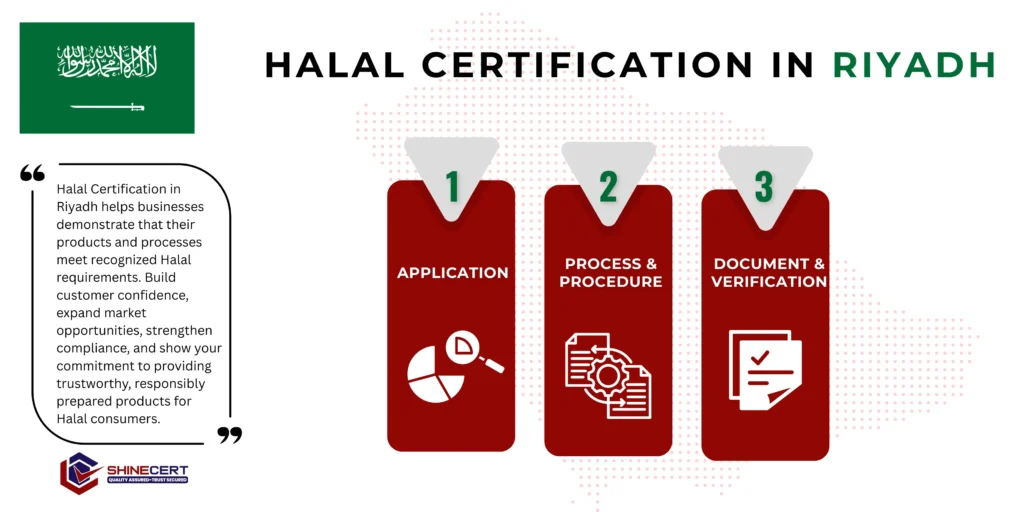
What are the steps to get Halal Certification in Riyadh?
our services
- ISO Certification Riyadh
- ISO 9001 Certification Riyadh
- ISO 14001 Certification Riyadh
- ISO 27001 Certification Riyadh
- ISO 22000 Certification Riyadh
- ISO 45001 Certification Riyadh
- ISO 42001 Certification Riyadh
- ISO 20000-1 Certification Riyadh
- ISO 13485 Certification Riyadh
- ISO 17025 Certification Riyadh
- CE Mark Certification Riyadh
- GMP Certification Riyadh
- GDPR Certification Riyadh
- Halal Certification Riyadh
Halal Certification Process in Riyadh
Product and Supply Chain Assessment
We review your product formulation, ingredient sourcing, and supply chain to identify any non-compliant ingredients, cross-contamination risks, or gaps against Saudi Halal Center requirements.
A documented assessment of formulation, sourcing, and supply chain compliance gaps.
Halal Management System Documentation
We help build the halal policy, ingredient traceability records, and production control procedures required to demonstrate halal integrity is managed systematically, not just claimed on packaging.
A complete halal policy, traceability records, and production control procedures.
Implementation and Staff Training
Halal handling procedures are rolled out across production, storage, and logistics staff, with training on preventing cross-contamination and maintaining segregation from non-halal materials.
Trained staff able to prevent cross-contamination and maintain halal segregation.
Internal Verification
We conduct an internal review of ingredient documentation, supplier halal certificates, and production records to confirm readiness before the certification body's assessment.
Documented internal verification confirming readiness for external audit.
Certification Audit
An approved halal certification body conducts an audit of your facility, documentation, and supply chain traceability, before issuing halal certification recognized under the Saudi Halal Center framework, subject to periodic renewal and surveillance.
Your halal certification recognized under the Saudi Halal Center framework.
Product and Supply Chain Assessment
We review your product formulation, ingredient sourcing, and supply chain to identify any non-compliant ingredients, cross-contamination risks, or gaps against Saudi Halal Center requirements.
A documented assessment of formulation, sourcing, and supply chain compliance gaps.
Halal Management System Documentation
We help build the halal policy, ingredient traceability records, and production control procedures required to demonstrate halal integrity is managed systematically, not just claimed on packaging.
A complete halal policy, traceability records, and production control procedures.
Implementation and Staff Training
Halal handling procedures are rolled out across production, storage, and logistics staff, with training on preventing cross-contamination and maintaining segregation from non-halal materials.
Trained staff able to prevent cross-contamination and maintain halal segregation.
Internal Verification
We conduct an internal review of ingredient documentation, supplier halal certificates, and production records to confirm readiness before the certification body's assessment.
Documented internal verification confirming readiness for external audit.
Certification Audit
An approved halal certification body conducts an audit of your facility, documentation, and supply chain traceability, before issuing halal certification recognized under the Saudi Halal Center framework, subject to periodic renewal and surveillance.
Your halal certification recognized under the Saudi Halal Center framework.
Why Riyadh Businesses Need Halal Certification?
Saudi Arabia’s centralization of halal certification under the Saudi Halal Center has raised the compliance bar, while Riyadh’s growing food service, hospitality, and export sectors increase the commercial stakes of getting halal status right.
- SASO’s Saudi Halal Center framework is mandatory for regulated product categories. Businesses importing or distributing meat, poultry, and certain other animal-derived products into Saudi Arabia must hold valid halal certification recognized under the Saudi Halal Center framework, and non-compliant shipments face rejection at customs.
- Riyadh’s hospitality and food service growth increases consumer scrutiny : As Riyadh’s hospitality sector expands rapidly around giga-project developments such as Diriyah Gate and King Salman Park, hotels, restaurants, and catering companies face growing consumer and corporate client expectations around verified halal integrity, not just self-declared compliance.
- RHQ multinational food and consumer goods companies need a compliant path to market : Regional headquarters companies in the food, beverage, and consumer goods sectors relocating to Riyadh under the RHQ Program need their products to meet Saudi halal certification requirements to sell into the local and wider GCC market.
- Export businesses benefit from GCC-wide halal recognition : Saudi Halal Center certification is increasingly recognized across GCC markets, giving Riyadh-based food and consumer goods companies a pathway to regional export beyond the domestic Saudi market alone.
Halal Certification Cost in Riyadh
- Product category and complexity : A single packaged food product with simple, well-documented ingredients costs less to certify than a multi-ingredient product requiring verification of numerous supplier halal certificates.
- Number of products and production lines in scope : Each additional product line or SKU requiring its own ingredient traceability and production control documentation adds to the overall certification cost.
- Facility size and production complexity : Larger manufacturing facilities with multiple production lines require more extensive segregation controls and staff training than a smaller, single-line operation.
- Existing supply chain documentation : Businesses that already maintain strong ingredient traceability and supplier documentation need less foundational work than those building this documentation from scratch.
- Import versus domestic production : Imported products, particularly meat and poultry, often carry additional certification and customs documentation requirements compared to domestically manufactured goods.
- Choice of certification body : Approved certification bodies vary in fee structure, and international bodies with broader GCC recognition may charge differently than Saudi-focused certifiers.
- Level of consulting support required : A fully guided, end-to-end engagement costs more than a lighter advisory arrangement for businesses with strong internal quality and supply chain documentation capability.
Mandatory Documents Required
- Halal Policy and Management Commitment : The organization must demonstrate leadership commitment to maintaining halal integrity throughout operations. Document needed: a signed Halal Policy Statement.
- Ingredient and Supplier Documentation : Every ingredient used in a certified product must be traceable to a verified halal-compliant source. Document needed: Supplier Halal Certificates and an Ingredient Traceability Register for every raw material.
- Slaughter and Processing Compliance (for meat and poultry) : Animal products must be slaughtered and processed according to Islamic law by qualified personnel. Document needed: Slaughterhouse Halal Certification and processing facility compliance records.
- Segregation and Cross-Contamination Controls : Halal products must be physically and procedurally separated from non-halal materials throughout production, storage, and transport. Document needed: a Segregation and Cross-Contamination Control Procedure.
- Production Control Records : Organizations must be able to demonstrate that production processes consistently follow halal requirements batch after batch. Document needed: Batch Production Records showing halal compliance checks at each stage.
- Staff Training Records : Personnel involved in handling halal products must understand halal requirements and contamination risks. Document needed: Halal Awareness Training Records for relevant staff.
- Internal Verification Records : Organizations must periodically verify their own compliance before external certification body assessment. Document needed: Internal Verification Reports documenting self-checks against Saudi Halal Center requirements.
Industries in Riyadh That Need Halal Certification
Food and beverage manufacturers
Companies producing packaged food, beverages, and processed products for the Saudi market need halal certification to meet both regulatory requirements and consumer purchasing expectations.
Read moreMeat and poultry importers and distributors
This is the most tightly regulated category, halal certification is mandatory for imported meat and poultry products entering Saudi Arabia, with non-compliant shipments facing customs rejection.
Read moreHotels, restaurants, and catering companies
As Riyadh's hospitality sector grows around giga-project developments, food service operators increasingly seek halal certification to reassure both local and international guests of verified compliance.
Read moreCosmetics and personal care manufacturers
Halal certification is expanding into cosmetics and personal care products as Saudi and GCC consumers increasingly seek halal-verified alternatives to conventional formulations.
Read morePharmaceutical and nutraceutical companies
Companies producing supplements, vitamins, and certain pharmaceutical products pursue halal certification to meet both regulatory expectations and growing consumer demand in this category.
Read moreFood export and trading companies
Riyadh-based trading companies exporting food products across the GCC benefit from Saudi Halal Center certification's growing regional recognition, simplifying market entry into neighboring countries.
Read moreWhy Choose ShineCert?
ShineCert has spent 10 years helping food, hospitality, and consumer goods businesses build compliance frameworks that satisfy both regulators and increasingly discerning consumers. We’ve supported more than 10,000 organizations globally, and our own office based right here in Riyadh means we understand exactly how the Saudi Halal Center framework applies to businesses operating in this market.
Choosing a Certification Body in Riyadh
| Approach | What You Get | Typical Fit |
|---|---|---|
| DIY (Self-Managed) | Your team interprets the requirements, builds documentation, and prepares for audit independently. | Best for organizations with in-house food safety or quality expertise and time to spare. Higher risk of ingredient traceability gaps going unnoticed until audit. |
| Consultant-Led | An external consultant guides gap assessment, documentation, and implementation, while your team owns execution. | The most common choice — balances cost against speed and reduces the risk of a failed or delayed audit. |
| ShineCert End-to-End | We manage gap assessment, documentation, implementation, staff training, and coordination with the certification body from start to finish. | Best for businesses that want a single accountable partner and the fastest, lowest-risk path to certification. |
Case Study
- A packaged food manufacturer in Riyadh supplying several hotel chains found that a growing number of hospitality clients were requiring verified halal certification rather than accepting self-declared compliance, following industry-wide scrutiny of halal claims. Working with ShineCert, the company mapped its full ingredient supply chain, replaced two suppliers who could not provide valid halal certificates, and implemented segregated storage and production controls across its facility.
- The company achieved halal certification recognized under the Saudi Halal Center framework and retained its hospitality clients through their next contract renewal cycle, while also opening export opportunities into neighboring GCC markets.
Ready to Get Certified?
Contact ShineCert today for a free consultation on Halal certification in Riyadh. Our Riyadh-based team will assess your product and supply chain readiness and scope a clear path to certification.
Frequently Asked Questions
Yes, for specific regulated categories. Halal certification is mandatory for imported meat, poultry, and certain other animal-derived products entering Saudi Arabia under the Saudi Halal Center framework. For many other food and consumer product categories, it is not strictly mandatory but is increasingly expected by retailers, hospitality clients, and consumers.
Look for a consultant with genuine local Riyadh presence, direct experience with Saudi Halal Center requirements, and a track record supporting food, hospitality, or consumer goods businesses through certification. ShineCert’s Riyadh-based team has guided organizations across these sectors through the full process.
Cost depends on your product category, number of products in scope, facility complexity, and whether products are imported or domestically produced. Contact ShineCert for a scoped quotation.
Timelines vary based on product complexity and existing supply chain documentation, but most Riyadh businesses complete the process within a committed, structured engagement.
The Saudi Halal Center was established under the Saudi Standards, Metrology and Quality Organization to standardize halal certification nationally, replacing a previously fragmented landscape of separate certifying bodies. It provides a single recognized framework that applies consistently across Saudi Arabia.
Yes. Halal certification is subject to periodic renewal and surveillance to confirm continued compliance, similar to other management-system-based certifications, rather than being a one-time approval.