
ISO 20000-1 Certification in Riyadh
Quick Answer
ISO 20000-1 is the international standard for IT Service Management Systems (SMS). It sets requirements for planning, designing, delivering, and continually improving IT services, covering incident management, service level management, capacity planning, and change control to ensure consistent, reliable service delivery.
What Is ISO 20000-1?
ISO 20000-1 is the internationally recognized standard for IT Service Management Systems. It gives organizations a structured framework for delivering IT services in a consistent, measurable, and continually improving way, covering the full service lifecycle from planning and design through delivery, incident resolution, and change management. Unlike a set of best-practice guidelines, ISO 20000-1 is a certifiable management system standard, meaning an accredited third party can independently verify that an organization’s IT service delivery genuinely meets the standard’s requirements.
For a Riyadh business, ISO 20000-1 certification means demonstrating that IT services, whether delivered internally or to external clients, are managed with defined service levels, documented processes, and a track record of continual improvement, not run informally on institutional knowledge. It has become a common requirement for IT outsourcing, managed service, and technology consulting contracts across Riyadh’s fast-growing technology sector.
What are the steps to get ISO 20000-1 Certification in Riyadh?
our services
- ISO Certification Riyadh
- ISO 9001 Certification Riyadh
- ISO 14001 Certification Riyadh
- ISO 27001 Certification Riyadh
- ISO 22000 Certification Riyadh
- ISO 45001 Certification Riyadh
- ISO 42001 Certification Riyadh
- ISO 20000-1 Certification Riyadh
- ISO 13485 Certification Riyadh
- ISO 17025 Certification Riyadh
- CE Mark Certification Riyadh
- GMP Certification Riyadh
- GDPR Certification Riyadh
- Halal Certification Riyadh
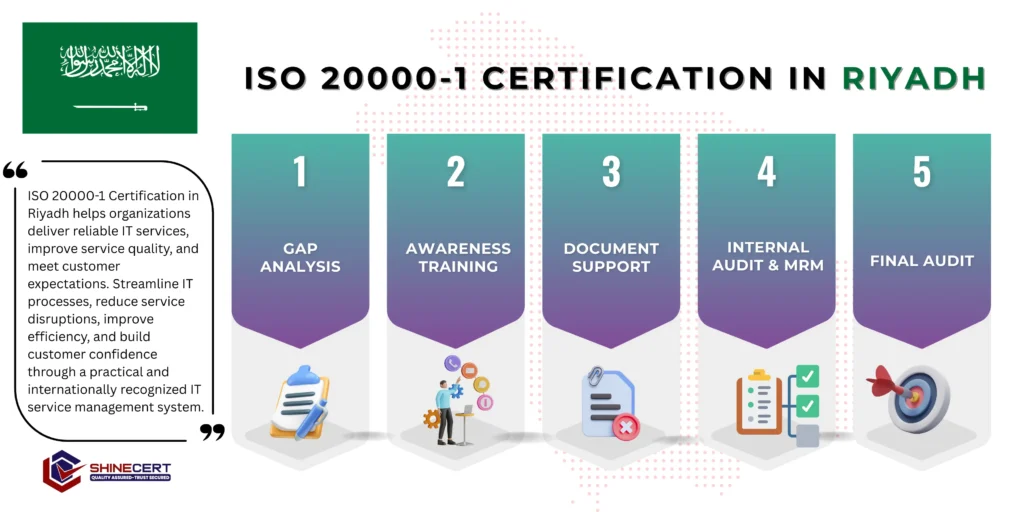
ISO 20000-1 Certification Process in Riyadh
Service Management Gap Assessment
We review your current IT service delivery processes, incident management, change control, capacity planning, and service level management, against ISO 20000-1 requirements to identify gaps.
A documented gap assessment against ISO 20000-1 requirements.
Service Management System Design
We help build the policies, service catalog, service level agreements, and process documentation ISO 20000-1 requires, structured around how your organization actually delivers services.
A complete service management policy, service catalog, and process documentation.
Implementation and Team Training
The service management processes are rolled out across relevant IT teams, with training on incident logging, change approval workflows, and service level reporting.
Trained IT teams able to log incidents, manage changes, and report service levels.
Internal Audit and Management Review
We test whether the service management system is genuinely operating, reviewing incident records, service level performance data, and change logs, and conduct a formal management review before external assessment.
Documented review of incident, change, and service level performance.
Certification Audit
An accredited certification body conducts a two-stage audit assessing your documented service management system and its practical operation, before issuing your ISO 20000-1 certificate, valid for three years with annual surveillance audits.
Your ISO 20000-1 certificate, valid for three years with annual surveillance audits.
Service Management Gap Assessment
We review your current IT service delivery processes, incident management, change control, capacity planning, and service level management, against ISO 20000-1 requirements to identify gaps.
A documented gap assessment against ISO 20000-1 requirements.
Service Management System Design
We help build the policies, service catalog, service level agreements, and process documentation ISO 20000-1 requires, structured around how your organization actually delivers services.
A complete service management policy, service catalog, and process documentation.
Implementation and Team Training
The service management processes are rolled out across relevant IT teams, with training on incident logging, change approval workflows, and service level reporting.
Trained IT teams able to log incidents, manage changes, and report service levels.
Internal Audit and Management Review
We test whether the service management system is genuinely operating, reviewing incident records, service level performance data, and change logs, and conduct a formal management review before external assessment.
Documented review of incident, change, and service level performance.
Certification Audit
An accredited certification body conducts a two-stage audit assessing your documented service management system and its practical operation, before issuing your ISO 20000-1 certificate, valid for three years with annual surveillance audits.
Your ISO 20000-1 certificate, valid for three years with annual surveillance audits.
Why Riyadh Businesses Need ISO 20000-1?
Riyadh’s emergence as a regional technology and AI hub, combined with growing government digital service delivery, has raised expectations for formally managed, auditable IT service delivery.
- SDAIA’s national digital transformation agenda raises the bar for IT service quality : As Saudi Arabia’s Data and AI Authority drives national digital government and AI initiatives from its Riyadh headquarters, IT service providers supporting government and quasi-government clients face growing expectations around service reliability, incident response, and change control discipline.
- RHQ multinationals expect certified IT service delivery from local providers : Many of the 700-plus regional headquarters companies now operating in Riyadh under the RHQ Program rely on managed IT service providers, and increasingly require those providers to hold ISO 20000-1 certification as a baseline vendor qualification requirement.
- Government IT tenders through Etimad increasingly specify service management certification : Public-sector IT procurement in Riyadh is placing growing weight on demonstrated service management maturity, and ISO 20000-1 gives bidders a concrete, internationally recognized qualification to meet these requirements.
- Data center and cloud service growth demands formal service management discipline : As Riyadh’s data center and cloud infrastructure sector expands to support the city’s AI and digital economy ambitions, providers managing critical infrastructure services face rising client expectations around uptime, incident response, and capacity planning discipline.
ISO 20000-1 Certification Cost in Riyadh
- Scope and complexity of IT services delivered : A provider managing a narrow set of well-defined services costs less to certify than one delivering a broad portfolio across infrastructure, applications, and end-user support.
- Existing service management maturity : Organizations already using structured incident and change management tools and processes need less foundational work than those managing IT services informally.
- Number of clients and service level agreements in scope : Providers with numerous distinct client SLAs require more extensive service level management documentation and reporting infrastructure, increasing implementation cost.
- Number of employees and IT team structure : Larger IT teams spread across multiple functions require broader process rollout and training, adding to overall project cost.
- Integration with existing management systems : Businesses that already hold ISO 27001 certification can often streamline ISO 20000-1 implementation by reusing existing risk management and document control processes.
- Choice of certification body : International accredited bodies with strong global brand recognition typically charge higher audit fees than regionally established bodies offering equivalent accredited scope.
- Level of consulting support required : A fully guided, end-to-end engagement costs more than a lighter advisory arrangement for organizations with strong internal IT service management capability.
Mandatory Documents Required (By Clause)
- Clause 4 — Context of the Organization : The organization must define the scope of its service management system and the services it covers. Document needed: an SMS Scope Statement and Service Catalog.
- Clause 5 — Leadership : Top management must establish a service management policy and assign clear roles. Document needed: a signed Service Management Policy.
- Clause 6 — Planning : Organizations must plan the service management system and manage risks to service delivery. Document needed: a Service Management Plan and Risk Register for service delivery risks.
- Clause 7 — Support of the SMS : The standard requires competent staff, documented information, and knowledge management. Document needed: Training Records and a Knowledge Management Procedure.
- Clause 8 — Operation of the SMS : This is the operational core: service delivery, relationship and supplier management, resolution and fulfilment, and service assurance. Document needed: Service Level Agreements, an Incident and Service Request Management Procedure, and a Change Management Procedure.
- Clause 9 — Performance Evaluation : Organizations must monitor, measure, and internally audit service performance. Document needed: Service Level Performance Reports and Internal Audit Reports.
- Clause 10 — Improvement : Nonconformities and service failures must be investigated and used to drive continual service improvement. Document needed: a Continual Service Improvement Log tracking issues and resolutions.
Industries in Riyadh That Need ISO 20000-1
Managed IT service providers and outsourcers
Companies delivering outsourced IT support and infrastructure management to corporate and government clients in Riyadh face direct client demand for ISO 20000-1 as a vendor qualification requirement.
Read moreData centers and cloud infrastructure providers
As Riyadh's role as a regional technology hub grows, providers managing critical hosting and cloud infrastructure need formally managed service delivery to win and retain enterprise contracts.
Read moreGovernment IT contractors
Firms delivering IT services to government and quasi-government entities through Etimad-managed tenders increasingly need ISO 20000-1 to meet procurement qualification criteria.
Read moreBanking and financial services technology providers
Financial institutions and their technology vendors in Riyadh require rigorous service management discipline given the operational and regulatory stakes of IT service failures in the sector.
Read moreTelecommunications companies
Telecom providers supporting Riyadh's critical digital infrastructure need certified service management to demonstrate reliability across their network and customer service operations.
Read moreRHQ multinational technology teams
Regional headquarters entities running their own internal IT service functions in Riyadh often need to align local service delivery with a parent company's existing ISO 20000-1 certified global operations.
Read moreHealthcare IT and health-tech providers
As Riyadh's hospital network digitizes clinical systems, IT service providers supporting healthcare technology need certified, reliable service management given the patient-safety implications of IT downtime.
Read moreWhy Choose ShineCert?
ShineCert has spent 10 years helping organizations build service management systems that improve real service delivery, not just satisfy an auditor’s checklist. We’ve supported more than 10,000 organizations globally, and our own office based right here in Riyadh means we understand exactly what RHQ clients, government tenders, and enterprise buyers in this city expect from a certified IT service provider.
Choosing a Certification Body in Riyadh
| Approach | What You Get | Typical Fit |
|---|---|---|
| DIY (Self-Managed) | Your team interprets the standard, builds documentation, and prepares for audit independently. | Best for organizations with in-house IT service management expertise and time to spare. Higher risk of process gaps going unnoticed until audit. |
| Consultant-Led | An external consultant guides gap assessment, documentation, and implementation, while your team owns execution. | The most common choice — balances cost against speed and reduces the risk of a failed or delayed audit. |
| ShineCert End-to-End | We manage gap assessment, documentation, implementation, staff training, and coordination with the certification body from start to finish. | Best for businesses that want a single accountable partner and the fastest, lowest-risk path to certification. |
Case Study
- A managed IT service provider supporting several RHQ-status multinational clients in Riyadh found that a growing share of new client tenders explicitly required ISO 20000-1 certification as a qualification criterion, despite the company’s IT service delivery being genuinely strong in practice. Working with ShineCert, the company formalized its existing incident and change management practices into documented processes, built a structured service catalog with clear SLAs, and implemented service performance reporting for each client.
- The company achieved ISO 20000-1 certification within a single implementation cycle and used it to qualify for two large enterprise IT outsourcing tenders it would otherwise have been excluded from.
Ready to Get Certified?
Contact ShineCert today for a free consultation on ISO 20000-1 certification in Riyadh. Our Riyadh-based team will assess your IT service management readiness and scope a clear path to certification.
Frequently Asked Questions
ISO 20000-1 certification is not a blanket legal requirement, but it is increasingly required by government IT tenders through Etimad, RHQ multinational clients, and enterprise buyers as a vendor qualification standard for managed IT and technology service providers.
Look for a consultant with genuine local Riyadh presence, direct experience with IT service management processes, and a track record supporting technology and managed service providers through certification. ShineCert’s Riyadh-based team has guided organizations across IT outsourcing, data centers, and telecommunications through the full process.
Cost depends on the scope and complexity of the IT services you deliver, existing service management maturity, and number of client SLAs in scope. Contact ShineCert for a scoped quotation.
Timelines vary based on service portfolio complexity and existing process maturity, but most Riyadh businesses complete the process within a committed, structured engagement.
ITIL is a best-practice framework for IT service management with no formal certification of the organization itself, only of individuals who complete ITIL training. ISO 20000-1 is a certifiable management system standard that independently verifies an organization’s actual service delivery against defined requirements, many organizations use ITIL practices to help meet ISO 20000-1 requirements.
Yes. Many Riyadh technology providers implement ISO 20000-1 alongside ISO 27001, since service management and information security processes overlap significantly, particularly around change management, incident handling, and risk assessment.