
ISO 22000 Certification in Riyadh
Quick Answer
ISO 22000 is the international standard for food safety management systems, published by the International Organization for Standardization. It builds on HACCP hazard-analysis principles within a full management-system framework covering leadership, resources, and continual improvement. Certification is issued by an accredited certification body after an independent audit.
What Is ISO 22000?
ISO 22000 integrates HACCP’s hazard-analysis approach with a broader management-system framework, requiring prerequisite programmes such as hygiene, pest control, and cleaning schedules alongside formal hazard identification and control at every production step. It’s designed to apply across the entire food supply chain, from primary producers and manufacturers through to caterers, retailers, and packaging suppliers, not just kitchens or factories.
Certification is issued by an independent, accredited certification body, never by ISO itself. In Saudi Arabia, legitimate certification bodies must hold accreditation from SASO’s Saudi Accreditation Committee (SAC), and food businesses should confirm this accreditation specifically covers ISO 22000 rather than assuming a general quality accreditation is sufficient.
What are the steps to get ISO 22000 Certification in Riyadh?
our services
- ISO Certification Riyadh
- ISO 9001 Certification Riyadh
- ISO 14001 Certification Riyadh
- ISO 27001 Certification Riyadh
- ISO 22000 Certification Riyadh
- ISO 45001 Certification Riyadh
- ISO 42001 Certification Riyadh
- ISO 20000-1 Certification Riyadh
- ISO 13485 Certification Riyadh
- ISO 17025 Certification Riyadh
- CE Mark Certification Riyadh
- GMP Certification Riyadh
- GDPR Certification Riyadh
- Halal Certification Riyadh
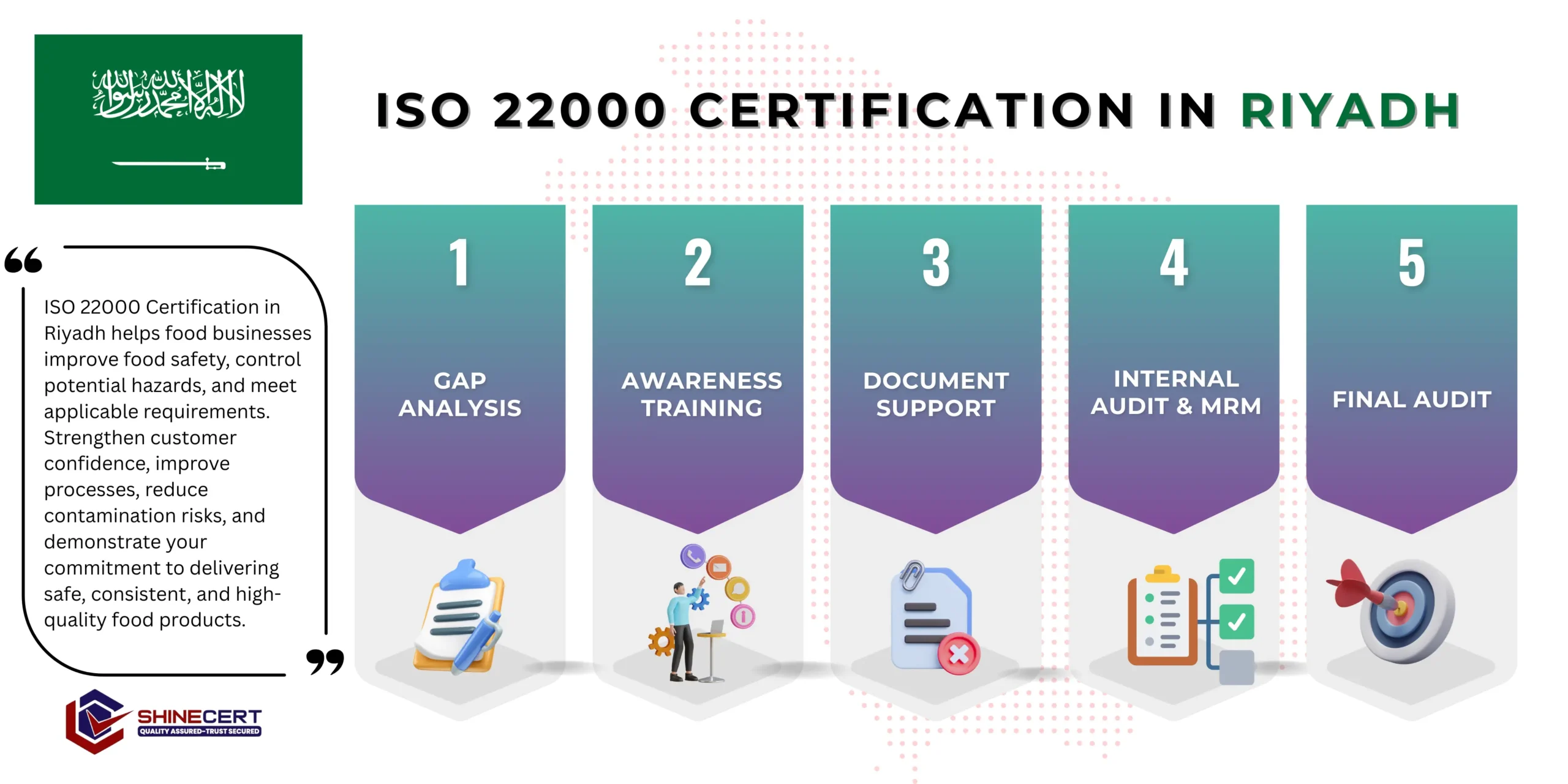
ISO 22000 Certification Process in Riyadh
Gap Assessment
We review your existing SFDA compliance and hygiene practices against every ISO 22000 clause and produce a specific, written list of what's missing, covering both prerequisite programmes and hazard-analysis documentation.
A documented gap assessment covering your prerequisite programmes and hazard-analysis documentation.
Documentation Development
We build the food safety policy, prerequisite programmes, and hazard-analysis documentation your gap assessment identified as missing, matched to your actual menu, production process, or supply chain.
A complete food safety policy, prerequisite programmes, and hazard-analysis documentation matched to your operations.
Implementation & Training
Production and kitchen staff are trained on the formalized system, with attention to the cross-functional food-safety-team structure the standard requires, ensuring responsibility for food safety doesn't sit with one person alone.
Trained staff and a cross-functional food-safety team operating the formalized system.
Internal Audit & Management Review
We conduct a structured internal audit, followed by a formal management review responding to the findings and closing gaps before the certification audit.
A documented internal audit report and management review minutes showing findings were addressed.
Certification Audit
Your SASO-accredited certification body conducts a two-stage external audit, resulting in your ISO 22000 certificate, valid for three years with annual surveillance visits.
Your ISO 22000 certificate, valid for three years with annual surveillance visits.
Gap Assessment
We review your existing SFDA compliance and hygiene practices against every ISO 22000 clause and produce a specific, written list of what's missing, covering both prerequisite programmes and hazard-analysis documentation.
A documented gap assessment covering your prerequisite programmes and hazard-analysis documentation.
Documentation Development
We build the food safety policy, prerequisite programmes, and hazard-analysis documentation your gap assessment identified as missing, matched to your actual menu, production process, or supply chain.
A complete food safety policy, prerequisite programmes, and hazard-analysis documentation matched to your operations.
Implementation & Training
Production and kitchen staff are trained on the formalized system, with attention to the cross-functional food-safety-team structure the standard requires, ensuring responsibility for food safety doesn't sit with one person alone.
Trained staff and a cross-functional food-safety team operating the formalized system.
Internal Audit & Management Review
We conduct a structured internal audit, followed by a formal management review responding to the findings and closing gaps before the certification audit.
A documented internal audit report and management review minutes showing findings were addressed.
Certification Audit
Your SASO-accredited certification body conducts a two-stage external audit, resulting in your ISO 22000 certificate, valid for three years with annual surveillance visits.
Your ISO 22000 certificate, valid for three years with annual surveillance visits.
Why Riyadh Businesses Need ISO 22000?
ISO 22000 matters in Riyadh because the capital’s exploding hospitality, catering, and food-retail sector, driven directly by giga-project tourism and population growth, has raised buyer expectations around certified food safety well beyond baseline SFDA compliance.
- SFDA sets the legal floor : The Saudi Food and Drug Authority (SFDA) enforces mandatory food-safety compliance for every food business in Riyadh. ISO 22000 builds on that legal floor with a structured, internationally recognized management system that goes further than baseline compliance, giving buyers independent, audited assurance rather than relying solely on the business’s own claims of compliance.
- Giga-project hospitality growth : Riyadh’s hospitality sector is scaling rapidly alongside giga-projects like Diriyah Gate and King Salman Park, and international hotel operators and large catering contractors increasingly require ISO 22000 from their food suppliers as a condition of doing business, since global hospitality brands typically hold their entire supply chain to a consistent international standard regardless of location.
- RHQ and enterprise catering : As multinational companies establish Regional Headquarters in Riyadh, their corporate catering and food-service vendors face import-standard expectations that ISO 22000 helps satisfy, particularly where the parent company’s own facilities elsewhere already operate under the same certification.
- Genuine accreditation matters : Always verify current SAC accreditation before choosing a certification body, since hospitality and RHQ clients increasingly perform their own due diligence on a vendor’s certifier, not just the certificate itself.
ISO 22000 Certification Cost in Riyadh
- Nature of the business : A single-process food producer costs less to certify than a multi-line processor or large hotel kitchen with diverse menus and suppliers, since hazard analysis scales with the number of distinct products and processes involved.
- Number of employees : Audit duration scales with headcount, directly affecting the certification body’s fee, particularly in large hotel or catering operations with rotating shift staff.
- Number of departments and sites : Multi-outlet restaurant groups or multi-site caterers mean broader hazard analysis and a larger internal audit programme, since each site’s specific menu and process needs its own assessment.
- Existing documentation maturity : Businesses with functioning SFDA-compliant hygiene practices spend less on documentation development than those starting from informal practices, since much of the prerequisite programme work can be formalized rather than built from nothing.
- DIY vs. consultant vs. end-to-end support : In-house implementation costs staff time and carries higher first-audit failure risk, while a guided engagement typically compresses the timeline and reduces the risk of nonconformities.
- Certification body chosen : Fees vary by certification body size and auditor day rates, all valid provided SAC accreditation is current, making it worth comparing quotes on both price and scope.
- Bundling with ISO 9001 : An integrated audit for hospitality groups pursuing both quality and food-safety certification shares overhead rather than duplicating audit visits and management review cycles.
Mandatory Documents Required (By Clause)
- Clause 4 — Context of the Organization : Requires identifying food-safety-relevant issues and defining scope. Document needed: a written Scope Statement.
- Clause 5 — Leadership : Requires top-management commitment to food safety. Document needed: a signed Food Safety Policy.
- Clause 6 — Planning : Requires food-safety objectives and planning. Document needed: documented Food Safety Objectives.
- Clause 7 — Support : Covers competence and infrastructure. Document needed: training records and prerequisite-programme documentation.
- Clause 8 — Operation : The hazard-analysis core. Document needed: Hazard Analysis Records and Critical Control Point monitoring records.
- Clause 9 — Performance Evaluation : Requires monitoring and internal audit. Document needed: verification records, internal audit reports, and management review minutes.
- Clause 10 — Improvement : Requires handling nonconformities. Document needed: Nonconformity and Corrective Action records.
Industries in Riyadh That Need ISO 22000
Hospitality & Hotels
International hotel operators expanding into Riyadh's giga-project-driven tourism sector require certified food safety from every kitchen and catering partner across their properties.
Read moreCatering & Food Service
Corporate and event catering companies serving Riyadh's growing RHQ and enterprise base need certification to win larger contracts, particularly where clients issue formal vendor qualification questionnaires.
Read moreFood Manufacturing & Processing
Packaged-food producers supplying Riyadh's retail sector need ISO 22000 to satisfy both SFDA baseline requirements and retailer expectations around traceability and hazard control.
Read moreRestaurants & Food Retail
Larger restaurant groups and food-retail chains use certification to differentiate on food-safety credibility in a competitive market where consumer trust increasingly hinges on visible, verifiable standards.
Read moreCold-Chain Logistics
Companies handling temperature-sensitive food distribution across Riyadh's expanding retail and hospitality footprint need documented food-safety management extending beyond production into storage and transport.
Read moreEvent Management
Large-scale event caterers serving Riyadh's growing entertainment and giga-project-linked events sector increasingly need certified food-safety credentials to bid on high-visibility contracts.
Read moreCase Study
- A catering company supplying corporate offices across Riyadh’s growing RHQ business district approached ShineCert after losing a major contract bid specifically because they lacked certified food safety management. Their kitchen practices were solid, but hazard analysis was informal and traceability records were scattered across different menu lines, making it difficult to answer the client’s vendor questionnaire with confidence.
- Over eight weeks, hazard analysis was formally documented across every menu category, and a proper batch-traceability system was implemented covering ingredients through to final delivery. Certification was achieved with zero major nonconformities, and the company won the next contract cycle with the same client, citing the certification directly in its renewed proposal.
Choosing a Certification Body in Riyadh
Verify current SAC accreditation for your specific standard and industry scope before signing with any certification body, this is non-negotiable, since accreditation can be scope-limited.
| Approach | What It Involves | Best For |
|---|---|---|
| DIY | Your quality/food-safety team manages documentation alone | Companies with existing HACCP expertise |
| Hiring a Consultant | External expert guides documentation and audit prep | Companies wanting guidance while choosing their own certifier |
| ShineCert End-to-End | We manage gap assessment through audit-readiness | Companies wanting one point of accountability |
Why Choose ShineCert?
ShineCert at a glance: 10 years of ISO consulting experience, 10,000+ organizations certified globally, with our own office based right here in Riyadh, local, on-the-ground support that understands the specific pace of the city’s hospitality growth.
We build your food safety management system directly on top of your existing SFDA-compliant hygiene work, avoiding duplicate documentation while genuinely strengthening your hazard-analysis system, so the certificate reflects real operational discipline rather than paperwork alone.
Frequently Asked Questions
No, it’s voluntary. SFDA compliance is the legal requirement; ISO 22000 becomes necessary when specific hospitality or corporate clients require it.
Look for genuine local presence, a verified track record, and no conflict of interest with the certification body.
It depends on your business size, number of sites, and existing documentation maturity, see the cost breakdown above.
No. SFDA compliance remains a separate legal obligation; ISO 22000 formalizes and extends food-safety management beyond the legal minimum.
Confirm current accreditation under SASO’s Saudi Accreditation Committee (SAC) for ISO 22000 specifically.