
ISO 13485 Certification in Riyadh
Quick Answer
ISO 13485 is the international standard for medical device quality management systems, published by the International Organization for Standardization. It is deliberately kept stable and distinct from other ISO standards specifically because regulators, including Saudi Arabia’s SFDA, reference it directly in device-approval frameworks. Certification is issued by an accredited certification body after an independent audit.
What Is ISO 13485?
ISO 13485 places less emphasis on customer satisfaction than ISO 9001 and more on regulatory compliance and risk management specific to devices that can directly affect patient safety, covering design controls, risk management, and post-market surveillance across the full device lifecycle, from initial design through manufacturing, distribution, and eventual decommissioning.
Certification is issued by an independent, accredited certification body, never by ISO itself. In Saudi Arabia, legitimate certification bodies must hold accreditation from SASO’s Saudi Accreditation Committee (SAC), and device companies should confirm this accreditation is current before relying on a certificate to support regulatory submissions, since SFDA and hospital procurement teams increasingly check certifier credentials directly.
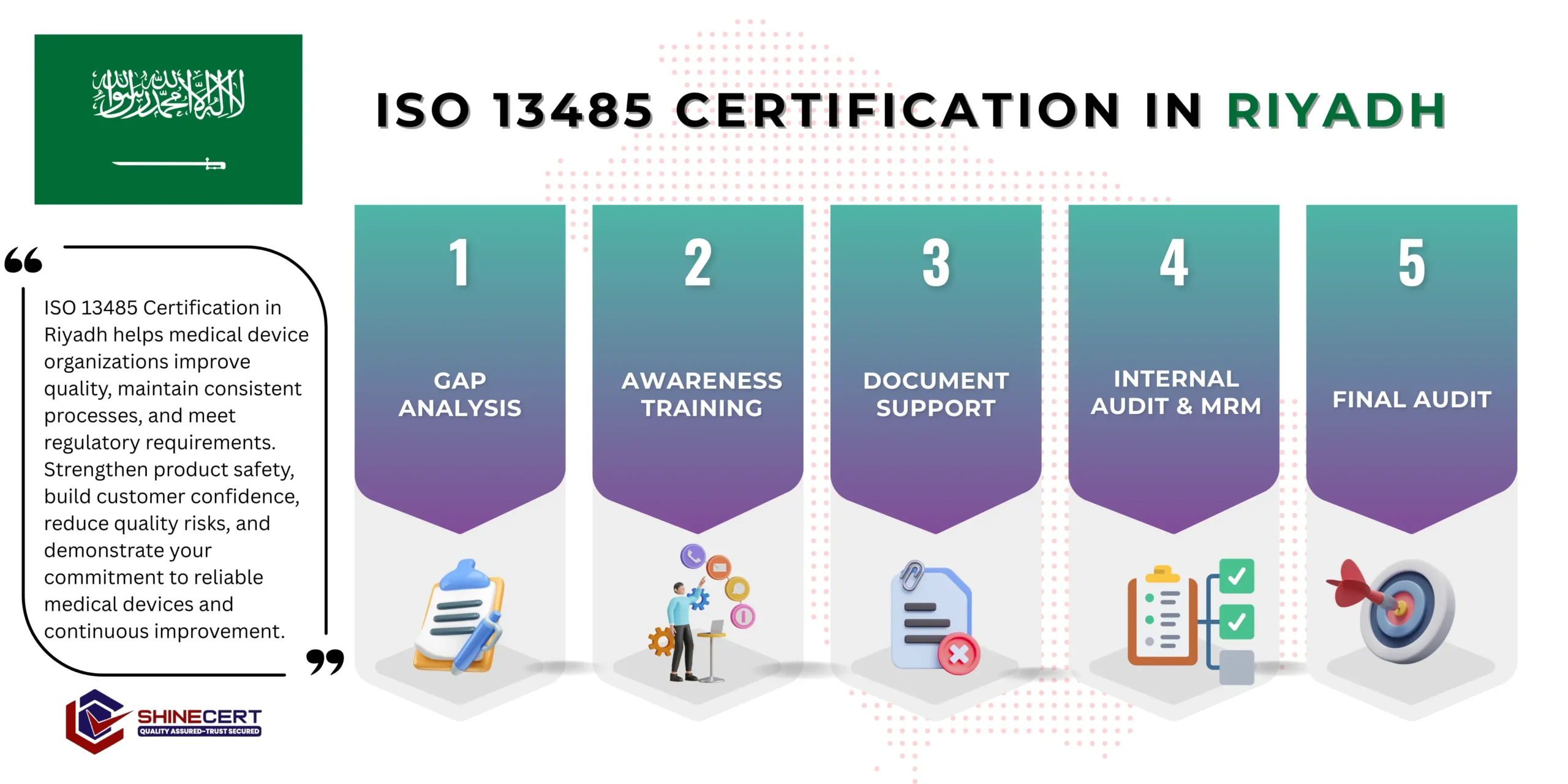
What are the steps to get ISO 13485 Certification in Riyadh?
our services
- ISO Certification Riyadh
- ISO 9001 Certification Riyadh
- ISO 14001 Certification Riyadh
- ISO 27001 Certification Riyadh
- ISO 22000 Certification Riyadh
- ISO 45001 Certification Riyadh
- ISO 42001 Certification Riyadh
- ISO 31000 Certification Riyadh
- ISO 13485 Certification Riyadh
- ISO 17025 Certification Riyadh
- CE Mark Certification Riyadh
- GMP Certification Riyadh
- GDPR Certification Riyadh
- Halal Certification Riyadh
ISO 13485 Certification Process in Riyadh
Gap Assessment
We review your current quality processes and MDMA documentation against every ISO 13485 clause, aligned to your device's specific risk classification and intended use.
A documented gap assessment aligned to your device's risk classification and intended use.
Documentation Development
We build the quality manual, design-control procedures, and risk-management documentation your gap assessment identified as missing, structured to double as supporting evidence for your MDMA2 submission.
A complete quality manual, design-control procedures, and risk-management documentation, doubling as MDMA2 evidence.
Implementation & Training
Staff involved in design, manufacturing, and post-market activities are trained on the formalized system, with particular attention to complaint handling and post-market surveillance responsibilities.
Trained staff with clear complaint-handling and post-market surveillance responsibilities.
Internal Audit & Management Review
We conduct a structured internal audit, followed by a formal management review responding to the findings and closing gaps before external assessment.
A documented internal audit report and management review minutes showing findings were addressed.
Certification Audit
Your SASO-accredited certification body conducts a two-stage external audit, resulting in your ISO 13485 certificate, valid for three years with annual surveillance audits.
Your ISO 13485 certificate, valid for three years with annual surveillance audits.
Gap Assessment
We review your current quality processes and MDMA documentation against every ISO 13485 clause, aligned to your device's specific risk classification and intended use.
A documented gap assessment aligned to your device's risk classification and intended use.
Documentation Development
We build the quality manual, design-control procedures, and risk-management documentation your gap assessment identified as missing, structured to double as supporting evidence for your MDMA2 submission.
A complete quality manual, design-control procedures, and risk-management documentation, doubling as MDMA2 evidence.
Implementation & Training
Staff involved in design, manufacturing, and post-market activities are trained on the formalized system, with particular attention to complaint handling and post-market surveillance responsibilities.
Trained staff with clear complaint-handling and post-market surveillance responsibilities.
Internal Audit & Management Review
We conduct a structured internal audit, followed by a formal management review responding to the findings and closing gaps before external assessment.
A documented internal audit report and management review minutes showing findings were addressed.
Certification Audit
Your SASO-accredited certification body conducts a two-stage external audit, resulting in your ISO 13485 certificate, valid for three years with annual surveillance audits.
Your ISO 13485 certificate, valid for three years with annual surveillance audits.
Why Riyadh Businesses Need ISO 13485?
ISO 13485 matters in Riyadh because SFDA’s medical device registration pathway now requires a full Technical File Assessment for every device class, and a certified quality system is the fastest way to demonstrate the underlying rigor that process expects.
- SFDA’s MDMA2 pathway : From 2026, all medical devices sold in Saudi Arabia must follow the MDMA2 (Saudi Route) for marketing authorization, a full Technical File Assessment through the GHAD portal, regardless of device class, replacing the older GHTF-based pathway. ISO 13485 certification provides much of the quality-system evidence this stricter process expects, meaning companies without it face significantly more work assembling a submission from scratch.
- GCC-wide market access : SFDA device registration is recognized across the GCC, UAE, Kuwait, Bahrain, Oman, and Qatar, making Riyadh a genuinely strategic base for device companies targeting the wider regional market, not just Saudi Arabia alone, since a single certified quality system can support registration efforts across several GCC markets simultaneously.
- Riyadh’s healthcare cluster : As a major hub for hospitals, clinics, and healthcare investment tied to Vision 2030’s health-sector transformation, Riyadh hosts a growing base of device distributors and importers who need certified quality systems to satisfy both SFDA and hospital-procurement requirements, particularly as major hospital groups formalize their own supplier qualification criteria around international quality standards.
- Genuine accreditation matters : Always verify current SAC accreditation before choosing a certification body, since a certificate from an improperly accredited body can create real delays or complications when submitted as part of an MDMA2 technical file.
ISO 13485 Certification Cost in Riyadh
- Nature of the business : A device distributor faces meaningfully less scope than a manufacturer with design and production responsibilities, since design controls and manufacturing process validation add substantial documentation and audit depth.
- Device risk classification : Class I devices require far less documentation and audit depth than Class III or IV devices, which also require on-site GMP inspection carrying its own separate fee structure.
- Number of employees and sites : Audit duration scales with headcount and site count under accreditation rules, particularly where design, manufacturing, and distribution happen across separate locations.
- Existing documentation maturity : Companies with existing MDMA-aligned technical documentation spend less on the certification-specific documentation stage, since much of the underlying technical content can be restructured rather than rewritten.
- DIY vs. consultant vs. end-to-end support : In-house implementation costs staff time and carries higher first-audit failure risk, especially given the regulatory stakes involved when a failed audit can delay a market-entry timeline.
- Certification body chosen : Fees vary by certification body size and auditor day rates, all valid provided SAC accreditation is current, making it worth comparing quotes carefully given how much rides on the certificate’s credibility.
- Coordination with SFDA’s MDMA process : Structuring ISO 13485 documentation to directly support your GHAD portal submission can reduce duplicate work significantly, often the single biggest cost lever available to device companies pursuing both simultaneously.
Mandatory Documents Required (By Clause)
- Clause 4 — Context of the Organization : Requires defining your QMS scope specific to your device categories. Document needed: a written Scope Statement.
- Clause 5 — Leadership : Requires top-management commitment to quality and regulatory compliance. Document needed: a signed Quality Policy.
- Clause 6 — Planning : Requires risk-based planning specific to device safety. Document needed: Quality Objectives and a Risk Management File.
- Clause 7 — Support : Covers competence and infrastructure. Document needed: training records and a controlled-environment procedure where relevant.
- Clause 8 — Operation : Covers design, production, and post-market surveillance. Document needed: Design and Development Files, Device Master Records, and a Post-Market Surveillance Plan.
- Clause 9 — Performance Evaluation : Requires monitoring and internal audit. Document needed: internal audit reports and management review minutes.
- Clause 10 — Improvement : Requires handling nonconformities and complaints. Document needed: CAPA records and Complaint Handling records.
Industries in Riyadh That Need ISO 13485
Medical Device Manufacturers
Companies designing and producing devices across all SFDA risk classifications need certification as a foundation for MDMA2 registration, since the standard's design-control requirements map directly onto what the Technical File Assessment expects.
Read moreDevice Distributors & Importers
Companies bringing devices into the Saudi market carry distinct MDMA obligations and benefit from a certified quality system supporting distributor due diligence, complaint handling, and traceability across the supply chain.
Read moreHospitals & Healthcare Providers
Larger Riyadh healthcare institutions increasingly require certified suppliers as part of their own procurement quality standards, treating ISO 13485 as a baseline qualification for device vendors.
Read moreDiagnostic & Laboratory Equipment Suppliers
Companies supplying testing and diagnostic equipment need certification to satisfy both SFDA and laboratory-accreditation requirements that overlap significantly with ISO 13485's quality-system expectations.
Read moreClass III/IV Device Manufacturers
Companies in the highest-risk device categories face on-site GMP inspection requirements where ISO 13485 certification substantially eases the process, since much of the documentation an inspector expects already exists in a well-run certified system.
Read moreHealthcare Technology Startups
Riyadh's growing health-tech sector, supported by Vision 2030 investment, increasingly needs certified quality systems to attract hospital and investor partners who treat certification as a proxy for genuine regulatory readiness.
Read moreCase Study
- A device distributor based in Riyadh, importing diagnostic equipment for regional hospital clients, approached ShineCert after SFDA’s shift to the MDMA2 pathway required a far more detailed technical file than their previous registration process. Their existing documentation was scattered and hadn’t been updated to reflect current design and risk-management expectations, leaving them at risk of missing their next registration renewal window.
- Over ten weeks, the quality system was rebuilt to directly support both ISO 13485 certification and the GHAD portal submission, with the Risk Management File and Device Master Records serving both purposes simultaneously rather than being built as two separate document sets. Certification was achieved with zero major nonconformities, and the MDMA2 submission proceeded using largely the same documentation base, saving the distributor significant time against their registration deadline.
Choosing a Certification Body in Riyadh
Verify current SAC accreditation for your specific standard and industry scope before signing with any certification body, this is non-negotiable, since accreditation can be scope-limited.
| Approach | What It Involves | Best For |
|---|---|---|
| DIY | Your regulatory/quality team manages documentation alone | Companies with existing device-regulatory expertise |
| Hiring a Consultant | External expert guides documentation and audit prep | Companies wanting guidance while choosing their own certifier |
| ShineCert End-to-End | We manage gap assessment through audit-readiness, aligned with MDMA2 | Companies wanting certification and SFDA registration coordinated together |
Why Choose ShineCert?
ShineCert at a glance: 10 years of ISO consulting experience, 10,000+ organizations certified globally, with our own office based right here in Riyadh, local, on-the-ground support that understands SFDA’s current registration pathway in practice, not just on paper.
We build your ISO 13485 quality system to directly support your SFDA MDMA2 technical file, rather than treating certification as a separate exercise from your core regulatory obligations, which is precisely where many device companies waste time and budget.
Frequently Asked Questions
Not directly by name, but SFDA’s MDMA2 registration pathway is mandatory for any device sold in Saudi Arabia, and ISO 13485 is the practical, widely accepted way to demonstrate the quality-system foundation that process expects.
Look for genuine local presence, specific familiarity with SFDA’s MDMA2 pathway, and no conflict of interest with the certification body.
It depends on your device’s risk classification, whether you manufacture or distribute, and existing documentation maturity, see the cost breakdown above.
Not automatically, but it provides much of the underlying quality-system evidence the Technical File Assessment expects.
Confirm current accreditation under SASO’s Saudi Accreditation Committee (SAC) for ISO 13485 specifically.