
ISO 9001 Certification in Riyadh
Quick Answer
ISO 9001 is the world’s most widely used quality management standard, published by the International Organization for Standardization. It sets requirements for how an organization plans, controls, and continually improves the processes that determine whether it consistently delivers what customers actually asked for. Certification is issued after an independent third-party audit, not a self-declaration.
What Is ISO 9001?
ISO 9001 is not a product standard, it doesn’t certify what you make, but how reliably you make it. First published in 1987 and now in its 2015 edition (with a 2026 revision in progress), the standard is built around requirements covering leadership commitment, risk-based planning, operational control, performance evaluation, and continual improvement.
Certification is issued by an independent, accredited certification body after an audit, never by ISO itself, and never by a consultant. In Saudi Arabia, legitimate certification bodies must hold accreditation from SASO’s Saudi Accreditation Committee (SAC).
What are the steps to get ISO 9001 Certification in Riyadh?
our services
- ISO Certification Riyadh
- ISO 9001 Certification Riyadh
- ISO 14001 Certification Riyadh
- ISO 27001 Certification Riyadh
- ISO 22000 Certification Riyadh
- ISO 45001 Certification Riyadh
- ISO 42001 Certification Riyadh
- ISO 20000-1 Certification Riyadh
- ISO 13485 Certification Riyadh
- ISO 17025 Certification Riyadh
- CE Mark Certification Riyadh
- GMP Certification Riyadh
- GDPR Certification Riyadh
- Halal Certification Riyadh
ISO 9001 Certification Process in Riyadh
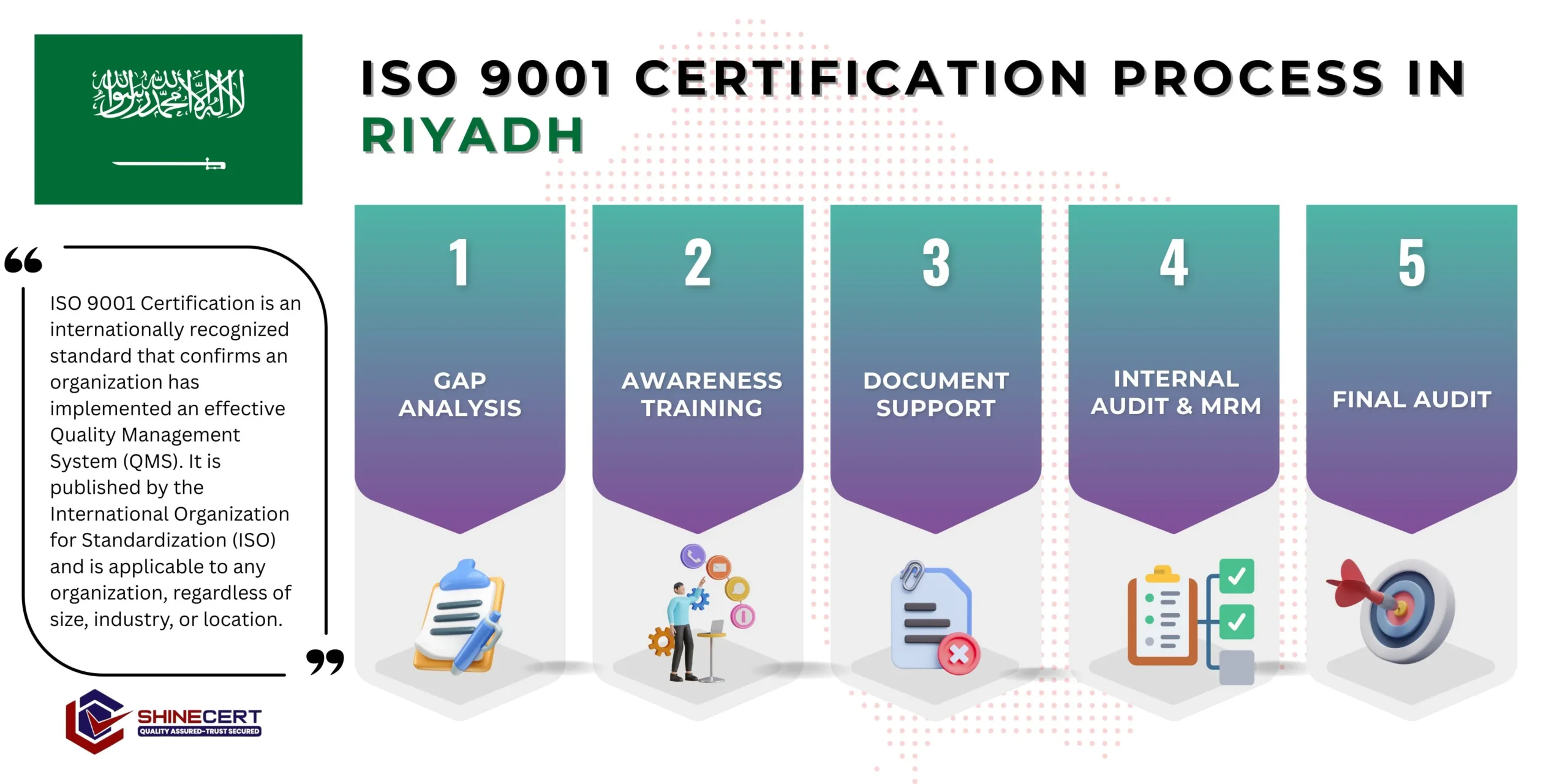
Certification follows five stages, each building directly on the one before it.
Gap Assessment
We review your current operations against every ISO 9001 clause and produce a specific, written list of what's missing. This becomes the working plan for every stage that follows, so nothing later is guesswork.
A documented gap assessment identifying every ISO 9001 clause not yet met by your current operations.
Documentation Development
We build the quality manual, procedures, and record templates your gap assessment identified as missing. Documentation is written to match how your business actually operates, not copied from a generic template your staff will quietly ignore.
A complete quality manual, procedures, and record templates matched to your operations.
Implementation & Training
Your team is trained on the new procedures, and the system is put into genuine operation, generating the real records an auditor will later review. Staff need to understand why a control exists, not just recite the steps.
Trained staff and the operational records that demonstrate the system genuinely runs.
Internal Audit & Management Review
We conduct a structured internal audit of your own system, followed by a formal management review where leadership responds to the findings. This step catches most issues before an external auditor ever sees them.
A documented internal audit report and management review minutes showing findings were addressed.
Certification Audit
Your chosen SASO-accredited certification body conducts a two-stage external audit, reviewing documentation first, then testing whether the system genuinely works in practice, resulting in your ISO 9001 certificate.
Your ISO 9001 certificate, issued following a two-stage external audit.
Gap Assessment
We review your current operations against every ISO 9001 clause and produce a specific, written list of what's missing. This becomes the working plan for every stage that follows, so nothing later is guesswork.
A documented gap assessment identifying every ISO 9001 clause not yet met by your current operations.
Documentation Development
We build the quality manual, procedures, and record templates your gap assessment identified as missing. Documentation is written to match how your business actually operates, not copied from a generic template your staff will quietly ignore.
A complete quality manual, procedures, and record templates matched to your operations.
Implementation & Training
Your team is trained on the new procedures, and the system is put into genuine operation, generating the real records an auditor will later review. Staff need to understand why a control exists, not just recite the steps.
Trained staff and the operational records that demonstrate the system genuinely runs.
Internal Audit & Management Review
We conduct a structured internal audit of your own system, followed by a formal management review where leadership responds to the findings. This step catches most issues before an external auditor ever sees them.
A documented internal audit report and management review minutes showing findings were addressed.
Certification Audit
Your chosen SASO-accredited certification body conducts a two-stage external audit, reviewing documentation first, then testing whether the system genuinely works in practice, resulting in your ISO 9001 certificate.
Your ISO 9001 certificate, issued following a two-stage external audit.
Why Riyadh Businesses Need ISO 9001?
ISO 9001 matters in Riyadh because it directly affects Etimad government tender scoring, is increasingly expected by the multinational companies establishing Regional Headquarters here, and is the fastest way for a giga-project contractor or supplier to clear qualification without a lengthy independent buyer evaluation.
- The Regional Headquarters (RHQ) Program : Since 1 January 2024, Saudi government entities generally cannot contract with foreign companies above SAR 1 million unless they hold an RHQ license based in Riyadh, more than 700 multinational companies have already relocated their regional headquarters here as a result. New RHQ entrants standing up genuine local operations for the first time need a credible, certified quality system quickly, both to satisfy their own global compliance standards and to compete for the Saudi government contracts the RHQ license was designed to unlock.
- Etimad tender scoring : ISO 9001 is not legally mandatory, but it directly affects your technical score on the Etimad Platform, Saudi Arabia’s national e-procurement system, most Riyadh businesses competing for government or semi-government contracts treat it as a practical requirement.
- Giga-project supply chains : The Royal Commission for Riyadh City (RCRC), which oversees an investment portfolio exceeding $1 trillion across projects like New Murabba, King Salman Park, and the Riyadh Metro, acts as the primary arbiter for international tenders and sustainable-development standards across the city, prime contractors on these projects routinely require ISO 9001 from every tier of their supply chain.
- Genuine accreditation matters : SASO itself has confirmed that quality-management certification bodies must hold SAC approval, always verify this directly before choosing a certifier operating in Riyadh.
ISO 9001 Certification Cost in Riyadh
ISO 9001 certification cost in Riyadh is not a fixed price, it depends on several specific factors that genuinely change the scope of work involved.
- Nature of the business : A professional-services firm with straightforward processes costs less to certify than a manufacturer or contractor with complex operations and multiple production lines to document and control.
- Number of employees : Audit duration under accreditation rules scales directly with headcount, a 15-person firm requires a shorter audit than a 200-person organization, which affects the certification body’s fee directly.
- Number of departments and sites : More departments and more physical locations mean more processes to document, more staff to train, and a broader internal audit programme, all of which add genuine scope, not just paperwork.
- Existing documentation maturity : A business that already runs disciplined, documented processes spends far less on the documentation-development stage than one starting from informal or undocumented practices, a common situation for newly established RHQ entities still building out local operations.
- DIY vs. consultant vs. end-to-end support : Doing it entirely in-house costs staff time and carries a higher risk of a failed first audit. Using an experienced consultant shifts cost toward professional fees but usually compresses the timeline and reduces that risk.
- Certification body chosen : Fees vary between certification bodies based on their size, reputation, and auditor day rates, all are equally valid provided their SASO/SAC accreditation is genuine and current.
- Bundling multiple standards : Pursuing ISO 9001 alongside ISO 45001 or ISO 14001 in one integrated audit shares significant overhead across standards rather than duplicating it.
Mandatory Documents Required (By Clause)
- Clause 4 — Context of the Organization : Requires you to identify internal and external issues affecting your business and define the scope of your management system. Document needed: a written Scope Statement defining exactly which sites, products, and processes the certification covers.
- Clause 5 — Leadership : Requires top management to demonstrably own the quality policy and objectives, not delegate it entirely to a quality manager. Document needed: a signed, top-management-approved Quality Policy communicated to staff.
- Clause 6 — Planning : Requires documented objectives and a risk-and-opportunity analysis showing you’ve assessed what could go wrong. Document needed: Quality Objectives with measurable targets, and a Risk & Opportunity Register.
- Clause 7 — Support : Covers competence, awareness, communication, and documented information, proving your people know what’s expected of them. Document needed: Competence and training records, and a documented-information control procedure.
- Clause 8 — Operation : The operational core: how you plan and control production or service delivery, including supplier evaluation. Document needed: Operational planning records and supplier/vendor evaluation records.
- Clause 9 — Performance Evaluation : Requires internal audits, management review, and monitoring of customer satisfaction. Document needed: Internal audit reports, management review minutes, and customer satisfaction data.
- Clause 10 — Improvement : Requires a documented process for handling nonconformities and driving corrective action. Document needed: Nonconformity and Corrective Action records, closing the loop back into Clause 6 planning.
Industries in Riyadh That Need ISO 9001
Construction & Contracting
Prime contractors and subcontractors on RCRC-governed giga-projects, New Murabba, King Salman Park, the Riyadh Metro, routinely require ISO 9001 as a baseline supplier-qualification condition.
Read moreMultinational Regional Headquarters
Companies establishing an RHQ in Riyadh under the government's mandate need a credible quality system quickly, both to satisfy internal global compliance standards and to compete for the government contracts the RHQ license unlocks.
Read moreGovernment Contractors & Consulting Firms
Businesses bidding on Etimad tenders rely on ISO 9001 to directly strengthen their technical score against competing bids.
Read moreManufacturing & Industrial
Factories across Riyadh's Second Industrial City need ISO 9001 to satisfy quality expectations from both regulators and corporate buyers.
Read moreIT & Financial Services
Riyadh's growing fintech and IT-services sector uses ISO 9001 as the foundation before layering on sector-specific standards like ISO 27001.
Read moreHealthcare & Pharmaceuticals
Hospitals, clinics, and pharmaceutical distributors need ISO 9001 as a quality baseline underpinning patient-safety and product-quality commitments.
Read moreHospitality & Real Estate
With Riyadh's rapid hospitality and mixed-use development expansion tied to giga-projects, developers and operators increasingly use ISO 9001 to demonstrate operational maturity to investors and partners.
Read moreCase Study
- A multinational logistics firm establishing its Regional Headquarters in Riyadh under the RHQ Program approached ShineCert six weeks before a major Etimad tender submission deadline. Their global quality standards existed on paper at the group level, but nothing had been localized or documented for the new Riyadh entity, no local risk register, no local internal audit programme, and no evidence the global policy was actually operating on the ground.
- Working against the deadline, we built a Riyadh-specific quality manual referencing the group’s existing global standards rather than starting from zero, ran a compressed but genuine internal audit, and completed certification in time for the submission. The company’s bid was shortlisted, with the evaluator specifically noting the certified quality system as a scoring factor.
Choosing a Certification Body in Riyadh
Verify current SAC accreditation for your specific standard and industry scope before signing with any certification body, this is non-negotiable, since accreditation can be scope-limited.
| Approach | What it involves | Best for |
|---|---|---|
| DIY | Your team manages the documentation and process on its own. | Companies with existing QMS expertise. |
| Hiring a consultant | An external expert guides your documentation and audit preparation. | Companies that want guidance while choosing their own certifier. |
| ShineCert end-to-end | We manage everything from gap assessment through audit readiness. | Companies that want one point of accountability. |
How to Migrate from ISO 9001:2015 to ISO 9001:2026 (Clause by Clause)?
ISO 9001:2026 is set for publication on 16 September 2026, following full technical consensus reached at the February 2026 working-group meeting in Mexico City. Organizations already certified to ISO 9001:2015 get a three-year transition window, until roughly September 2029, to migrate, but Riyadh businesses renewing a certificate or pursuing first-time certification from late 2026 onward should plan against the new edition now rather than building a 2015-only system that needs reworking within a year or two.
The revision is evolutionary, not a rewrite, the core process-approach structure and Clauses 1 through 10 stay the same. The real work is concentrated in leadership behavior, climate-context documentation, and separating risk management from opportunity management, which is where most Riyadh organizations will find their genuine gap.
The 2024 climate-change amendment is now formally built into the base standard: your organization must explicitly determine and document whether climate change is a relevant issue for your QMS, not just your business generally. Document needed: update your existing Scope Statement / Context Analysis to include a specific, recorded assessment of climate change relevance, for a Riyadh contractor this might mean documenting exposure to extreme-heat working conditions or giga-project sustainability requirements; for an office-based services firm, it may be a brief, justified statement that climate change has limited direct relevance to the QMS scope.
A new explicit requirement (5.1.1) requires top management to actively promote and demonstrate quality culture and ethical behavior, not simply approve a policy document. Document needed: an updated Quality Policy that references quality culture and ethical conduct directly, plus an evidence trail showing genuine promotion — leadership communications, town-hall or all-staff briefing records, and management review minutes that discuss culture and ethics, not just numbers.
Clause 6.1 is restructured into clearer sub-sections that separate risk-treatment actions from opportunity-pursuit actions, rather than bundling both into a single combined analysis. Document needed: split your existing Risk & Opportunity Register into two distinct, separately tracked logs, a Risk Treatment Log and an Opportunity Action Log, each with its own owner, action, and status field.
Awareness training (7.3) must now explicitly cover quality culture and ethical behavior, and the “working environment” requirement is broadened beyond physical conditions to cover social and psychological factors as well. Document needed: updated training records showing culture/ethics content was actually delivered, and an updated Working Environment procedure or risk assessment that addresses factors such as workload stress and workplace conduct alongside physical safety.
A new requirement addresses preventing human error in operational processes, rather than only detecting and correcting it after the fact. Document needed: updated work instructions with built-in error-proofing steps (verification checkpoints, mistake-proofing controls) at critical stages, and records demonstrating these controls are actually in use.
Internal audit requirements become more specific, and management review inputs expand to explicitly cover the new areas above. Document needed: an updated internal audit checklist reflecting the 2026 clause structure, and a revised Management Review Agenda template with dedicated inputs for climate-context status, quality culture/ethics evidence, and human-error prevention performance.
Largely unchanged in substance, but Corrective Action records should now be able to trace back cleanly into the separated Risk Treatment Log and the human-error prevention data captured under Clause 8. Document needed: confirm your existing Nonconformity and Corrective Action template still links correctly to the restructured Clause 6 registers.
Why Choose ShineCert?
ShineCert at a glance: 10 years of ISO consulting experience, 10,000+ organizations certified globally, with our own office based right here in Riyadh, not a remote or coordinated engagement like most of our other markets, but local, on-the-ground support.
We are not a certification body, we never audit or issue our own certificates. That independence means our only incentive is getting your system genuinely ready for a first-time pass with your chosen SAC-accredited certifier.
Frequently Asked Questions
No, it’s voluntary under Saudi law. It becomes practically necessary for most Etimad government tenders, RCRC giga-project supplier qualification, and increasingly for companies establishing an RHQ.
Look for a consultant with a genuine local presence, a verified track record, and no conflict of interest with the certification body itself. ShineCert operates as an independent consultant, never a certifier, specifically to avoid that conflict.
It depends on your business size, number of departments and sites, and existing documentation maturity, see the cost breakdown above for the specific factors involved.
Yes, it directly affects technical scoring on the Etimad Platform for most government and semi-government contracts.
It’s not a formal RHQ licensing requirement, but many multinationals pursue it quickly after establishing their Regional Headquarters, both to satisfy internal global compliance standards and to compete effectively for the government contracts the RHQ license is designed to unlock.
Confirm current accreditation under SASO’s Saudi Accreditation Committee (SAC) for ISO 9001 specifically, always check directly, don’t assume.
Yes, eventually. ISO 9001:2026 publishes 16 September 2026, and existing 2015-certified organizations have a three-year transition window, until roughly September 2029, to migrate. The changes are evolutionary rather than a full rewrite, concentrated mainly in leadership behavior, climate-context documentation, and separating risk from opportunity management, see the clause-by-clause migration guide above.