
ISO 14001 Certification in Riyadh
Quick Answer
ISO 14001 is the international standard for environmental management systems, published by the International Organization for Standardization. It requires an organization to identify its environmental impacts, control them, and demonstrate continual improvement. Certification is issued by an accredited certification body after an independent audit, not a self-declaration.
What Is ISO 14001?
ISO 14001 sets requirements for how an organization identifies its environmental aspects, the elements of its activities that interact with the environment, and controls them systematically. It doesn’t dictate specific performance targets; it requires a structured management system that identifies impacts, sets objectives, and drives continual improvement across areas such as waste, emissions, water use, and resource consumption.
Certification is issued by an independent, accredited certification body after an audit, never by ISO itself. In Saudi Arabia, legitimate certification bodies must hold accreditation from SASO’s Saudi Accreditation Committee (SAC), and any business evaluating a certifier should confirm this accreditation is current and covers the ISO 14001 scope specifically, not simply a general quality accreditation.
What are the steps to get ISO 14001 Certification in Riyadh?
our services
- ISO Certification Riyadh
- ISO 9001 Certification Riyadh
- ISO 14001 Certification Riyadh
- ISO 27001 Certification Riyadh
- ISO 22000 Certification Riyadh
- ISO 45001 Certification Riyadh
- ISO 42001 Certification Riyadh
- ISO 20000-1 Certification Riyadh
- ISO 13485 Certification Riyadh
- ISO 17025 Certification Riyadh
- CE Mark Certification Riyadh
- GMP Certification Riyadh
- GDPR Certification Riyadh
- Halal Certification Riyadh
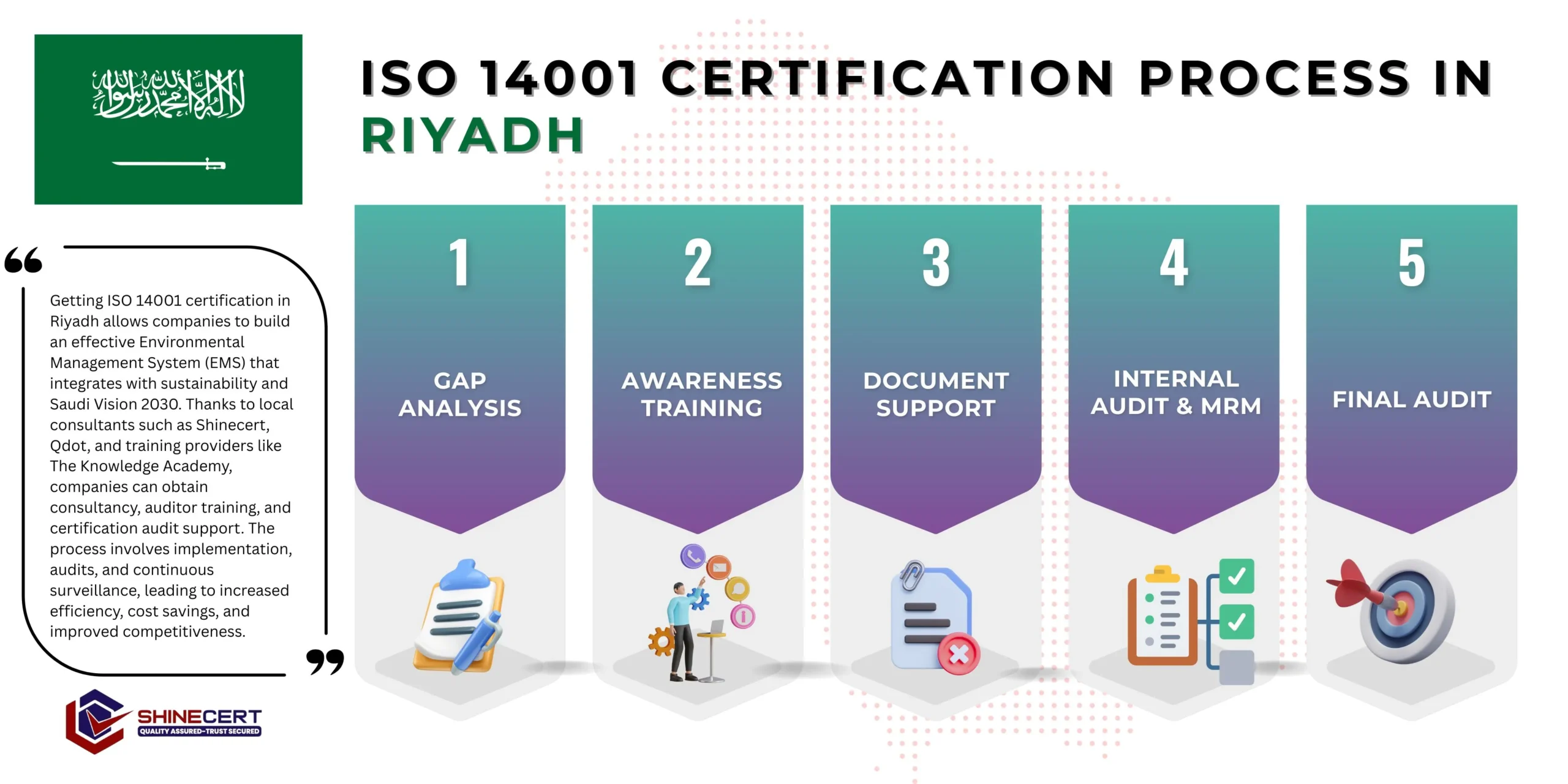
ISO 14001 Certification Process in Riyadh
Gap Assessment
We review your environmental aspects and current practices against every ISO 14001 clause and produce a specific, written list of what's missing, covering everything from waste handling to emergency preparedness.
A documented gap assessment identifying every ISO 14001 clause not yet met by your current practices.
Documentation Development
We build the environmental policy, aspects-and-impacts register, and legal register your gap assessment identified as missing, matched to your actual operations rather than generic templates that don't reflect your real environmental footprint.
A complete environmental policy, aspects-and-impacts register, and legal register matched to your operations.
Implementation & Training
Your team is trained on the new environmental controls, and the system runs long enough to generate real monitoring records that an auditor can review, not paperwork produced the week before the audit.
Trained staff and the environmental monitoring records that demonstrate the system genuinely runs.
Internal Audit & Management Review
We conduct a structured internal audit of your own system, followed by a formal management review responding to the findings and closing any gaps before the external audit begins.
A documented internal audit report and management review minutes showing findings were addressed.
Certification Audit
Your SASO-accredited certification body conducts a two-stage external audit, resulting in your ISO 14001 certificate, valid for three years with annual surveillance visits to confirm the system remains active.
Your ISO 14001 certificate, valid for three years with annual surveillance visits.
Gap Assessment
We review your environmental aspects and current practices against every ISO 14001 clause and produce a specific, written list of what's missing, covering everything from waste handling to emergency preparedness.
A documented gap assessment identifying every ISO 14001 clause not yet met by your current practices.
Documentation Development
We build the environmental policy, aspects-and-impacts register, and legal register your gap assessment identified as missing, matched to your actual operations rather than generic templates that don't reflect your real environmental footprint.
A complete environmental policy, aspects-and-impacts register, and legal register matched to your operations.
Implementation & Training
Your team is trained on the new environmental controls, and the system runs long enough to generate real monitoring records that an auditor can review, not paperwork produced the week before the audit.
Trained staff and the environmental monitoring records that demonstrate the system genuinely runs.
Internal Audit & Management Review
We conduct a structured internal audit of your own system, followed by a formal management review responding to the findings and closing any gaps before the external audit begins.
A documented internal audit report and management review minutes showing findings were addressed.
Certification Audit
Your SASO-accredited certification body conducts a two-stage external audit, resulting in your ISO 14001 certificate, valid for three years with annual surveillance visits to confirm the system remains active.
Your ISO 14001 certificate, valid for three years with annual surveillance visits.
Why Riyadh Businesses Need ISO 14001?
ISO 14001 matters in Riyadh because the city’s giga-project governance body has made sustainability a formal evaluation criterion, and because Vision 2030’s environmental commitments are increasingly reflected in how large developers and government buyers select suppliers.
- RCRC’s sustainability mandate : The Royal Commission for Riyadh City (RCRC), which governs an investment portfolio exceeding $1 trillion across projects including King Salman Park, New Murabba, and the Sports Boulevard, acts as the primary arbiter of sustainable-development standards across the capital. Contractors bidding into these projects increasingly face environmental-management scrutiny as part of qualification, and companies without a certified system are finding themselves excluded from pre-qualification lists before price is even discussed.
- Vision 2030 environmental targets. Saudi Arabia’s national development plan includes explicit environmental and green-space commitments for Riyadh specifically, tied to the city’s transformation into a greener, more livable capital. Government and giga-project buyers increasingly favor suppliers who can demonstrate a formal environmental-management system over those relying on informal practices, since a certified EMS gives them auditable evidence to report against their own sustainability commitments.
- Etimad tender scoring : ISO 14001 is not legally mandatory, but for construction, industrial, and environmentally regulated tenders on the Etimad Platform, it can meaningfully strengthen technical scoring alongside ISO 9001. Bid evaluators increasingly treat the absence of environmental certification as a gap worth noting, even where it isn’t listed as a mandatory qualification criterion.
- Genuine accreditation matters : Always verify current SAC accreditation before choosing a certification body, SASO has confirmed certification bodies must hold this approval, and using an unaccredited or improperly scoped certifier can mean a certificate that carries no real weight with RCRC-governed projects or Etimad evaluators.
ISO 14001 Certification Cost in Riyadh
ISO 9001 certification cost in Riyadh is not a fixed price, it depends on several specific factors that genuinely change the scope of work involved.
- Nature of the business. A company with one significant environmental aspect, such as electricity use, costs far less to certify than one managing emissions, waste, or discharge across multiple processes, since the scope of the aspects register and operational controls scales with the complexity of what needs managing.
- Number of employees : Audit duration scales with headcount under accreditation rules, directly affecting the certification body’s fee, since larger workforces typically mean more interviews and a broader sample of records for the auditor to review.
- Number of departments and sites : More locations mean more environmental aspects to document and audit, adding genuine scope to both the consulting engagement and the external audit itself, particularly where different sites have materially different environmental footprints.
- Existing documentation maturity : Companies with informal but functioning environmental practices spend less on documentation development than those starting from nothing, since much of the consulting effort in a low-maturity organization goes into building processes that don’t yet exist at all.
- DIY vs. consultant vs. end-to-end support : In-house implementation costs staff time and carries higher first-audit failure risk; a consultant shifts cost toward professional fees but typically compresses the timeline and reduces the chance of nonconformities at the certification audit.
- Certification body chosen : Fees vary by certification body size, reputation, and auditor day rates, all valid provided SAC accreditation is current, so comparing quotes on accreditation scope as well as price is worthwhile.
- Bundling with ISO 9001 or ISO 45001 : An integrated audit across standards shares overhead rather than duplicating it, since a single auditor visit covering multiple management systems is typically more cost-effective than separate audits for each standard.
Mandatory Documents Required (By Clause)
- Clause 4 — Context of the Organization : Requires identifying environmental issues relevant to your business and defining your system’s scope. Document needed: a written Scope Statement.
- Clause 5 — Leadership : Requires top-management ownership of environmental commitment. Document needed: a signed Environmental Policy.
- Clause 6 — Planning : Requires identifying environmental aspects and setting objectives. Document needed: an Aspects and Impacts Register plus Environmental Objectives.
- Clause 7 — Support : Covers competence and awareness. Document needed: training records and a documented-information control procedure.
- Clause 8 — Operation : Covers operational controls for significant aspects. Document needed: operational control procedures and emergency-preparedness plans.
- Clause 9 — Performance Evaluation : Requires monitoring and internal audit. Document needed: monitoring records, internal audit reports, and management review minutes.
- Clause 10 — Improvement : Requires handling nonconformities. Document needed: Nonconformity and Corrective Action records.
Industries in Riyadh That Need ISO 14001
Construction & Contracting
RCRC-governed giga-projects increasingly weigh environmental-management credentials in supplier and contractor selection, particularly for firms handling significant waste, dust, or discharge on active construction sites.
Read moreManufacturing & Industrial
Factories in Riyadh's Second Industrial City managing emissions, waste, and resource use need ISO 14001 to satisfy both regulators and corporate buyers who are tightening supply chain sustainability expectations.
Read moreReal Estate & Urban Development
Developers working on Riyadh's mixed-use giga-projects use ISO 14001 to demonstrate sustainability commitments to investors and government partners evaluating long-term environmental performance, not just construction-phase compliance.
Read moreHospitality & Facilities Management
Hotels and large facility operators tied to Riyadh's tourism and giga-project expansion increasingly need environmental-management credentials for corporate and government contracts, especially as sustainability becomes a visible part of the guest experience.
Read moreOil, Gas & Petrochemicals
Energy-sector companies with Riyadh operations need ISO 14001 as part of a broader compliance package alongside ISO 45001 and ISO 50001, reflecting the sector's historically higher environmental risk profile.
Read moreLogistics & Transport
Companies managing fleet emissions and warehousing environmental impact benefit from a structured system as Riyadh's logistics sector scales with population and giga-project growth, and as clients begin asking for environmental performance data as part of vendor selection.
Read moreCase Study
- A construction subcontractor working on an RCRC-governed giga-project site in Riyadh approached ShineCert after a prime contractor flagged the absence of a certified environmental-management system as a qualification gap. Their site practices were reasonably solid, but nothing was documented, no aspects register, no emergency-preparedness plan specific to the site’s waste and dust-control obligations, and no way to show a prime contractor or government client that their environmental controls were anything more than an informal habit.
- Over seven weeks, we built an aspects-and-impacts register matched to the actual site conditions, formalized emergency-preparedness procedures covering dust, waste, and chemical storage risks specific to the project, and ran a genuine internal audit that surfaced two minor gaps before the real assessment. Certification was achieved with zero major nonconformities, and the subcontractor retained its position on the project through its next qualification review cycle.
Choosing a Certification Body in Riyadh
Verify current SAC accreditation for your specific standard and industry scope before signing with any certification body, this is non-negotiable, since accreditation can be scope-limited.
| Approach | What it involves | Best for |
|---|---|---|
| DIY | Your team manages the documentation and process on its own. | Companies with existing EMS expertise. |
| Hiring a consultant | An external expert guides your documentation and audit preparation. | Companies that want guidance while choosing their own certifier. |
| ShineCert end-to-end | We manage everything from gap assessment through audit readiness. | Companies that want one point of accountability. |
How to Migrate from ISO 14001:2015 to ISO 14001:2026 (Clause by Clause)
ISO 14001:2026 has already been published, it was released on 15 April 2026, replacing the 2015 edition together with the climate-change amendment (ISO 14001:2015/Amd 1:2024) that preceded it. Existing 2015-certified organizations have a three-year transition window, until roughly May 2029, to migrate, but Riyadh businesses pursuing first-time certification or a recertification audit from 2026 onward should be certified straight to the 2026 edition rather than the withdrawn 2015 version.
The overall scale of change is described as moderate, less extensive than the 2015 revision was, but climate and change-management requirements are genuinely new obligations, not just rewording, and matter directly for Riyadh’s giga-project and RCRC-facing businesses.
This is the clause with the most substantive change: climate change was already a mandatory consideration since the 2024 amendment, and the 2026 edition now explicitly adds four further named environmental conditions alongside it, biodiversity, ecosystem health, pollution levels, and natural resource availability. Document needed: an expanded Context Analysis / Environmental Aspects framing document that records, for each of the five conditions, whether it’s relevant to your organization and why, for a Riyadh construction subcontractor this likely means documenting exposure to extreme-heat conditions, dust/pollution impact, and water-resource pressure on active giga-project sites.
The standard clarifies that interested parties, such as RCRC, giga-project developers, or government buyers, can hold climate-related expectations that must be captured within your EMS scope. Document needed: an updated Interested Parties Register with a dedicated column or section identifying which stakeholders have climate- or environment-related requirements and what those requirements actually are.
Leadership accountability is broadened so top management must demonstrably support environmental performance across all relevant roles, not only formally designated management roles. Document needed: an updated Environmental Policy and roles-and-responsibilities matrix that extends explicit environmental accountability to operational roles, site supervisors, procurement staff — not just senior management.
This is a genuinely new requirement: a formal, standalone register of environmental risks and opportunities, distinct from the existing aspects-and-impacts register. Document needed: a new Risks and Opportunities Register, separate from your Aspects and Impacts Register, tracking environmental risk items and improvement opportunities with owners and status.
The most significant addition in the 2026 revision: organizations must now determine the need for, and formally plan and manage, changes that affect or could affect the EMS, new sites, new processes, new equipment. Document needed: a new Change Management Procedure specific to the EMS, with a template for assessing the environmental impact of a planned change before it goes ahead, not after.
This clause is broadened to give significantly more weight to externally provided processes, products, and services, effectively a stronger supply-chain and life-cycle lens. Document needed: expanded supplier and contractor environmental-control procedures covering the full life-cycle perspective, particularly relevant for Riyadh contractors managing multiple subcontractor tiers on giga-project sites.
Restructured into three explicit subclauses, 9.3.1 General, 9.3.2 Inputs, 9.3.3 Results, rather than one combined clause. Document needed: a restructured Management Review Minutes template matching the three-part format, with the Inputs section explicitly covering climate-related risks and opportunities, the new Risks and Opportunities Register, and outcomes from any changes assessed under Clause 6.3.
Why Choose ShineCert?
ShineCert at a glance: 10 years of ISO consulting experience, 10,000+ organizations certified globally, with our own office based right here in Riyadh, local, on-the-ground support, not a remote engagement.
We are not a certification body, we never audit or issue our own certificates. Our only incentive is getting your system genuinely ready for a first-time pass, which is why our engagements focus on building controls your team can actually sustain after the certificate is issued, not just documentation that looks good on audit day.
Frequently Asked Questions
No, it’s voluntary. It becomes practically valuable for RCRC giga-project supplier qualification and increasingly for Etimad tenders involving environmentally regulated activities.
Look for genuine local presence, a verified track record, and no conflict of interest with the certification body. ShineCert is independent of any certifier.
It depends on your business size, number of environmental aspects, and existing documentation maturity, see the cost breakdown above.
Yes, RCRC-governed projects increasingly weigh environmental-management credentials in supplier selection.
Confirm current accreditation under SASO’s Saudi Accreditation Committee (SAC) for ISO 14001 specifically.
Yes, eventually. ISO 14001:2026 was published on 15 April 2026, and existing 2015-certified organizations have a three-year transition window, until roughly May 2029, to migrate. The two brand-new requirements, a formal Risks and Opportunities Register and a Planning of Changes process, are the areas most Riyadh businesses will need to build from scratch; see the clause-by-clause migration guide above.