
ISO 27701 Certification in Nigeria
Quick Answer
ISO 27701 is the international standard for privacy information management systems, extending ISO 27001’s information security framework specifically into privacy management. In Nigeria, it maps closely onto the Nigeria Data Protection Act 2023 (NDPA) and the Nigeria Data Protection Commission’s (NDPC) specific obligations around data subject rights, lawful processing, and accountability, genuinely more precisely than ISO 27001 alone, which addresses security but not privacy-specific requirements like consent management and data subject access requests. Organizations classified by the NDPC as Data Controllers or Processors of Major Importance find ISO 27701 particularly directly relevant to their compliance obligations. Certification typically takes three to five months on top of or alongside ISO 27001, with cost depending on genuine factors like data processing scale and existing privacy practices.
What Is ISO 27701, Actually?
ISO 27701 is an international standard, published by the International Organization for Standardization, that extends ISO 27001’s information security management system specifically into privacy information management. It adds requirements around how organizations collect, process, store, and share personal data as data controllers or data processors, covering consent management, data subject rights, privacy by design, and data sharing agreements, on top of the security controls ISO 27001 already requires. It’s built as an extension rather than a fully standalone standard, meaning organizations typically implement it alongside or after ISO 27001, though ShineCert can also scope a combined implementation for organizations pursuing both together from the start. Getting certified means an independent, accredited body has formally verified your privacy information management practices meet the standard’s requirements, giving customers, regulators, and partners genuine confidence your organization manages personal data responsibly and systematically.
Why ISO 27701 PIMS Matters So Much in Nigeria Right Now?
- The NDPA’s data subject rights provisions require genuinely operational processes, not just policy statements : The NDPA grants Nigerian data subjects specific rights, access to their data, correction, deletion, and objection to processing among them, and organizations classified as Data Controllers or Processors of Major Importance need real, working processes to actually fulfill these requests within reasonable timeframes, not simply a privacy notice acknowledging the rights exist on paper.
- NDPC classification tiers create genuinely tiered privacy obligations that ISO 27701 maps onto directly : The NDPC’s Ultra-High Level and Extra-High Level classification framework, based on data volume and sensitivity, determines the depth of privacy governance regulated organizations are expected to demonstrate, ISO 27701’s structured approach to data mapping, consent tracking, and processing records gives these organizations a genuinely credible way to demonstrate that depth.
- Annual Compliance Audit Return filing benefits directly from a mature privacy management system : Organizations required to file CARs through licensed Data Protection Compliance Organizations find the process considerably more manageable when their data processing activities, consent records, and privacy controls are already documented systematically through an ISO 27701-aligned system, rather than assembled reactively each filing cycle.
- Nigeria’s growing data-driven sectors, fintech, healthtech, insurtech, process genuinely sensitive personal data at meaningful scale. As these sectors grow, the volume and sensitivity of personal data being processed grows with them, and international partners, investors, and increasingly domestic clients expect demonstrable privacy governance that goes beyond general information security alone.
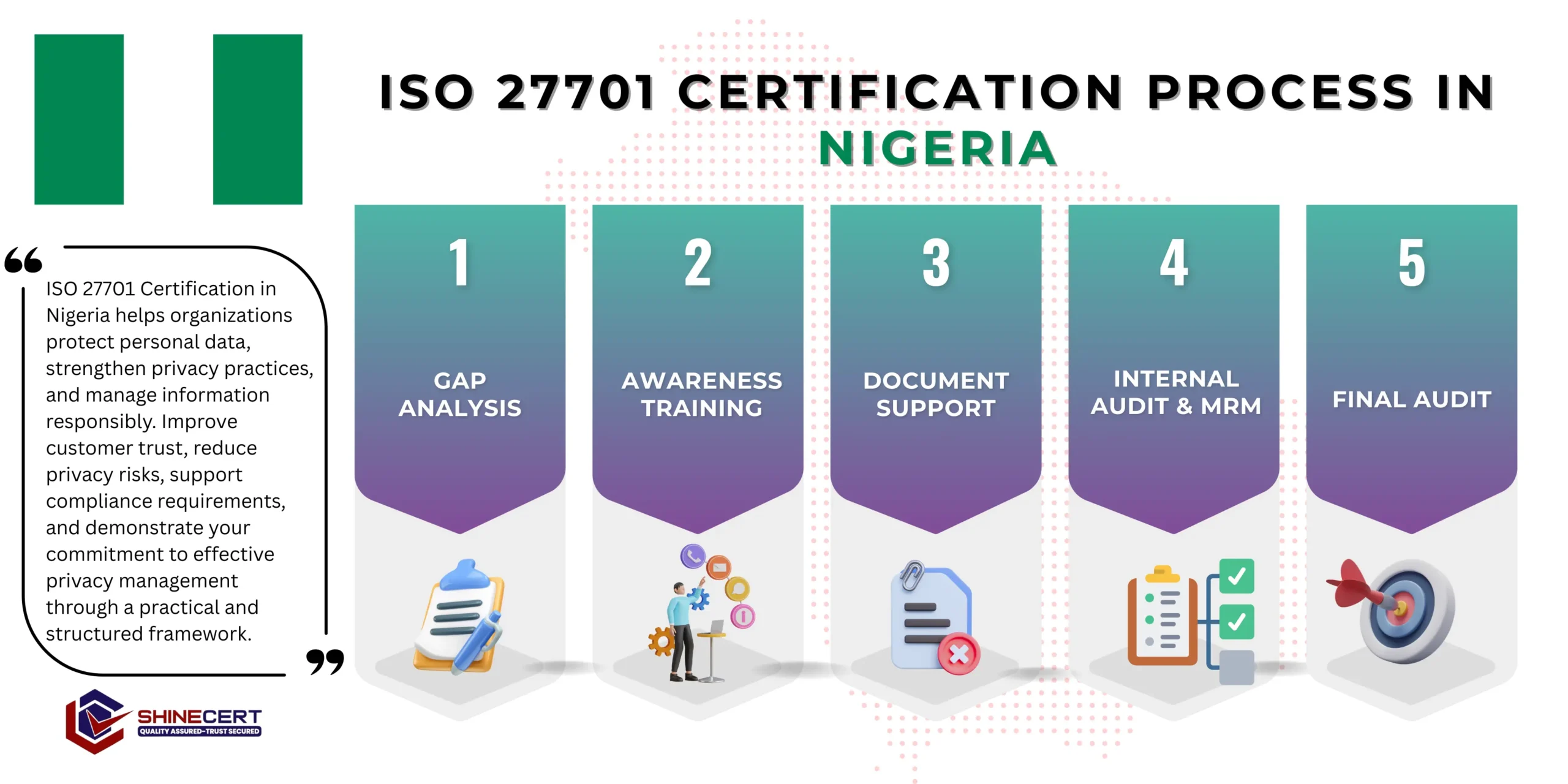
What are the steps to get ISO 27701 Certification in Nigeria?
our services
- ISO Certification Nigeria
- ISO 9001 Certification Nigeria
- ISO 14001 Certification Nigeria
- ISO 27001 Certification Nigeria
- ISO 22000 Certification Nigeria
- ISO 20000-1 Certification Nigeria
- ISO 45001 Certification Nigeria
- ISO 42001 Certification Nigeria
- ISO 13485 Certification Nigeria
- ISO 17025 Certification Nigeria
- ISO 31000 Certification Nigeria
- ISO 22301 Certification Nigeria
- ISO 27701 Certification Nigeria
- ISO 37001 Certification Nigeria
- ISO 50001 Certification Nigeria
- CE Mark Certification Nigeria
- GMP Certification Nigeria
- GDPR Certification Nigeria
- Halal Certification Nigeria
- SOC Certification Nigeria
Our Five-Step Certification Process, in Depth
Gap Assessment
We review your actual data processing activities, current consent and data subject request handling, and NDPA classification status, mapping what we find against ISO 27701's requirements and your genuine regulatory obligations together.
A gap report mapping your real privacy practices against ISO 27701 requirements and your NDPA compliance status side by side.
Documentation
We build your data mapping, consent management records, and data subject rights procedures around your organization's actual data flows, a fintech processing payment and identity data has a meaningfully different privacy risk profile than a professional services firm, and the documentation reflects that specifically.
A complete, version-controlled PIMS documentation set, with data subject rights procedures genuinely operational rather than theoretical.
Implementation
Consent capture, data subject request handling, and data sharing governance move into genuine daily operation, with staff trained on their specific privacy responsibilities.
A functioning PIMS with real privacy controls actively operating around your actual data processing.
Internal Audit and Management Review
We audit against every ISO 27701 clause and cross-check against NDPA obligations specifically, surfacing gaps while stakes are low. Findings go to formal management review with documented decisions on privacy priorities and resourcing.
An internal audit report, management review minutes, and corrective actions closed out before the certification audit.
Certification Audit
Stage 1 confirms your PIMS documentation is genuinely audit-ready; Stage 2 verifies privacy controls are actually operating as documented, including testing whether a data subject request would genuinely be handled correctly. We stay engaged through both stages.
Your ISO 27701 certificate, valid for three years, plus a surveillance audit schedule.
Gap Assessment
We review your actual data processing activities, current consent and data subject request handling, and NDPA classification status, mapping what we find against ISO 27701's requirements and your genuine regulatory obligations together.
A gap report mapping your real privacy practices against ISO 27701 requirements and your NDPA compliance status side by side.
Documentation
We build your data mapping, consent management records, and data subject rights procedures around your organization's actual data flows, a fintech processing payment and identity data has a meaningfully different privacy risk profile than a professional services firm, and the documentation reflects that specifically.
A complete, version-controlled PIMS documentation set, with data subject rights procedures genuinely operational rather than theoretical.
Implementation
Consent capture, data subject request handling, and data sharing governance move into genuine daily operation, with staff trained on their specific privacy responsibilities.
A functioning PIMS with real privacy controls actively operating around your actual data processing.
Internal Audit and Management Review
We audit against every ISO 27701 clause and cross-check against NDPA obligations specifically, surfacing gaps while stakes are low. Findings go to formal management review with documented decisions on privacy priorities and resourcing.
An internal audit report, management review minutes, and corrective actions closed out before the certification audit.
Certification Audit
Stage 1 confirms your PIMS documentation is genuinely audit-ready; Stage 2 verifies privacy controls are actually operating as documented, including testing whether a data subject request would genuinely be handled correctly. We stay engaged through both stages.
Your ISO 27701 certificate, valid for three years, plus a surveillance audit schedule.
Certification Validity, Surveillance Audits, and Recertification
An ISO 27701 certificate is valid for three years from the date it’s issued, aligned with the underlying ISO 27001 certificate it extends. During years one and two, your certification body conducts an annual surveillance audit, narrower in scope, typically sampling data subject request handling and consent records and confirming previously identified nonconformities were genuinely closed. Before the three-year mark, a full recertification audit, comparable in depth to your original Stage 2 audit, confirms your PIMS has continued functioning as your data processing activities evolved. Passing recertification issues a new three-year certificate.
Cost of ISO 27701 Certification in Nigeria, What Actually Drives It
| Organization Profile | Relative Investment Level | Why |
|---|---|---|
| Small, limited data processing scope | Lower | Narrower data mapping and simpler consent management |
| Medium, moderate data processing or NDPA EHL entity | Moderate | Broader data mapping and more extensive rights processes |
| Larger, extensive data processing or NDPA UHL entity | Higher | Extensive data mapping and third-party governance complexity |
| Combined with new ISO 27001 implementation | Higher combined, but lower than fully separate engagements | Shared risk assessment infrastructure reduces combined cost |
- Whether you already hold ISO 27001 certification : Organizations extending an existing ISMS face considerably less scope than those building both information security and privacy management simultaneously.
- Volume and sensitivity of personal data processed : A business processing large volumes of sensitive personal or financial data faces a genuinely broader data mapping and risk assessment scope than one with limited, low-sensitivity data.
- NDPA classification tier : Organizations classified as Ultra-High Level or Extra-High Level face genuinely more extensive regulatory expectations, typically translating into a broader ISO 27701 scope as well.
- Number of third-party data sharing relationships : Each additional data processor or third party your organization shares personal data with expands the due diligence and agreement documentation work required.
- Certification body fees, tracked separately from our consulting fees : The certification audit itself is conducted and invoiced directly by an independently accredited certification body, separate from ShineCert’s implementation work.
- Internal capacity to contribute : A data protection officer or privacy lead who can genuinely own documentation, data mapping, and internal audit coordination reduces the consulting hours required.
ISO 27701 Benefits Nigerian Businesses Actually Get
ISO 27701’s structured approach to consent management and data subject request handling gives your organization genuinely operational processes for meeting NDPA rights obligations, not just policy language.
Systematic data mapping and processing records considerably simplify annual CAR filing for organizations classified as Data Controllers or Processors of Major Importance.
ISO 27701 is understood and trusted globally as evidence of genuine privacy management maturity, particularly valuable for Nigerian businesses processing data on behalf of international clients.
Systematic privacy risk assessment catches genuine gaps, inadequate consent records, undocumented data sharing, unclear retention periods, before they become NDPC compliance findings or data subject complaints.
ISO 27701 requires assigning genuine ownership for privacy decisions, replacing the common pattern of privacy being treated as a general IT or legal concern with no specific operational owner.
Demonstrable, independently verified privacy practice is a genuine differentiator in sectors handling sensitive personal or financial data, where trust is directly tied to business relationships.
Organizations already certified to ISO 27001 find ISO 27701 a considerably more efficient path to privacy certification than building privacy governance from scratch, since core risk assessment and management review infrastructure carries directly across.
The standard requires genuine, documented data sharing agreements and due diligence on data processors, an area many organizations manage informally until certification forces real structure onto it.
ISO 27701 requires genuinely identifying privacy-specific risks in your actual data processing activities, cross-border data transfers, third-party sharing, retention practices, and building real, documented controls around each one.
Mandatory Documents Required for ISO 27701 Implementation
A documented statement defining which personal data processing activities, systems, and business units the privacy information management system covers, aligned with your NDPA data controller or processor classification.
A documented policy, approved by top management, expressing genuine commitment to protecting personal data and complying with the NDPA and applicable data subject rights obligations.
A documented, actively maintained inventory of what personal data you collect, why, how it’s processed, where it’s stored, and who it’s shared with, the foundational record of NDPC compliance audits directly examined.
Documentation and evidence showing consent is genuinely obtained, recorded, and withdrawable in line with NDPA requirements, not assumed or inferred.
A documented, operational procedure for receiving and responding to data subject requests, access, correction, deletion, objection, within a genuinely defined and realistic timeframe.
Documented agreements and due diligence records for any third party your organization shares personal data with, including genuine assessment of that party’s own privacy practices.
Documentation of privacy risk assessments conducted for new or higher-risk data processing activities, evaluating genuine impact on data subjects before processing begins.
A documented procedure defining how long personal data is genuinely retained and how it’s securely disposed of once no longer needed.
A documented procedure for detecting, assessing, and notifying the NDPC and affected data subjects of a personal data breach within the required timeframe.
A planned internal audit cycle, documented management review decisions, and evidence staff handling personal data have received relevant privacy training.
Challenges Organizations Face, Implementation, Risk Management, Audit, and Ongoing Certification
- Challenges during implementation : Organizations sometimes assume general data security measures already satisfy privacy requirements, when ISO 27701 specifically requires privacy-distinct processes like consent tracking and data subject rights handling that security controls alone don’t address.
- Challenges in risk management : A common gap is assessing privacy risk only for directly collected data while overlooking risk introduced through third-party data sharing or data enrichment from external sources.
- Challenges during internal and certification audits : Auditors specifically test whether a data subject request would genuinely be handled correctly within the process as documented, a rights request procedure that exists on paper but has never actually been executed is a common and telling gap.
- Challenges maintaining certification after the initial audit : Data mapping tends to fall out of date as new systems, data sources, or third-party integrations are added after certification, particularly when no one has clear, ongoing ownership for keeping the data inventory genuinely current.
Case Study
A Lagos-based HR technology platform managing recruitment and employee data for corporate clients approached us after several client companies began asking, as part of their own vendor due diligence, specifically how the platform handled data subject access requests and consent withdrawal, questions the founding team could answer in principle but hadn’t formalized into a documented, repeatable process.
Our gap assessment found the platform’s underlying data security was already ISO 27001-certified and genuinely solid, but privacy-specific processes, consent tracking separate from general terms acceptance, a defined data subject request workflow, and documented data sharing agreements with corporate clients, didn’t yet exist as formal, auditable practice. Because the ISO 27001 foundation was already in place, we were able to build the ISO 27701 extension directly onto existing risk assessment and management review infrastructure.
Certification took just under three months, considerably faster than a combined build would have taken, and the resulting documentation directly answered the client due diligence questions that had originally prompted the engagement.
This reflects a pattern we see often, solid underlying security undermined by privacy-specific processes that were never formally separated out and documented, rather than a single specific engagement.
Industries and Sectors We Certify in Nigeria and Which Standards Each Actually Needs
Fintech and digital payments
ISO 27701 directly addresses NDPA privacy obligations for sensitive financial and identity data; pair with ISO 27001 for the underlying information security foundation.
Read moreHealthtech and health data platforms
ISO 27701 addresses genuinely sensitive health data privacy requirements; pair with ISO 27001 for information security.
Read moreInsurtech
ISO 27701 addresses privacy risk in underwriting and claims data specifically; pair with ISO 27001 for the broader data security foundation.
Read moreHR technology and recruitment platforms
ISO 27701 addresses candidate and employee data privacy requirements; pair with ISO 27001 for information security.
Read moreMarketing technology and customer data platforms
ISO 27701 directly addresses consent management for marketing and customer profiling data; pair with ISO 42001 if AI-driven personalization is involved.
Read moreProfessional services handling client personal data
ISO 27701 addresses genuine client data privacy obligations; pair with ISO 27001 for overall information security.
Read moreWhy Choose ShineCert for ISO 27701 Certification Nigeria?
ShineCert brings 10 years of ISO consulting and certification experience to Nigeria’s market, coordinated through our Riyadh and India offices with services delivered remotely or on-site depending on what your engagement genuinely needs. We’ve guided more than 10,000 organizations through ISO certification worldwide, and we build every Nigeria privacy engagement around your actual data processing activities and NDPA classification, not a generic template lifted from a different regulatory environment. ShineCert is the best ISO consultant in Nigeria.
Choosing a Certification Body in Nigeria?
What to Check | Why It Matters |
Accreditation under a recognized international accreditation framework | Confirms genuine, internationally recognized certification |
Genuine familiarity with the NDPA and NDPC compliance framework specifically | Ensures the auditor understands how your PIMS connects to your actual regulatory obligations |
Experience certifying both ISO 27001 and ISO 27701 together | Relevant if you’re pursuing both standards simultaneously rather than extending an existing ISMS |
A genuine data-subject-rights-testing audit approach | Confirms the auditor checks real process execution, not just documentation review |
Ready to Get Started?
Whether you’re responding to client due diligence questions or strengthening NDPA compliance proactively, we’ll walk through your specific data processing activities and cost factors before proposing a fixed-scope plan, delivered remotely, on-site, or however genuinely fits your project. Book a free consultation or contact us directly to get started.
Frequently Asked Questions
Look for demonstrated experience with your specific data processing profile, genuine familiarity with the NDPA and NDPC compliance framework, and transparent scoping rather than flat package pricing. ShineCert scopes every Nigeria engagement individually.
ISO 27701 is built as an extension of ISO 27001, so most organizations implement it alongside or after ISO 27001. ShineCert can scope a combined implementation for organizations pursuing both together from the start.
Not automatically, but the overlap is substantial, a certified PIMS gives you most of the documented processes the NDPC expects for data subject rights and consent management, considerably strengthening your compliance position.
It genuinely depends on your data processing scale, NDPA classification tier, and whether you already hold ISO 27001, we scope every project individually.
Typically two and a half to eight months depending on organization size and whether ISO 27001 is already in place, see our detailed timeline breakdown above.
ISO 27001 addresses information security broadly; ISO 27701 adds privacy-specific requirements like consent management and data subject rights handling that map directly onto NDPA obligations, which ISO 27001 alone doesn’t cover.
Much of the documentation and data mapping work runs effectively over remote sessions, though certain process verification benefits from on-site presence, we scope the right mix per project.
ShineCert doesn’t maintain a standalone Nigeria office; we coordinate Nigeria engagements from our Riyadh and India offices, with services delivered remotely or on-site as your project requires.