
ISO 37001 Certification in Nigeria
Quick Answer
ISO 37001 is the international standard for anti-bribery management systems, and in Nigeria it addresses a genuinely significant, actively enforced problem: corruption is estimated to have cost the country between ₦7 trillion and ₦25 trillion, with procurement and contract fraud responsible for over 80% of public sector corruption cases. In July 2026, the Economic and Financial Crimes Commission convened a strategic roundtable with the Independent Corrupt Practices Commission, the Code of Conduct Bureau, and the Bureau of Public Procurement specifically to deepen coordination against procurement fraud, signaling genuinely intensifying institutional scrutiny businesses bidding for contracts should expect. ISO 37001 gives your organization a structured, internationally recognized way to demonstrate real anti-bribery controls. Certification typically takes three to five months, and cost depends on genuine factors like organizational complexity and contract exposure, never a flat figure quoted upfront.
What Is ISO 37001, Actually?
ISO 37001 is an international standard, published by the International Organization for Standardization, that sets out requirements for an anti-bribery management system, a structured way an organization prevents, detects, and responds to bribery risk across its own operations, its employees, and its business relationships including agents, contractors, and joint venture partners. It requires genuine due diligence on business associates, controls over financial transactions and gifts, a confidential reporting channel, and clear leadership accountability, going considerably beyond a general code-of-conduct document. Getting certified means an independent, accredited body has formally verified your anti-bribery controls meet the standard’s requirements, giving government procurement bodies, international partners, and investors genuine confidence your organization manages bribery risk systematically, not just on paper.
Why ISO 37001 ABMS Matters So Much in Nigeria Right Now?
- Nigeria’s anti-corruption institutions are actively deepening coordination specifically around procurement fraud : The EFCC’s July 2026 strategic roundtable with the ICPC, Code of Conduct Bureau, and Bureau of Public Procurement was convened explicitly to improve intelligence sharing and eliminate duplication in anti-corruption enforcement, a genuine signal that procurement-related scrutiny is intensifying and becoming more coordinated across agencies rather than remaining siloed.
- Procurement and contract fraud represents the single largest share of Nigeria’s public sector corruption problem : With procurement and contract fraud responsible for over 80% of public sector corruption cases, and total corruption losses estimated at between ₦7 trillion and ₦25 trillion, businesses bidding for public contracts operate in an environment where genuine, demonstrable anti-bribery controls are directly relevant to both compliance risk and reputational standing.
- The EFCC and ICPC maintain genuinely distinct but complementary enforcement mandates that both intersect with private business : The ICPC targets corruption in the public sector specifically, including bribery and abuse of office, while the EFCC investigates financial crimes across all sectors, including private businesses, meaning both public contractors and private companies with significant financial dealings face genuine exposure to enforcement scrutiny.
- International partners and investors increasingly treat anti-bribery certification as a genuine due-diligence baseline for Nigerian business relationships : Given Nigeria’s documented corruption risk profile, international companies and investors increasingly ask for demonstrable anti-bribery controls before entering partnerships or investment relationships, and ISO 37001 certification answers that question with independently verified evidence rather than a policy assurance alone.
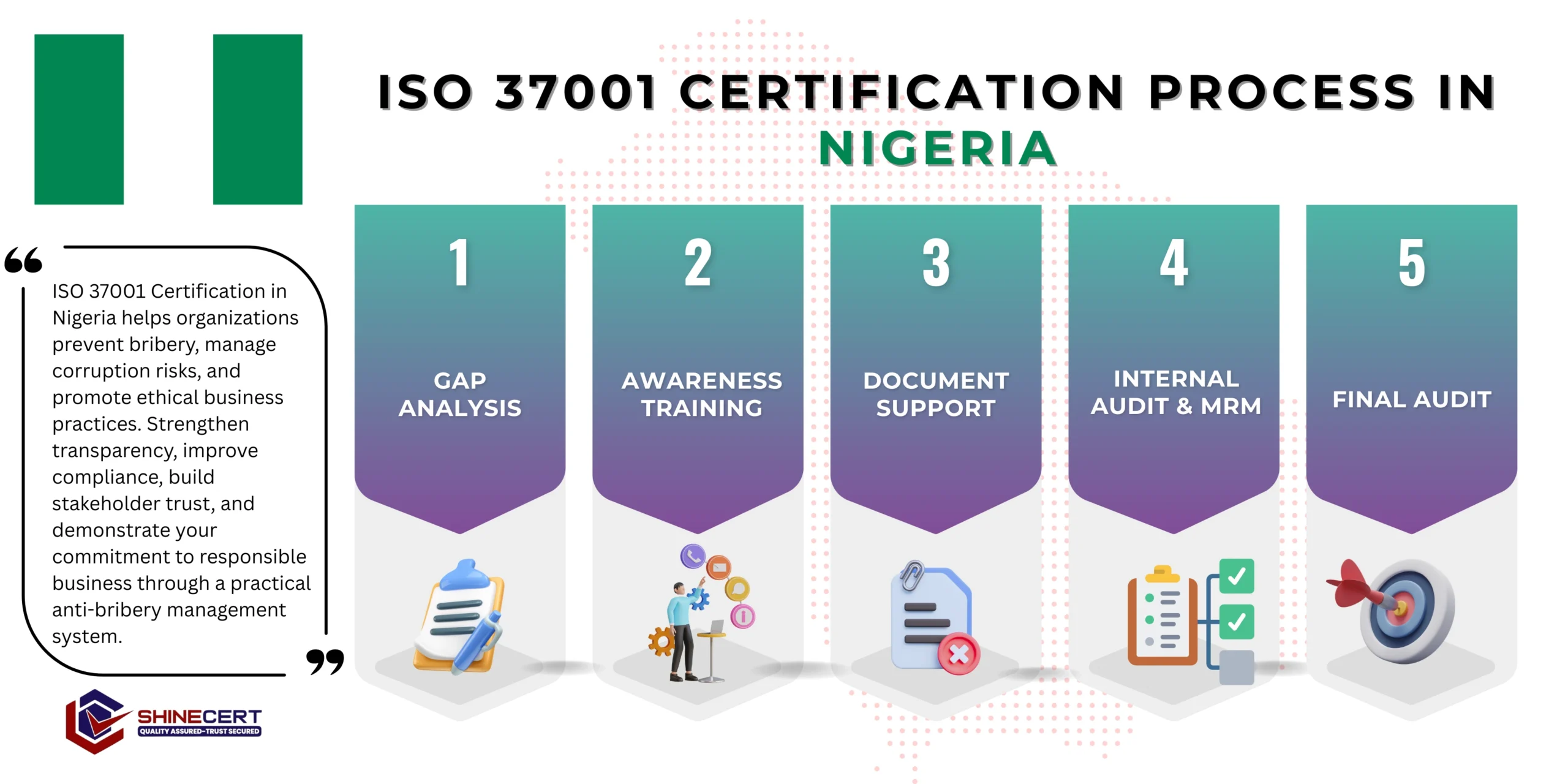
What are the steps to get ISO 37001 Certification in Nigeria?
our services
- ISO Certification Nigeria
- ISO 9001 Certification Nigeria
- ISO 14001 Certification Nigeria
- ISO 27001 Certification Nigeria
- ISO 22000 Certification Nigeria
- ISO 20000-1 Certification Nigeria
- ISO 45001 Certification Nigeria
- ISO 42001 Certification Nigeria
- ISO 13485 Certification Nigeria
- ISO 17025 Certification Nigeria
- ISO 31000 Certification Nigeria
- ISO 22301 Certification Nigeria
- ISO 27701 Certification Nigeria
- ISO 37001 Certification Nigeria
- ISO 50001 Certification Nigeria
- CE Mark Certification Nigeria
- GMP Certification Nigeria
- GDPR Certification Nigeria
- Halal Certification Nigeria
- SOC Certification Nigeria
Our Five-Step Certification Process, in Depth
Gap Assessment
We review your actual business relationships, financial controls, and current bribery risk exposure, particularly around any public procurement or higher-risk contract relationships, mapping what we find against ISO 37001's requirements.
A gap report identifying your real bribery risk exposure and exactly where formal ISO 37001 controls are missing.
Documentation
We build your bribery risk assessment, due diligence procedures, and financial controls around your organization's actual business relationships, a government contractor faces a meaningfully different risk profile than a business with limited public sector exposure, and the documentation reflects that specifically.
A complete, version-controlled ABMS documentation set, with due diligence procedures genuinely tailored to your real business associate relationships.
Implementation
Due diligence processes, financial controls, and the confidential reporting channel move into genuine daily operation, with staff trained on their specific anti-bribery responsibilities.
A functioning ABMS with real controls actively operating around your actual business relationships and transactions.
Internal Audit and Management Review
We audit against every ISO 37001 clause, surfacing gaps while stakes are low. Findings go to formal management review with documented decisions on anti-bribery priorities and resourcing.
An internal audit report, management review minutes, and corrective actions closed out before the certification audit.
Certification Audit
Stage 1 confirms your ABMS documentation is genuinely audit-ready; Stage 2 verifies controls are actually operating as documented, through direct review of due diligence records and staff interviews. We stay engaged through both stages.
Your ISO 37001 certificate, valid for three years, plus a surveillance audit schedule.
Gap Assessment
We review your actual business relationships, financial controls, and current bribery risk exposure, particularly around any public procurement or higher-risk contract relationships, mapping what we find against ISO 37001's requirements.
A gap report identifying your real bribery risk exposure and exactly where formal ISO 37001 controls are missing.
Documentation
We build your bribery risk assessment, due diligence procedures, and financial controls around your organization's actual business relationships, a government contractor faces a meaningfully different risk profile than a business with limited public sector exposure, and the documentation reflects that specifically.
A complete, version-controlled ABMS documentation set, with due diligence procedures genuinely tailored to your real business associate relationships.
Implementation
Due diligence processes, financial controls, and the confidential reporting channel move into genuine daily operation, with staff trained on their specific anti-bribery responsibilities.
A functioning ABMS with real controls actively operating around your actual business relationships and transactions.
Internal Audit and Management Review
We audit against every ISO 37001 clause, surfacing gaps while stakes are low. Findings go to formal management review with documented decisions on anti-bribery priorities and resourcing.
An internal audit report, management review minutes, and corrective actions closed out before the certification audit.
Certification Audit
Stage 1 confirms your ABMS documentation is genuinely audit-ready; Stage 2 verifies controls are actually operating as documented, through direct review of due diligence records and staff interviews. We stay engaged through both stages.
Your ISO 37001 certificate, valid for three years, plus a surveillance audit schedule.
Certification Validity, Surveillance Audits, and Recertification
An ISO 37001 certificate is valid for three years from the date it’s issued. During years one and two, your certification body conducts an annual surveillance audit, narrower in scope, typically sampling due diligence records and confirming previously identified nonconformities were genuinely closed. Before the three-year mark, a full recertification audit, comparable in depth to your original Stage 2 audit, confirms your ABMS has continued functioning throughout the cycle. Passing recertification issues a new three-year certificate.
Cost of ISO 37001 Certification in Nigeria, What Actually Drives It
| Organization Profile | Relative Investment Level | Why |
|---|---|---|
| Small, limited third-party relationships | Lower | Narrower due diligence and risk assessment scope |
| Medium, moderate contract and third-party exposure | Moderate | Broader due diligence across more relationships |
| Larger, government contractor or extensive third-party network | Higher | Extensive due diligence and complex approval control requirements |
| Bundled with ISO 9001 | Moderate-to-higher combined, lower than separate engagements | Shared implementation infrastructure reduces combined cost |
- Number and nature of third-party business relationships : Each additional agent, contractor, or joint venture partner requiring due diligence assessment expands the overall scope considerably.
- Extent of public sector or government contract exposure. Businesses bidding for public procurement contracts face genuinely higher scrutiny expectations and correspondingly more extensive control requirements.
- Existing compliance maturity : Businesses with some documented ethics or compliance policies already in place aren’t starting from zero, those relying entirely on informal practice face more foundational work.
- Certification body fees, tracked separately from our consulting fees : The certification audit itself is conducted and invoiced directly by an independently accredited certification body, separate from ShineCert’s implementation work.
- Whether you’re bundling standards : Building ISO 37001 alongside ISO 9001 shares meaningful implementation infrastructure, reducing combined cost.
- Internal capacity to contribute : A compliance officer or legal lead who can genuinely own documentation, due diligence coordination, and internal audit logistics reduces the consulting hours required.
ISO 37001 Benefits Nigerian Businesses Actually Get
A certified anti-bribery management system provides genuine, documented evidence of ethical business practice, directly relevant given intensifying EFCC, ICPC, and BPP coordination around procurement fraud specifically.
ISO 37001 is understood and trusted globally as evidence of genuine anti-bribery governance, valuable for Nigerian businesses seeking international partnerships or investment.
Systematic due diligence on business associates and financial controls catches genuine bribery risk before it results in an enforcement action or reputational crisis.
ISO 37001 requires genuine, documented anti-bribery policies and training for employees and business associates, replacing informal or assumed ethical standards with an actual, verifiable system.
Demonstrable, independently verified anti-bribery controls are a genuine differentiator when international investors or partners are conducting due diligence on Nigerian business relationships.
The standard requires establishing a real, accessible way for employees to report bribery concerns without fear of retaliation, surfacing genuine problems earlier than they’d otherwise be discovered.
ISO 37001 requires genuine due diligence on agents, contractors, and joint venture partners, addressing a common source of bribery exposure that many organizations don’t systematically manage.
ISO 37001 requires genuinely identifying bribery risk specific to your actual operations, which contracts, relationships, and jurisdictions carry elevated risk, and building real, documented controls around each one.
A certified system strengthens your overall governance standing with boards, investors, and regulators beyond anti-bribery specifically.
Mandatory Documents Required for ISO 37001 Implementation
A documented statement defining which business units, geographies, and relationships the anti-bribery management system covers, including agents, contractors, and joint venture partners where relevant.
A documented policy, approved by top management, expressing genuine, unambiguous commitment to preventing bribery, communicated clearly to employees and business associates.
A documented, actively maintained assessment of bribery risk specific to your actual operations, which contracts, relationships, regions, and transaction types carry elevated risk, updated as your business and its risk exposure change.
A documented process for assessing bribery risk in business associates, agents, contractors, joint venture partners, distributors, before and during the relationship, with actual due diligence records, not just a signed declaration.
Documented controls over payments, gifts, hospitality, and donations, including approval thresholds and record-keeping requirements that make bribery genuinely harder to conceal.
Evidence that employees, particularly those in higher-risk roles like procurement or business development, have received relevant anti-bribery training.
A documented, genuinely confidential channel for employees and business associates to report bribery concerns, with a defined process for investigating reports without retaliation against the reporter.
Documentation showing reported concerns are genuinely investigated and, where substantiated, result in real corrective action.
A documented list of applicable requirements, relevant Nigerian anti-corruption legislation, sector-specific procurement regulations, along with evidence of how each is being met.
A planned internal audit cycle, documented management review decisions, and evidence of top management’s genuine, visible commitment to the anti-bribery program.
Challenges Organizations Face, Implementation, Risk Management, Audit, and Ongoing Certification
- Challenges during implementation : Businesses sometimes treat anti-bribery policy as a document exercise rather than genuinely embedding due diligence and approval controls into actual day-to-day procurement and business development practice.
- Challenges in risk management : A common gap is conducting due diligence on new business associates at the start of a relationship but never genuinely revisiting it as the relationship continues, missing changes in risk that emerge over time.
- Challenges during internal and certification audits : Auditors specifically probe whether the confidential reporting channel is genuinely trusted and used, not just theoretically available, a reporting channel with zero reports over several years is itself sometimes a flag worth investigating rather than automatic evidence of a clean record.
- Challenges maintaining certification after the initial audit : Due diligence records for ongoing business relationships tend to fall out of date if not genuinely refreshed periodically, and new hires in higher-risk roles need continued training rather than a one-time onboarding session.
Case Study
A mid-size construction firm bidding regularly on public infrastructure contracts across several Nigerian states approached us after a competitor’s disqualification from a major tender over procurement irregularities made leadership genuinely concerned about their own third-party relationships, particularly with local agents and subcontractors they had engaged informally over the years without any structured due diligence process.
Our gap assessment found the firm’s core project delivery practices were genuinely solid, but there was no documented due diligence process for engaging agents or subcontractors, no formal approval threshold for gifts or hospitality connected to tender relationships, and no confidential channel for staff to raise concerns. The firm had, in practice, avoided problematic relationships largely through leadership’s personal judgment rather than a systematic, documented process.
We built a due diligence framework covering their existing and future agent and subcontractor relationships, formal approval controls for gifts and hospitality tied to tender processes, and a confidential reporting channel. Certification took just under five months, and the resulting ABMS documentation became a genuine, positive differentiator in their next major tender submission.
This reflects a pattern we see often, genuinely good judgment at the leadership level that had never been formalized into a documented, defensible system, rather than a single specific engagement.
Industries and Sectors We Certify in Nigeria and Which Standards Each Actually Needs
Construction and infrastructure (public contracts)
ISO 37001 is close to essential given direct exposure to public procurement scrutiny; pair with ISO 9001 for project quality management.
Read moreOil and gas services
ISO 37001 addresses genuine bribery risk in a sector with significant government and international counterparty exposure; pair with ISO 45001 for occupational safety.
Read moreBanking and financial services
ISO 37001 addresses bribery risk alongside broader financial crime exposure; pair with ISO 27001 for information security.
Read moreImport/export and trading businesses
ISO 37001 addresses genuine bribery risk in customs and cross-border transaction relationships; pair with ISO 9001 for quality management.
Read moreGovernment-facing consulting and professional services
ISO 37001 directly addresses procurement-related bribery risk relevant to this sector’s client relationships; pair with ISO 9001 for service quality.
Read moreTelecommunications
ISO 37001 addresses bribery risk in licensing and regulatory relationships; pair with ISO 27001 given the customer data these businesses handle.
Read moreWhy Choose ShineCert for ISO 37001 Certification Nigeria?
ShineCert brings 10 years of ISO consulting and certification experience to Nigeria’s market, coordinated through our Riyadh and India offices with services delivered remotely or on-site depending on what your engagement genuinely needs. We’ve guided more than 10,000 organizations through ISO certification worldwide, and we build every Nigeria anti-bribery engagement around your actual business relationships and contract exposure, not a generic template lifted from a different regulatory environment. ShineCert is the best ISO consultant in Nigeria.
Choosing a Certification Body in Nigeria?
What to Check | Why It Matters |
Accreditation under a recognized international accreditation framework | Confirms genuine, internationally recognized certification |
Genuine familiarity with Nigeria’s anti-corruption enforcement landscape | Ensures the auditor understands how your ABMS connects to your actual regulatory exposure |
Experience with your specific sector’s bribery risk profile | Public contracting, oil and gas, and financial services carry genuinely different risk considerations |
A genuine due-diligence-verification audit approach | Confirms the auditor checks real business associate records, not just documentation review |
Ready to Get Started?
Whether you’re strengthening a tender submission or responding to genuine third-party risk concerns, we’ll walk through your specific business relationships and cost factors before proposing a fixed-scope plan, delivered remotely, on-site, or however genuinely fits your project. Book a free consultation or contact us directly to get started.
Frequently Asked Questions
Look for demonstrated experience with Nigeria’s anti-corruption enforcement landscape, genuine familiarity with public procurement scrutiny, and transparent scoping rather than flat package pricing. ShineCert scopes every Nigeria engagement individually.
No, certification means your organization has genuine, documented anti-bribery controls in place, which considerably reduces actual bribery risk and strengthens your position if scrutiny ever arises, but it isn’t a guarantee against investigation.
It genuinely depends on your number of third-party relationships and public sector contract exposure, we scope every project individually.
Typically two and a half to eight months depending on organization size and third-party relationship complexity, see our detailed timeline breakdown above.
No, while public procurement exposure is a significant driver, any business with third-party relationships, international partnerships, or investor due diligence expectations benefits from demonstrable anti-bribery controls.
Certification means your organization has a documented process for investigating reported concerns and taking corrective action, the goal is that genuine problems surface and get addressed, not that they never occur.
Much of the documentation and risk assessment work runs effectively over remote sessions, though certain due diligence verification benefits from in-person involvement, we scope the right mix per project.
ShineCert doesn’t maintain a standalone Nigeria office; we coordinate Nigeria engagements from our Riyadh and India offices, with services delivered remotely or on-site as your project requires.