
ISO 31000 Certification in Nigeria
Quick Answer
ISO 31000 is the international guideline standard for risk management, and unlike ISO 9001 or ISO 27001, it isn’t a certifiable management system standard, no accredited body issues an “ISO 31000 certificate.” Instead, organizations implement its risk management framework and principles, and can pursue an independent conformity assessment or gap assessment against the standard’s guidance. In Nigeria, that framework is genuinely valuable given real, ongoing exposure to exchange rate movement, monetary policy shifts, and regional security considerations that materially affect business planning. ShineCert helps Nigerian businesses build a structured ISO 31000-aligned risk management framework, typically over two to four months, with cost depending on genuine factors like organizational complexity and existing risk practices.
What Is ISO 31000, Actually?
ISO 31000 is an international standard, published by the International Organization for Standardization, that provides guidelines and principles for managing risk in any organization, regardless of size or sector. Unlike management system standards such as ISO 9001 or ISO 45001, it doesn’t specify auditable requirements that an accredited certification body verifies, it’s genuinely a framework and set of principles, describing how organizations should approach identifying, analyzing, evaluating, and treating risk as an integrated part of governance and decision-making, rather than a bolt-on compliance exercise. Because of this, there’s no formal “ISO 31000 certification” in the way there is for ISO 9001. What ShineCert offers instead is structured implementation support and an independent conformity or gap assessment against the standard’s guidance, giving your organization a credible, internationally recognized framework and a documented assessment of how well it’s actually applied.
Why the ISO 31000 Risk Management Framework Matters So Much in Nigeria Right Now?
- Naira exchange rate movement remains a genuine, material planning variable even amid recent stabilization : After extreme volatility that saw the exchange rate spike above ₦1,600 to the US dollar in early 2025, the rate has since settled into a considerably calmer ₦1,350 to ₦1,430 range, with daily volatility dropping sharply. That stabilization is genuinely welcome, but economists are clear it remains conditional, a fall in foreign reserves, policy inconsistency, or security-driven capital outflows could still disrupt it, meaning businesses with import exposure or foreign-denominated obligations need a genuine, structured way to plan for both continued stability and renewed volatility.
- The Central Bank of Nigeria’s tight monetary policy stance directly shapes business borrowing and investment decisions : With the Monetary Policy Rate held at historically elevated levels and the Cash Reserve Ratio kept high specifically to consolidate inflation control and FX stability, financing costs and credit availability remain genuinely sensitive to CBN policy decisions, a structured risk framework helps businesses build financing and investment decisions around realistic policy scenarios rather than assuming current conditions are permanent.
- Regional security and political considerations continue to carry genuine, sector-specific operational risk : Businesses operating across multiple Nigerian states, or in sectors with physical infrastructure exposure, continue to face real security-related operational risk that varies considerably by region, a systematic risk framework helps structure how these considerations feed into site selection, logistics planning, and insurance decisions rather than being addressed informally or reactively.
- Nigeria’s broader push toward stronger corporate governance increasingly expects documented risk management : As institutional investors, regulators, and larger corporate partners scrutinize governance practices more closely, a structured, internationally recognized risk management framework increasingly functions as a genuine credibility signal in board reporting, investment due diligence, and partnership discussions.
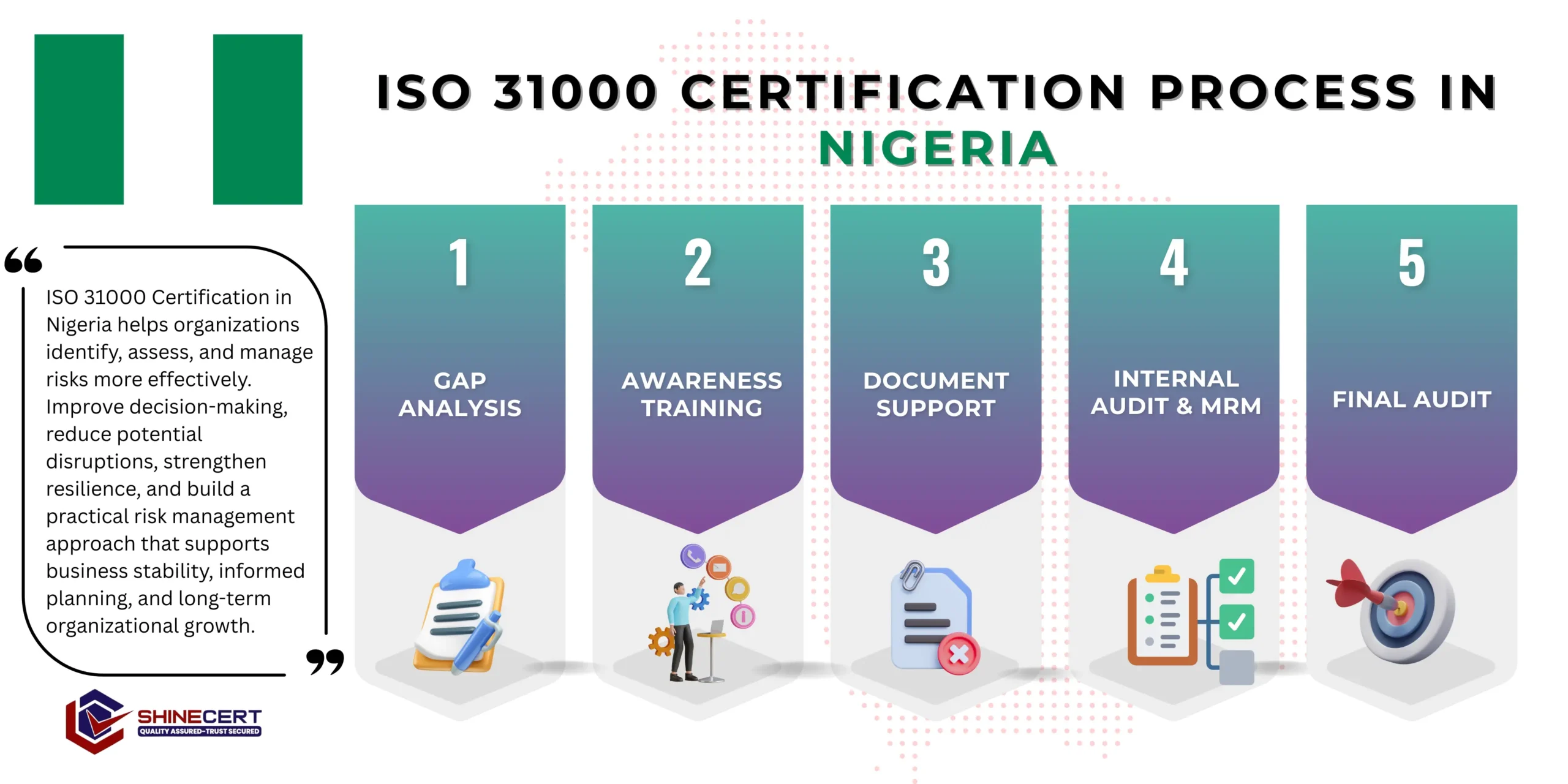
What are the steps to get ISO 31000 Certification in Nigeria?
our services
- ISO Certification Nigeria
- ISO 9001 Certification Nigeria
- ISO 14001 Certification Nigeria
- ISO 27001 Certification Nigeria
- ISO 22000 Certification Nigeria
- ISO 20000-1 Certification Nigeria
- ISO 45001 Certification Nigeria
- ISO 42001 Certification Nigeria
- ISO 13485 Certification Nigeria
- ISO 17025 Certification Nigeria
- ISO 31000 Certification Nigeria
- ISO 22301 Certification Nigeria
- ISO 27701 Certification Nigeria
- ISO 37001 Certification Nigeria
- ISO 50001 Certification Nigeria
- CE Mark Certification Nigeria
- GMP Certification Nigeria
- GDPR Certification Nigeria
- Halal Certification Nigeria
- SOC Certification Nigeria
Our Five-Step Implementation and Assessment Process, in Depth
Risk Landscape Assessment
We work directly with leadership to map your organization’s genuine risk exposure, currency and financing risk, operational and security risk across your actual regions of operation, regulatory risk, and strategic risk, rather than starting from a generic risk category list.
A risk landscape report reflecting your organization’s actual, specific exposure, not generic industry assumptions.
Framework Design
We build your risk management policy, framework documentation, and initial risk register around how your organization genuinely makes decisions, ensuring the framework integrates into real governance rather than sitting alongside it as a separate exercise.
A complete, version-controlled risk management framework and populated risk register specific to your organization.
Implementation
Risk treatment plans and ownership move into real governance practice, risk considerations genuinely feed into board discussions, investment decisions, and operational planning, rather than existing only in a document.
A functioning risk management framework with real decision-making integration and assigned ownership.
Internal Review
We test the framework against realistic decision scenarios relevant to your organization, a currency shock scenario, a security disruption scenario, a financing cost scenario, to confirm it genuinely holds up under pressure rather than only in theory.
A stress-tested framework with any gaps identified and addressed before external assessment.
Conformity Assessment
An independent assessment against ISO 31000’s guidance evaluates how genuinely your framework reflects the standard’s principles and process. Since this isn’t accredited certification, the output is a documented conformity assessment report rather than a certificate.
A documented conformity assessment report you can share with boards, investors, and partners as evidence of a structured, internationally aligned risk management practice.
Risk Landscape Assessment
We work directly with leadership to map your organization’s genuine risk exposure, currency and financing risk, operational and security risk across your actual regions of operation, regulatory risk, and strategic risk, rather than starting from a generic risk category list.
A risk landscape report reflecting your organization’s actual, specific exposure, not generic industry assumptions.
Framework Design
We build your risk management policy, framework documentation, and initial risk register around how your organization genuinely makes decisions, ensuring the framework integrates into real governance rather than sitting alongside it as a separate exercise.
A complete, version-controlled risk management framework and populated risk register specific to your organization.
Implementation
Risk treatment plans and ownership move into real governance practice, risk considerations genuinely feed into board discussions, investment decisions, and operational planning, rather than existing only in a document.
A functioning risk management framework with real decision-making integration and assigned ownership.
Internal Review
We test the framework against realistic decision scenarios relevant to your organization, a currency shock scenario, a security disruption scenario, a financing cost scenario, to confirm it genuinely holds up under pressure rather than only in theory.
A stress-tested framework with any gaps identified and addressed before external assessment.
Conformity Assessment
An independent assessment against ISO 31000’s guidance evaluates how genuinely your framework reflects the standard’s principles and process. Since this isn’t accredited certification, the output is a documented conformity assessment report rather than a certificate.
A documented conformity assessment report you can share with boards, investors, and partners as evidence of a structured, internationally aligned risk management practice.
Ongoing Review and Reassessment
Because ISO 31000 isn’t a certifiable standard, there’s no fixed three-year certificate cycle or formal surveillance audit schedule. What genuinely matters is that your risk register and framework stay current as your business and Nigeria’s operating environment evolve, leading organizations typically conduct a full framework review annually, alongside more frequent reviews of specific high-priority risks like currency exposure, which can shift meaningfully within a single quarter. ShineCert can support periodic reassessment on whatever cycle genuinely fits your organization’s risk profile and reporting needs.
Cost of ISO 31000 Implementation in Nigeria, What Actually Drives It
| Organization Profile | Relative Investment Level | Why |
|---|---|---|
| Small, single-location operation | Lower | Narrower risk landscape and simpler framework design |
| Medium, multi-department operation | Moderate | Broader risk categories and more extensive stakeholder engagement |
| Larger, multi-region or multi-entity operation | Higher | Extensive risk mapping and framework integration across regions and entities |
| Bundled with ISO 9001 or ISO 27001 | Moderate-to-higher combined, lower than separate engagements | Shared risk assessment infrastructure reduces combined cost |
- Nature and complexity of your business : A business with significant currency exposure, multi-region operations, or complex financing structures faces a genuinely broader risk landscape than a simpler, single-location operation.
- Number of business units and stakeholders : Framework design requires genuine engagement with leadership across each relevant business unit, and more units mean more stakeholder time and integration work.
- Existing risk management maturity : Businesses with some documented risk practices already in place, even informal ones, aren’t starting from zero, those with no structured risk practice face more foundational work.
- Whether you’re bundling with a certifiable standard : Building your ISO 31000 framework alongside ISO 9001 or ISO 27001 shares meaningful risk assessment infrastructure, reducing combined cost.
- Depth of conformity assessment required : A lighter internal gap assessment costs less than a more extensive, board-report-ready conformity assessment intended for external investor or partner review.
- Internal capacity to contribute : A risk officer or finance leader who can genuinely own framework documentation and stakeholder coordination reduces the consulting hours required.
ISO 31000 Benefits Nigerian Businesses Actually Get
A formal risk framework gives leadership a consistent, repeatable way to evaluate major decisions, market entry, capital investment, financing structure, against Nigeria’s genuinely variable macroeconomic and security backdrop, rather than relying on ad hoc judgment each time.
ISO 31000’s principles are understood and respected globally, giving international investors, partners, and lenders confidence in how your organization approaches risk, even without a formal certificate.
A systematic framework helps businesses build genuine contingency planning around exchange rate and interest rate scenarios, rather than being caught unprepared if current stability shifts.
Documented, structured risk management is increasingly expected by institutional investors and larger corporate partners as part of genuine governance due diligence.
Systematic risk identification across regions, suppliers, and operations helps businesses build genuine contingency plans before a disruption occurs, not after.
ISO 31000’s risk management principles feed directly into the risk assessment components of ISO 9001, ISO 27001, ISO 45001, and other certifiable management systems, making it a genuinely efficient starting point for organizations pursuing multiple standards.
The framework requires assigning genuine ownership for risk decisions across the organization, replacing the common pattern of risk being everyone’s concern in theory and no one’s specific responsibility in practice.
Organizations with a mature risk framework typically respond to disruptions, currency shifts, security incidents, supply chain breaks, with a pre-considered plan rather than genuine improvisation under pressure.
A structured framework gives leadership a genuinely coherent way to report risk exposure and mitigation efforts to boards, investors, and regulators.
ISO 31000 Implementation: Framework Elements, Not Mandatory Documents
Because ISO 31000 is guidance rather than a certifiable requirements standard, it doesn’t specify mandatory documents the way ISO 9001 or ISO 27001 do. What it does describe is a set of framework elements that a genuinely mature risk management practice includes, and these are what ShineCert helps build:
A documented statement of your organization’s genuine commitment to and approach toward risk management, approved by leadership and communicated across the organization.
Documentation describing how risk management is genuinely integrated into your organization’s governance, planning, and operational decision-making, rather than existing as a separate, disconnected activity.
A documented, actively maintained record of identified risks specific to your actual operations, currency exposure, financing risk, security and operational risk, regulatory risk, along with their assessed likelihood, impact, and assigned ownership.
Documentation of the specific actions chosen to treat significant risks, whether through avoidance, mitigation, transfer, or acceptance, with clear accountability for execution.
Evidence that the risk register and treatment plans are genuinely reviewed and updated on a regular cycle, not created once and left static as actual conditions change.
Clear documentation of who owns risk management at each level of the organization, from board oversight down to operational risk ownership.
Challenges Organizations Face, Implementation, Risk Management, Audit, and Ongoing Certification
- Challenges during implementation : Because ISO 31000 has no accredited certificate to work toward, leadership commitment can be harder to sustain through implementation compared to a certifiable standard with a clear external deadline, keeping the framework genuinely prioritized requires connecting it visibly to real decisions, not treating it as a documentation exercise.
- Challenges in risk management : A common gap is building a risk register once and treating it as complete, rather than genuinely revisiting it as conditions change, Nigeria’s currency and policy environment can shift meaningfully within a single quarter, and a static risk register quickly becomes disconnected from actual exposure.
- Challenges during internal review and conformity assessment : Assessors specifically probe whether risk treatment plans actually connect to real decisions made by leadership, a treatment plan that exists on paper but was never genuinely applied when a relevant risk materialized is a common and telling gap.
- Challenges maintaining the framework after initial implementation : Risk registers and treatment plans tend to become stale as new risks emerge and business circumstances change, particularly when no one has clear, ongoing ownership for keeping the framework genuinely current rather than treating it as a one-time project.
Case Study
A Lagos-based building materials importer approached us after the extreme naira volatility of early 2025, when the exchange rate spiked above ₦1,600 to the dollar, disrupted their pricing and financing decisions badly enough that leadership wanted a genuinely structured way to plan for future currency movement, rather than continuing to respond reactively each time the rate shifted.
Our risk landscape assessment found the business had real awareness of its currency exposure but no structured process for translating that awareness into pricing, hedging, or financing decisions, exchange rate risk was discussed informally in leadership meetings without a documented framework connecting the discussion to actual action. We built a risk register centered on currency and financing risk specifically, with treatment plans defining pricing adjustment triggers and financing decision thresholds tied to defined exchange rate bands.
Implementation ran over roughly three months, and when the naira later settled into its current, calmer trading range, leadership had a framework in place to reassess pricing and financing assumptions systematically rather than simply assuming the new stability would hold indefinitely.
This reflects a pattern we see often, genuine awareness of Nigeria’s macroeconomic risk without a structured framework connecting that awareness to actual decisions, rather than a single specific engagement.
Industries and Sectors We Support in Nigeria and Which Standards Each Actually Needs
Banking and financial services
ISO 31000 addresses genuine currency, credit, and regulatory risk central to this sector; pair with ISO 27001 for information security and ISO 22301 for business continuity.
Read moreImport-dependent manufacturing and trading businesses
ISO 31000 directly addresses currency and supply chain risk exposure; pair with ISO 9001 for overall quality management.
Read moreOil and gas services
ISO 31000 addresses genuine operational, security, and market risk; pair with ISO 45001 for occupational safety given elevated sector hazard levels.
Read moreReal estate and construction
ISO 31000 addresses financing cost, currency exposure for imported materials, and regional security risk; pair with ISO 9001 for project quality management.
Read moreMultinational and cross-border businesses
ISO 31000 addresses genuine currency, regulatory, and regional operational risk across multiple markets; pair with ISO 22301 for business continuity planning.
Read moreWhy Choose ShineCert for ISO 31000 Certification Nigeria?
ShineCert brings 10 years of ISO consulting and certification experience to Nigeria’s market, coordinated through our Riyadh and India offices with services delivered remotely or on-site depending on what your engagement genuinely needs. We’ve guided more than 10,000 organizations through ISO implementation and certification worldwide, and we build every Nigeria risk management engagement around your actual currency, financing, and operational risk landscape, not a generic template lifted from a different regulatory environment. ShineCert is the best ISO consultant in Nigeria.
Choosing a Risk Management Partner in Nigeria?
What to Check | Why It Matters |
Genuine understanding that ISO 31000 isn’t accredited certification | A partner offering a formal “ISO 31000 certificate” is misrepresenting how the standard works |
Real familiarity with Nigeria’s currency, monetary policy, and security risk landscape | Ensures the framework reflects your actual operating environment, not generic risk categories |
Experience integrating risk frameworks into genuine governance and decision-making | A framework that sits disconnected from real decisions provides limited practical value |
Ability to connect ISO 31000 work to other management systems you hold or are pursuing | Reduces duplicated effort across ISO 9001, ISO 27001, or other standards |
Ready to Get Started?
Whether you’re planning around currency volatility, financing cost shifts, or broader operational risk, we’ll walk through your specific risk landscape and cost factors before proposing a fixed-scope plan, delivered remotely, on-site, or however genuinely fits your project. Book a free consultation or contact us directly to get started.
Frequently Asked Questions
Look for genuine familiarity with Nigeria’s macroeconomic and security risk landscape, honest clarity that ISO 31000 isn’t accredited certification, and transparent scoping rather than flat package pricing. ShineCert scopes every Nigeria engagement individually.
No accredited body issues a formal ISO 31000 certificate, because it’s a guidance standard rather than a certifiable requirements standard. What ShineCert offers is structured framework implementation plus an independent conformity assessment, giving you credible, documented evidence of a mature risk management practice.
It genuinely depends on your organization’s size, number of business units, and existing risk management maturity, we scope every project individually.
Typically two to six months depending on organization size and risk landscape complexity, see our detailed timeline breakdown above.
It’s relevant at any size, a smaller business with genuine currency or supply chain exposure benefits from a structured framework just as much as a larger corporate, though the framework’s scope scales down considerably.
ISO 31000 doesn’t address currency risk directly, but its framework gives your organization a structured, repeatable way to identify, assess, and plan around currency exposure as one of several genuine risk categories your business faces.
Framework design and documentation work runs effectively over remote sessions, though risk landscape assessment benefits from direct conversation with leadership across your operating regions, we scope the right mix per project.
ShineCert doesn’t maintain a standalone Nigeria office; we coordinate Nigeria engagements from our Riyadh and India offices, with services delivered remotely or on-site as your project requires.