
ISO 22301 Certification in Riyadh
Quick Answer
ISO 22301 is the international standard for Business Continuity Management Systems (BCMS). It sets requirements for planning, establishing, implementing, operating, monitoring, and improving an organization’s ability to continue critical operations during and after disruptive incidents such as cyberattacks, natural events, or supply chain failures.
What Is ISO 22301?
ISO 22301 is the internationally recognized standard for Business Continuity Management Systems. It gives organizations a structured framework for identifying threats to operations, understanding the impact of a disruption should it occur, and building the capability to respond, recover, and keep critical functions running. The standard covers everything from risk and impact analysis through to incident response plans, recovery strategies, and regular testing.
For businesses in Riyadh, ISO 22301 certification means demonstrating, with independent, accredited verification, that the organization has a tested, documented plan for keeping essential services running through disruption rather than simply hoping nothing goes wrong. It’s increasingly requested by giga-project developers, RHQ parent companies, and financial institutions as proof that a supplier or partner won’t become a single point of failure.
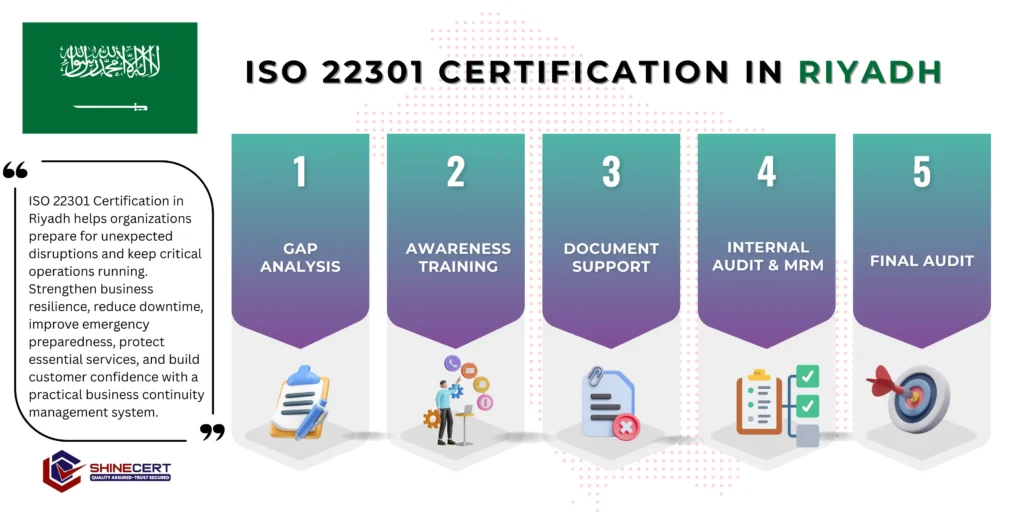
What are the steps to get ISO 22301 Certification in Riyadh?
our services
- ISO Certification Riyadh
- ISO 9001 Certification Riyadh
- ISO 14001 Certification Riyadh
- ISO 27001 Certification Riyadh
- ISO 22000 Certification Riyadh
- ISO 45001 Certification Riyadh
- ISO 42001 Certification Riyadh
- ISO 20000-1 Certification Riyadh
- ISO 13485 Certification Riyadh
- ISO 17025 Certification Riyadh
- CE Mark Certification Riyadh
- GMP Certification Riyadh
- GDPR Certification Riyadh
- Halal Certification Riyadh
ISO 22301 Certification Process in Riyadh
Business Impact Analysis and Gap Assessment
We identify your organization's critical activities, dependencies, and the operational, financial, and reputational impact of losing each one, then compare current continuity practices against ISO 22301's requirements.
A documented business impact analysis and gap assessment against ISO 22301's requirements.
Continuity Strategy and Documentation Development
We help design recovery strategies, resource requirements, and the documented plans, policies, and procedures ISO 22301 requires, tailored to how your organization actually operates.
Complete recovery strategies, resource requirements, and the documented plans and procedures ISO 22301 requires.
Implementation and Team Training
The continuity plans are rolled out across relevant departments, incident response teams are trained on their roles, and communication protocols are established for use during a real disruption.
Trained incident response teams and established communication protocols for use during a disruption.
Exercise, Testing, and Internal Audit
We run tabletop exercises and simulated disruption scenarios to confirm the plans work in practice, then conduct an internal audit and management review to close any remaining gaps before external assessment.
Documented exercise results, internal audit findings, and management review outcomes.
Certification Audit
An accredited certification body conducts a two-stage audit, documentation review followed by an on-site assessment of implementation and testing evidence, before issuing your ISO 22301 certificate, valid for three years with annual surveillance audits.
Your ISO 22301 certificate, valid for three years with annual surveillance audits.
Business Impact Analysis and Gap Assessment
We identify your organization's critical activities, dependencies, and the operational, financial, and reputational impact of losing each one, then compare current continuity practices against ISO 22301's requirements.
A documented business impact analysis and gap assessment against ISO 22301's requirements.
Continuity Strategy and Documentation Development
We help design recovery strategies, resource requirements, and the documented plans, policies, and procedures ISO 22301 requires, tailored to how your organization actually operates.
Complete recovery strategies, resource requirements, and the documented plans and procedures ISO 22301 requires.
Implementation and Team Training
The continuity plans are rolled out across relevant departments, incident response teams are trained on their roles, and communication protocols are established for use during a real disruption.
Trained incident response teams and established communication protocols for use during a disruption.
Exercise, Testing, and Internal Audit
We run tabletop exercises and simulated disruption scenarios to confirm the plans work in practice, then conduct an internal audit and management review to close any remaining gaps before external assessment.
Documented exercise results, internal audit findings, and management review outcomes.
Certification Audit
An accredited certification body conducts a two-stage audit, documentation review followed by an on-site assessment of implementation and testing evidence, before issuing your ISO 22301 certificate, valid for three years with annual surveillance audits.
Your ISO 22301 certificate, valid for three years with annual surveillance audits.
Why Riyadh Businesses Need ISO 22301?
Riyadh’s rapid infrastructure buildout, growing multinational presence, and increasing cyber threat exposure have made business continuity a board-level concern rather than an IT afterthought.
- Giga-project supply chains cannot tolerate single points of failure : Contractors and suppliers feeding New Murabba, King Salman Park, and Riyadh Metro-linked developments operate on tight, interdependent schedules. A disruption at one supplier can cascade across an entire project timeline, and master developers increasingly ask subcontractors to prove they have a continuity plan, not just a safety plan.
- RHQ companies bring global continuity standards to their Riyadh operations : Many of the 700-plus multinational regional headquarters now based in Riyadh under the RHQ Program already run ISO 22301-certified continuity programs elsewhere in their global operations, and expect their Riyadh entity to meet the same bar for group risk reporting.
- Cybersecurity mandates under the NCA increase the case for formal continuity planning : With the National Cybersecurity Authority’s Essential Cybersecurity Controls and the 2025 NCNICC-1 expansion extending mandatory compliance to all private-sector companies, resilience against cyber-driven disruption has become a named regulatory concern. ISO 22301 complements ISO 27001 by covering what happens operationally after an incident occurs, not just how it’s prevented.
- Financial institutions and insurers increasingly ask about continuity readiness : Riyadh banks and insurers underwriting large contracts linked to giga-projects or RHQ relocations are asking supplier due-diligence questions about business continuity capability, particularly for companies handling critical logistics, data, or infrastructure services.
ISO 22301 Certification Cost in Riyadh
- Nature of the business and criticality of operations : A company running critical infrastructure or financial services typically requires a deeper business impact analysis and more robust recovery strategies than a lower-risk service business, which affects the scope and cost of consulting work.
- Number of critical activities and departments in scope : Each additional business function, site, or critical process that needs its own recovery strategy and testing adds to implementation time and therefore total cost.
- Existing continuity maturity : Organizations with informal disaster recovery or IT backup practices already in place need less foundational work than those building continuity planning from scratch.
- Number of employees and geographic spread : Larger, more geographically distributed operations require broader stakeholder engagement, more extensive training, and more complex testing exercises, increasing overall project cost.
- Integration with existing management systems : Businesses that already hold ISO 27001 or ISO 9001 certification can often streamline ISO 22301 implementation by reusing existing risk and document control processes, reducing incremental cost.
- Choice of certification body : International accredited bodies with strong global brand recognition typically charge higher audit fees than regionally established bodies offering equivalent accredited scope.
- Level of consulting support required : A fully guided, end-to-end engagement costs more than a lighter advisory arrangement for organizations with strong internal project management capability.
Mandatory Documents Required (By Clause)
- Clause 4 — Context of the Organization : The organization must define the scope of its BCMS and understand internal and external issues affecting continuity. Document needed: a BCMS Scope Statement and Context Analysis.
- Clause 5 — Leadership : Top management must establish a continuity policy and assign clear roles and responsibilities. Document needed: a signed Business Continuity Policy and organizational roles matrix.
- Clause 6 — Planning : Organizations must identify risks and set measurable continuity objectives. Document needed: Business Continuity Objectives and a Risk Assessment aligned to the BCMS scope.
- Clause 7 — Support : The standard requires competent personnel, awareness, and controlled documentation. Document needed: Training Records and a Document Control Procedure for BCMS records.
- Clause 8 — Operation : This is the operational core: business impact analysis, risk assessment, continuity strategies, plans, and exercise programs. Document needed: a Business Impact Analysis Report, Business Continuity Plans per critical activity, and Exercise and Testing Records.
- Clause 9 — Performance Evaluation : Organizations must monitor, measure, and internally audit the BCMS, and conduct management reviews. Document needed: Internal Audit Reports and Management Review Minutes.
- Clause 10 — Improvement : Nonconformities identified through audits or real incidents must be corrected and used to strengthen the system. Document needed: a Corrective Action Log tracking nonconformities and root-cause resolution.
Industries in Riyadh That Need ISO 22301
Banking and financial services
Riyadh's banks and insurers operate under close regulatory scrutiny from SAMA around operational resilience, and ISO 22301 gives them an internationally recognized structure to formalize continuity planning across branches and digital channels.
Read moreData centers and IT infrastructure providers
As Riyadh's role as a regional technology and AI hub grows under SDAIA's national strategy, data center and hosting providers need demonstrable continuity capability to win enterprise and government contracts.
Read moreLogistics and supply chain companies
Firms moving materials and equipment into Riyadh's giga-project sites manage significant exposure to transport, customs, and supplier disruption, making continuity planning central to keeping delivery commitments.
Read moreHealthcare providers and hospitals
Continuity of clinical services during a disruption is a patient safety issue as much as an operational one, and Riyadh's expanding hospital network increasingly references ISO 22301 alongside clinical accreditation standards.
Read moreTelecommunications and utilities contractors
Companies supporting Riyadh's critical infrastructure, power, water, and telecom networks feeding giga-project developments, are expected to demonstrate resilience against both physical and cyber disruption.
Read moreRHQ multinational entities
Regional headquarters relocated to Riyadh under the RHQ Program frequently need local operations aligned with a parent company's existing ISO 22301-certified global continuity program.
Read moreHospitality and tourism operators
With Riyadh's giga-project-driven hospitality growth around Diriyah Gate and King Salman Park, hotel and event operators are adopting continuity planning to protect against booking disruptions and reputational damage.
Read moreChoosing a Certification Body in Riyadh
| Approach | What You Get | Typical Fit |
|---|---|---|
| DIY (Self-Managed) | Your team interprets the standard, builds documentation, and prepares for audit independently. | Best for organizations with in-house continuity or quality management expertise and time to spare. Higher risk of audit findings if gaps go unnoticed. |
| Consultant-Led | An external consultant guides gap assessment, documentation, and implementation, while your team owns execution. | The most common choice — balances cost against speed and reduces the risk of a failed or delayed audit. |
| ShineCert End-to-End | We manage gap assessment, documentation, implementation, exercise testing, and coordination with the certification body from start to finish. | Best for businesses that want a single accountable partner and the fastest, lowest-risk path to certification. |
Case Study
- A logistics company supplying materials to multiple Riyadh giga-project sites faced a contract requirement from its lead developer to show a certified business continuity plan following a supplier disruption elsewhere in the sector that delayed deliveries by weeks. With no formal plan in place, the company partnered with ShineCert to run a business impact analysis across its warehousing, transport, and customs clearance functions, build recovery strategies for its two highest-risk dependencies, and complete a tabletop exercise simulating a transport route disruption.
- The company achieved ISO 22301 certification ahead of its contract renewal deadline and used the certificate as a differentiator in subsequent giga-project tenders.
Why Choose ShineCert?
ShineCert has spent 10 years helping organizations build continuity capability that holds up under real disruption, not just audit scrutiny. We’ve supported more than 10,000 organizations globally, and our own office based right here in Riyadh means we understand the specific continuity pressures facing giga-project suppliers, RHQ entities, and regulated sectors operating in the city today.
Frequently Asked Questions
ISO 22301 is not currently a blanket legal requirement for all businesses in Riyadh, but it is increasingly requested by giga-project developers, RHQ parent companies, financial institutions, and government tenders as evidence of operational resilience.
Look for a consultant with genuine local Riyadh presence, experience running business impact analyses and continuity exercises for your sector, and a track record supporting giga-project or RHQ-linked clients. ShineCert’s Riyadh-based team has guided organizations across logistics, finance, and technology through the full certification process.
Cost depends on the criticality of your operations, number of business units in scope, existing continuity maturity, and certification body chosen. Contact ShineCert for a scoped quotation based on your organization.
Timelines vary based on organizational complexity and how much continuity planning already exists, but most Riyadh businesses move from gap assessment through to certification audit within a committed, structured engagement.
A disaster recovery plan typically focuses narrowly on IT systems recovery. ISO 22301 covers the entire organization, people, processes, facilities, and suppliers, and requires a management system with ongoing testing, review, and improvement, not a static document.
Yes. Many Riyadh organizations implement ISO 22301 alongside ISO 27001 because information security incidents are one of the most common triggers for business disruption, and the two systems share similar risk assessment and document control structures.