
ISO 22000 Certification
Food Safety Management System
Quick Answer
ISO 22000:2018 is the international standard for food safety management systems (FSMS), certifying that an organization controls food safety hazards across production, handling, and distribution through a structured, auditable management system, HACCP-based hazard analysis, prerequisite programs, traceability, rather than isolated hygiene checklists or a one-off inspection pass. It follows the same Harmonised Structure as ISO 9001 and ISO 45001, making it straightforward to integrate for organizations already certified to those standards. Certification is issued by an accredited certification body after an audit, and most organizations complete implementation and certification in three to five months.
What ISO 22000 Certification Actually Certifies?
ISO 22000 certification confirms that an organization’s food safety management system (FSMS) has been independently audited and found to conform to the international standard governing food safety across the entire food chain, from primary producers through processors, manufacturers, and food service. Its technical foundation is Hazard Analysis and Critical Control Points (HACCP), the internationally established methodology for identifying and controlling food safety hazards, but ISO 22000 wraps HACCP in the same management-system discipline (Harmonised Structure Clauses 4–10) shared with ISO 9001 and other ISO standards, adding leadership accountability, risk-based thinking, and a formal internal audit and management review cycle around the hazard analysis itself.
Certification confirms the organization has a functioning system for identifying food safety hazards, controlling them through prerequisite programs (PRPs) and critical control points (CCPs), and maintaining traceability sufficient to support a rapid, effective recall if something goes wrong, not that a food safety incident can never occur, but that the organization is genuinely equipped to prevent and respond to one.
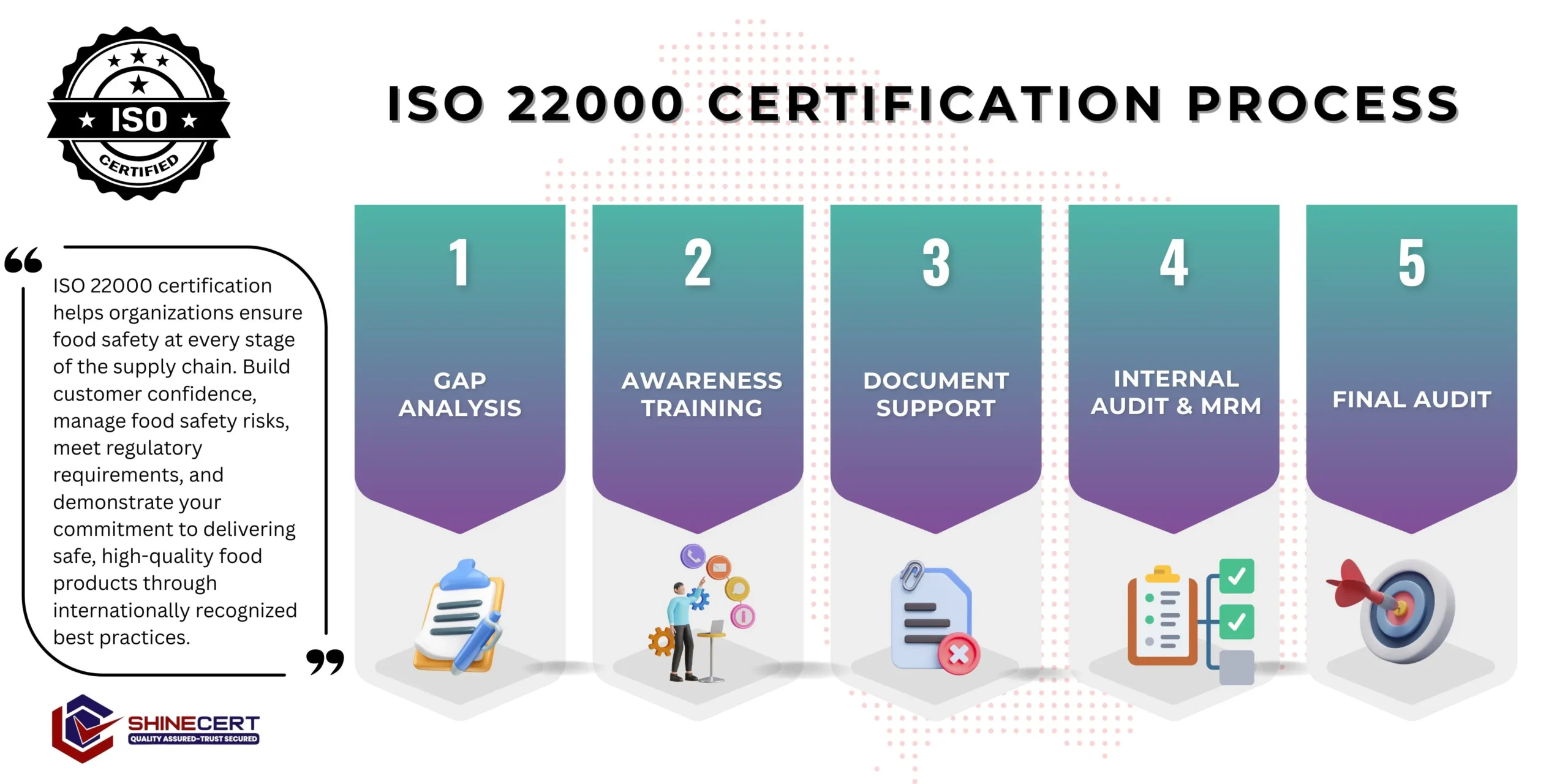
What are the steps to get ISO 22000 Certification?
our services
- ISO 9001 Certification
- ISO 14001 Certification
- ISO 27001 Certification
- ISO 22000 Certification
- ISO 45001 Certification
- ISO 13485 Certification
- ISO 20000 Certification
- ISO 17025 Certification
- CE Mark Certification
- GMP Certification
- Halal Certification
- SOC Certification
The ISO 22000 Certification Process: Implementation Framework
Clause 4: Context and Clause 5: Leadership
Define the FSMS scope across the specific stage(s) of the food chain the organization operates in, identify interested parties and food safety-related legal requirements, and secure documented top management commitment to food safety culture — a specific emphasis ISO 22000 places on leadership more explicitly than the older HACCP-alone approach did.
FSMS scope statement, food safety legal/regulatory register, and a food safety policy.
Clause 6/8: Planning and Hazard Analysis
This is the technical core: a documented hazard analysis identifying biological, chemical, and physical hazards relevant to the specific products and processes in scope, followed by the establishment of prerequisite programs (PRPs — hygiene, pest control, facility maintenance, supplier control), operational PRPs (OPRPs) for hazards that need more targeted control than general PRPs provide, and critical control points (CCPs) with defined critical limits, monitoring procedures, and corrective actions for hazards requiring the most rigorous control.
A completed hazard analysis, documented PRPs and OPRPs, and a CCP plan with critical limits and monitoring procedures.
Clause 7: Support and Competence
Food safety-specific competence and training (including HACCP-specific training for relevant staff), controlled documentation, and communication mechanisms across the food chain, including with suppliers and, where relevant, with regulatory authorities.
Food safety training records and a controlled FSMS document register.
Operational Control and Traceability
Implementation of the PRP, OPRP, and CCP controls established above, plus a traceability system capable of tracing product one step forward and one step back through the supply chain — a specific, testable requirement, not just a general record-keeping intention — and an emergency preparedness and recall procedure that's been tested, not just documented.
Operating PRP/OPRP/CCP controls, a tested traceability system, and a tested product recall procedure.
Performance Evaluation and Improvement
Verification and validation activities confirming hazard controls are actually working (not just implemented on paper), a structured internal audit program, management review with food safety-specific inputs, and corrective action for any nonconformity or near-miss.
Verification and validation records, completed internal audit cycle, management review records, and a corrective action log.
Clause 4: Context and Clause 5: Leadership
Define the FSMS scope across the specific stage(s) of the food chain the organization operates in, identify interested parties and food safety-related legal requirements, and secure documented top management commitment to food safety culture — a specific emphasis ISO 22000 places on leadership more explicitly than the older HACCP-alone approach did.
FSMS scope statement, food safety legal/regulatory register, and a food safety policy.
Clause 6/8: Planning and Hazard Analysis
This is the technical core: a documented hazard analysis identifying biological, chemical, and physical hazards relevant to the specific products and processes in scope, followed by the establishment of prerequisite programs (PRPs — hygiene, pest control, facility maintenance, supplier control), operational PRPs (OPRPs) for hazards that need more targeted control than general PRPs provide, and critical control points (CCPs) with defined critical limits, monitoring procedures, and corrective actions for hazards requiring the most rigorous control.
A completed hazard analysis, documented PRPs and OPRPs, and a CCP plan with critical limits and monitoring procedures.
Clause 7: Support and Competence
Food safety-specific competence and training (including HACCP-specific training for relevant staff), controlled documentation, and communication mechanisms across the food chain, including with suppliers and, where relevant, with regulatory authorities.
Food safety training records and a controlled FSMS document register.
Operational Control and Traceability
Implementation of the PRP, OPRP, and CCP controls established above, plus a traceability system capable of tracing product one step forward and one step back through the supply chain — a specific, testable requirement, not just a general record-keeping intention — and an emergency preparedness and recall procedure that's been tested, not just documented.
Operating PRP/OPRP/CCP controls, a tested traceability system, and a tested product recall procedure.
Performance Evaluation and Improvement
Verification and validation activities confirming hazard controls are actually working (not just implemented on paper), a structured internal audit program, management review with food safety-specific inputs, and corrective action for any nonconformity or near-miss.
Verification and validation records, completed internal audit cycle, management review records, and a corrective action log.
What Is ISO 22000?
ISO 22000:2018 specifies requirements for establishing, implementing, maintaining, and continually improving a food safety management system, combining the internationally recognized HACCP methodology with a full management system framework covering hazard analysis, prerequisite programs, traceability, and emergency preparedness across the food chain. It applies to any organization in the food chain, from primary producers and manufacturers to packaging suppliers and food service operators, and its Harmonised Structure makes integration with ISO 9001, ISO 45001, or ISO 14001 relatively straightforward for organizations pursuing multiple certifications.
ISO 22000 Certification Cost: What Actually Drives It
Cost depends on facility complexity, the number of product lines and hazard categories in scope, and current prerequisite program maturity, a small single-product facility certifies faster and cheaper than a multi-line manufacturer with more complex hazard profiles.
Mandatory Documented Information for ISO 22000
At minimum: food safety policy and objectives; hazard analysis documentation; PRP, OPRP, and CCP plans with critical limits; traceability procedure and records; recall procedure with testing evidence; supplier verification records; internal audit program and reports; and management review records.
ISO 22000 and Integrated Management Systems — How They Connect
ISO 22000 shares the Harmonised Structure with ISO 9001, ISO 45001, and ISO 14001, meaning organizations already certified to those standards can integrate food safety requirements into an existing management system framework rather than building a parallel one. This matters practically for food manufacturers who often need to demonstrate quality, safety, and environmental competence simultaneously to win large retail and export contracts, a single integrated audit cycle covering all applicable standards is both more efficient and more coherent for auditors evaluating the whole operation than separate, disconnected certification projects.
Benefits of ISO 22000 Certification
Access to retailer and export supply-chain lists that require certified food safety management as an entry condition.
Fewer disruptive product holds caused by unmanaged hazards and clearer accountability for food safety across shifts.
A structured hazard analysis process that catches contamination risk before it reaches a consumer, rather than after.
A recall process that can genuinely isolate an affected batch quickly, limiting both consumer risk and commercial exposure.
Food Safety Hazard Categories: What the Analysis Actually Covers
- A genuine ISO 22000 hazard analysis works through three distinct hazard categories for every product and process step, and skipping any one of them is a common source of nonconformity. Biological hazards include pathogenic bacteria (Salmonella, Listeria, E. coli), viruses, and parasites, controlled primarily through temperature control, hygiene, and, where applicable, kill-step processes like cooking or pasteurization. Chemical hazards include allergens (a growing area of regulatory and buyer scrutiny globally), cleaning chemical residues, naturally occurring toxins, and pesticide or veterinary drug residues in raw materials, allergen management specifically has become significant enough that many buyers now request a dedicated allergen management program as a condition of listing, beyond what a general hazard analysis alone would produce. Physical hazards include foreign material contamination (glass, metal, plastic fragments), controlled through supplier specifications, process design, and detection technology like metal detectors or X-ray inspection where warranted by risk.
- The distinction between a PRP, an OPRP, and a CCP is where many organizations new to ISO 22000 struggle. A PRP addresses general hygiene conditions applicable across the whole operation (facility cleaning, pest control, personnel hygiene). An OPRP addresses a hazard requiring more targeted control than a general PRP but where a precise critical limit isn’t the most practical control mechanism (for example, verifying supplier certificates before accepting raw material). A CCP is reserved for points where a specific, measurable critical limit is essential and achievable, a cooking temperature and time, a metal detector rejection threshold, and where failure to control at that exact point creates unacceptable risk. Misclassifying an OPRP as a CCP, or vice versa, is one of the more common technical errors auditors identify during hazard analysis review.
Building a Food Safety Culture, Not Just a Documented System
- ISO 22000’s Clause 5 leadership requirements go further than most organizations initially expect, reflecting a broader industry recognition that documented procedures alone don’t prevent food safety incidents, the people actually handling food, at every level, need to genuinely understand and buy into why the procedures exist.
- A documented hygiene procedure that staff view as bureaucratic box-ticking, rather than a genuine safety practice, tends to erode in exactly the moments (staff shortages, production pressure, unfamiliar substitute ingredients) when it matters most.
- Auditors experienced with ISO 22000 increasingly probe for evidence of genuine food safety culture during floor-level interviews, not just documentation review: do frontline staff understand why a specific control exists, not just that it exists; do they feel able to report a deviation without fear of blame; does management visibly prioritize food safety over production speed when the two conflict.
- Building this culture takes longer than building the documentation, and organizations that treat the two as separate workstreams, documentation handled by a compliance function, culture assumed to follow automatically, tend to see a gap between paper conformity and actual floor-level practice that eventually surfaces during a surveillance audit or, worse, an actual incident.
ISO 22000 vs. Retailer-Specific Schemes (BRCGS, IFS, FSSC 22000)
- Many major retailers, particularly in Europe and increasingly in the Gulf and Asia, require certification to a specific Global Food Safety Initiative (GFSI)-recognized scheme rather than accepting base ISO 22000 alone. FSSC 22000 combines ISO 22000 with additional technical specifications (PRP requirements from ISO/TS 22002 series documents specific to the sector) and is currently the most widely GFSI-recognized scheme built directly on ISO 22000. BRCGS and IFS are separate, non-ISO-based standards that some European retailers specify instead.
- Organizations should clarify exactly which scheme their actual target buyers require before committing to a certification project, since building toward the wrong scheme, even a closely related one, can mean redoing significant documentation. ShineCert scopes this specifically during the initial consultation rather than assuming base ISO 22000 is sufficient for every buyer relationship.
Verification and Validation: The Difference That Trips Up New Implementers
- ISO 22000 draws a specific, technical distinction between verification and validation that many organizations new to the standard conflate. Validation happens before a control is put into use, and confirms the control is actually capable of achieving the intended level of hazard control, for example, confirming through scientific evidence or testing that a specified cooking time and temperature genuinely eliminates the target pathogen for that specific product.
- Verification happens on an ongoing basis after implementation, and confirms the control is being applied as designed, checking that the cooking process is actually running at the validated time and temperature, batch after batch. An organization can have a perfectly validated CCP that fails at verification because staff aren’t consistently following it, or a control that’s being followed exactly as documented but was never properly validated to begin with and therefore doesn’t actually control the hazard it’s meant to. A mature FSMS treats both as distinct, ongoing activities, not a single one-time check performed at initial certification and never revisited.
Who Actually Needs ISO 22000 Certification?
Situation | Why ISO 22000 Applies |
Food manufacturing or processing | Direct food safety hazard exposure makes a formal FSMS a baseline operational necessity |
Supplying retail or foodservice distribution partners | Major retailers and distributors increasingly require documented food safety certification as a condition of listing |
Catering or institutional food service | Volume and vulnerable-population exposure (hospitals, schools) raise both risk and buyer expectations |
Operating across the food supply chain (packaging, storage, logistics) | ISO 22000 covers the full food chain, not just direct food producers, including packaging and storage providers |
Ready to scope your ISO 22000 certification project? Book your free consultation or contact ShineCert directly.
Book Free ConsultationReady to scope your ISO 22000 certification project? Book your free consultation or contact ShineCert directly.
Book Free ConsultationWhy Choose ShineCert for ISO 22000 Certification?
ShineCert has guided more than 10,000 organizations through ISO certification from genuine operating offices in Riyadh, Lebanon, and India, with meaningful food safety implementation experience across manufacturing and food service operations. We build hazard analyses around your actual products and processes, not a generic food-category template.
Choosing an Accredited Certification Body
Confirm current ISO 22000 (or the related FSSC 22000 scheme, common for retailer requirements) accreditation and sector-specific auditor experience, an auditor unfamiliar with your specific food category’s typical hazards will assess the hazard analysis less rigorously.
Factor | Why It Matters |
Current IAF-recognized ISO 22000 accreditation | Ensures international recognition |
Sector-specific food category experience | Determines whether hazard analysis review is substantive |
Understanding of retailer-specific scheme requirements (e.g., FSSC 22000) | Relevant if your buyers specify a particular certification scheme beyond base ISO 22000 |
Most Suitable For
ISO 22000 is essential for food manufacturers, processors, and any organization in the food supply chain seeking to supply retail or institutional buyers, and is often paired with Halal Certification for organizations serving Muslim-majority markets.
Common Implementation Challenges
- A hazard analysis that doesn’t reflect the organization’s actual products : Generic hazard analysis copied between similar facilities misses product-specific hazards that a rigorous, product-specific analysis would catch.
- PRPs that exist on paper but aren’t followed on the floor : Hygiene and pest control procedures that staff don’t consistently follow undermine the entire hazard control system built on top of them.
- Traceability systems that fail the one-up-one-back test : Many organizations discover during a mock recall exercise that their traceability system can’t actually trace product as precisely as documentation claims.
- Under-tested recall procedures : A recall procedure that’s never been tested through a mock recall is a paper exercise, not a functioning control.
- Supplier verification gaps : Raw material and ingredient supplier verification is frequently under-documented until an auditor specifically asks for evidence of ongoing supplier assessment.
Frequently Asked Questions
ISO 22000 certifies your food safety management system against an internationally recognized, HACCP-based standard. It’s typically essential for any business supplying retail or institutional food buyers who require documented food safety certification.
It depends on facility complexity, product line count, and current prerequisite program maturity. ShineCert provides a fixed quote after scoping.
Most organizations move from kickoff to certificate in three to six months.
HACCP is the underlying hazard analysis methodology; ISO 22000 wraps HACCP in a full management system standard with leadership accountability, risk-based thinking, and a formal audit and review cycle, making it a more comprehensive certifiable framework.
Some major retailers specify FSSC 22000, a scheme built on top of ISO 22000 with additional prerequisite program requirements, we clarify exactly which scheme your specific buyers require during scoping.
Allergen hazards are addressed within the chemical hazard category of the hazard analysis, but given how heavily buyers now scrutinize allergen control, most rigorous implementations build a dedicated allergen management program, covering supplier declarations, cross-contact prevention, and label verification, rather than treating allergens as just one line item among many chemical hazards.
It should be reviewed whenever a product, process, or supplier changes in a way that could introduce a new hazard, and formally revisited at least during each internal audit and management review cycle, not left static between certification renewal cycles.