
ISO Certification for Healthcare, Pharma and Medical Devices
Quick Answer
Medical device manufacturers most commonly pursue ISO 13485 as their foundational certification, since most international regulatory frameworks either require it directly or heavily reference its requirements during device registration and market access review. Healthcare providers and pharma companies handling patient data increasingly add ISO 27001 given the sensitivity of health information, while ISO 22301 matters for organizations where service continuity directly affects patient care. ISO 9001 remains relevant for broader quality management alongside these sector-specific standards. ShineCert typically completes ISO 13485 certification in five to eight months, reflecting the regulatory rigor this sector demands.
Why Certification Matters in Healthcare, Pharma & Medical Devices?
Few sectors carry consequences as immediate and severe from a quality or security failure as healthcare, pharma, and medical devices, where a defective product or a data breach doesn’t just create commercial or reputational damage — it can directly harm a patient or compromise care they depend on. This pressure shows up differently across the sector: a medical device manufacturer faces it through design controls and post-market surveillance obligations that regulatory bodies worldwide scrutinize closely before allowing market access, a healthcare provider faces it through patient data security expectations that have intensified as health records have moved decisively into digital systems, and a pharmaceutical supplier faces it through quality and traceability requirements where a manufacturing defect can affect patient safety at genuinely large scale before it’s even detected.
The honest picture: certification doesn’t eliminate every device defect, data breach, or care disruption, and no credible framework claims otherwise, but it demonstrates a structured, independently audited approach to managing these risks that regulators, healthcare institutions, and increasingly patients themselves have come to expect as baseline evidence of genuine organizational maturity, not an optional enhancement layered on top of core operations.
What are the steps to get ISO Certification?
our services
- ISO 9001 Certification
- ISO 14001 Certification
- ISO 27001 Certification
- ISO 22000 Certification
- ISO 45001 Certification
- ISO 13485 Certification
- ISO 17025 Certification
- CE Mark Certification
- GMP Certification
- Halal Certification
- SOC Certification
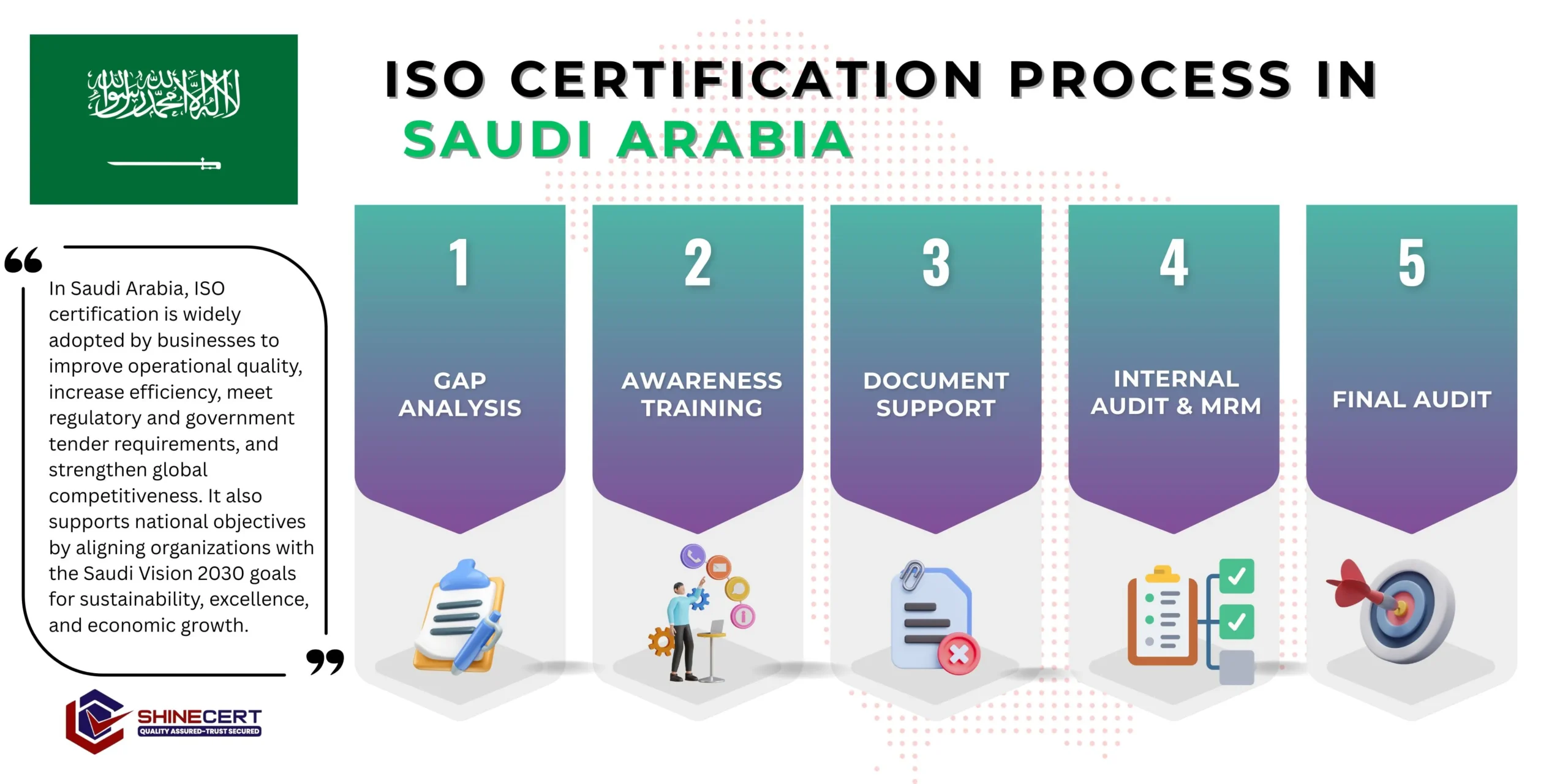
ShineCert’s 5-Step Certification Process for Healthcare, Pharma & Medical Devices
Gap Analysis
ShineCert reviews current design control, quality, and security practices against ISO 13485 and any additional target standard requirements.
Gap assessment report and regulatory requirements mapping.
Documentation and Risk Management Development
Quality manual, design control procedures, risk management files, and post-market surveillance procedures are developed.
Complete management system documentation and risk management framework.
Implementation and Staff Training
Design controls, traceability systems, and, where relevant, patient data security controls are rolled out, and staff are trained on new procedures.
Training records and implementation evidence.
Internal Audit
An internal audit and management review evaluate the system, including design history file completeness and post-market surveillance data review.
Internal audit report and management review minutes.
Certification Audit Support
ShineCert supports Stage 1 and Stage 2 audits with your chosen accredited certification body.
ISO 13485 certificate (and any additional certificates) and surveillance audit schedule.
Gap Analysis
ShineCert reviews current design control, quality, and security practices against ISO 13485 and any additional target standard requirements.
Gap assessment report and regulatory requirements mapping.
Documentation and Risk Management Development
Quality manual, design control procedures, risk management files, and post-market surveillance procedures are developed.
Complete management system documentation and risk management framework.
Implementation and Staff Training
Design controls, traceability systems, and, where relevant, patient data security controls are rolled out, and staff are trained on new procedures.
Training records and implementation evidence.
Internal Audit
An internal audit and management review evaluate the system, including design history file completeness and post-market surveillance data review.
Internal audit report and management review minutes.
Certification Audit Support
ShineCert supports Stage 1 and Stage 2 audits with your chosen accredited certification body.
ISO 13485 certificate (and any additional certificates) and surveillance audit schedule.
Healthcare Certification and Regulatory Device Registration — How They Connect
ISO 13485 certification and regulatory device registration are closely related but distinct processes, since holding the certification demonstrates quality management system conformity while regulatory registration additionally requires device-specific technical documentation, clinical evidence where applicable, and country-specific submission processes that certification alone doesn’t satisfy. Manufacturers that treat ISO 13485 certification as automatically granting market access in every target country discover the gap when a specific regulator’s registration process requires additional, device-specific evidence beyond the quality management system certificate itself, which is why ShineCert helps manufacturers understand exactly how certification and registration requirements interact for each specific target market.
Applicable ISO Standards for Healthcare, Pharma & Medical Devices
ISO 13485
Medical Devices Quality Management System
ISO 13485 — Medical Devices Quality Management System
ISO 13485 is the internationally recognized quality management standard specifically for medical device design, development, production, and servicing, and most major regulatory frameworks either require it directly for market access or heavily incorporate its requirements into their own device registration processes. Unlike generic ISO 9001, ISO 13485 places particular emphasis on risk management proportionate to device classification, design controls, and post-market surveillance obligations, reflecting the reality that a medical device quality failure can directly affect patient safety in ways a typical consumer product failure doesn't, making this the genuine foundational standard for any organization designing, manufacturing, or servicing medical devices.
ISO 27001
Information Security Management System
ISO 27001 — Information Security Management System
Healthcare providers, health technology companies, and organizations processing patient health information face particularly sensitive data security obligations, since health records represent some of the most sensitive personal data that exists and carry significant regulatory and reputational consequences if compromised. ISO 27001 certification demonstrates a structured, risk-based approach to protecting this data, and healthcare technology vendors in particular increasingly find hospital and health system customers requiring it as a baseline vendor security expectation before any procurement conversation can meaningfully progress.
ISO 22301
Business Continuity Management System
ISO 22301 — Business Continuity Management System
For healthcare providers and health technology companies where a service disruption directly translates into a gap in patient care — a hospital information system outage, a diagnostic lab's processing capability going offline, a medical supply chain disruption — ISO 22301 certification demonstrates structured business continuity planning and genuinely tested recovery capability that goes well beyond an informal disaster recovery arrangement. Organizations providing services where continuity failures carry direct patient safety consequences find this standard addresses a risk category that generic quality or security standards don't specifically cover.
ISO 9001
Quality Management System
ISO 9001 — Quality Management System
Pharmaceutical suppliers, healthcare service providers, and medical device companies alongside their sector-specific certifications often find ISO 9001 valuable for the broader quality management discipline it brings to customer requirement management, supplier quality, and continual improvement processes that complement but don't duplicate ISO 13485's device-specific focus, particularly for organizations with both medical device and non-device product lines requiring a unified quality framework across their full operation.
Right-Sized Certification Matters
The reverse question applies here too: healthcare and pharma organizations without direct medical device design or manufacturing activity, and without especially sensitive continuity or data exposure, sometimes find the full standard combination disproportionate to their actual operations, and ShineCert scopes recommendations against your specific regulatory obligations and patient-facing risk profile rather than defaulting to the broadest possible package.
Common Implementation Challenges in Healthcare, Pharma & Medical Devices Certification
- Design history files incomplete or inconsistent : Design control documentation that doesn’t genuinely capture the full design and development process is a common and serious finding during ISO 13485 audits.
- Post-market surveillance is treated as a passive, reactive process : Waiting for complaints to arrive rather than actively monitoring for emerging safety signals fails to satisfy the standard’s proactive intent.
- Risk management not genuinely proportionate to device classification : Applying identical risk management rigor to a low-risk and a high-risk device class misses the standard’s expectation of risk-proportionate controls.
- Patient data security controls tracked informally : Access controls and data handling practices for patient information are often assumed rather than documented as auditable, systematically verified records.
Benefits of Certification for Healthcare, Pharma & Medical Devices Organizations
- International business and market access benefits : ISO 13485 certification frequently determines whether a medical device manufacturer can access specific international markets at all, since many regulatory frameworks build the standard’s requirements directly into device registration and market authorization processes, making certification a genuine market access precondition rather than a competitive differentiator among already-qualified manufacturers.
- Trust and reputation benefits : In a sector where patients and healthcare institutions are placing genuine trust in product safety and data protection, certification provides independently verified evidence that a manufacturer’s or provider’s internal claims about quality and security management can’t replicate with the same credibility, particularly valuable for newer or smaller organizations competing against more established, larger competitors.
- Process improvement and operational benefits : Structured quality and security implementation frequently surfaces genuine operational gaps, design controls that existed informally but weren’t consistently documented across product lines, post-market surveillance data that wasn’t being systematically analyzed for emerging safety signals, patient data access controls that had accumulated inconsistently over time, and organizations that engage seriously with the improvement cycle typically see measurable reductions in device complaints, data incidents, and regulatory findings over time.
- Regulatory and risk-reduction benefits : Certified management systems provide healthcare, pharma, and medical device organizations with a stronger position during regulatory inspection and, in the event of a product safety issue or data incident, demonstrate that reasonable, structured controls were genuinely in place, which matters significantly both for regulatory standing and for limiting broader liability exposure.
Healthcare, Pharma & Medical Devices Certification Cost: What Actually Drives It
- Company size and device portfolio complexity : A manufacturer with multiple device classes or higher-risk device categories faces more extensive design control and risk management documentation than a single-product, lower-risk device manufacturer.
- Nature of the business and patient data exposure : Organizations processing substantial patient health data face more rigorous security risk assessment than those with limited direct patient data handling.
- Number of departments and product lines in scope : Certification covering multiple device families or facilities as distinct units costs more than a narrowly scoped, single-product certification.
- Existing quality and risk management maturity : Organizations with established design control and risk management practices, even if informal, typically implement faster and at lower cost than those building these systems from scratch.
- Standard combination and target market requirements : Adding ISO 27001 or ISO 22301 alongside ISO 13485, or targeting multiple regulatory markets with distinct requirements, adds distinct scope and cost.
Post-Market Surveillance: Where Genuine Device Safety Management Gets Tested
- A design history file and risk management documentation completed at product launch only tells part of the safety story, genuine device safety management depends on systematically monitoring real-world performance after the device reaches the market, and ISO 13485 implementation frequently reveals that many manufacturers have far less structured post-market surveillance than they assumed before undergoing genuine gap analysis.
- Building this well requires actively analyzing complaint trends, adverse event reports, and field performance data for emerging safety signals, not merely logging complaints as they arrive and closing them individually without broader trend analysis. ShineCert helps medical device manufacturers build genuine post-market surveillance capability into their ISO 13485 systems, since a manufacturer that only discovers a systemic device issue through a regulatory inquiry, rather than through its own proactive monitoring, faces a materially worse outcome than one that identifies and addresses the same issue proactively through its own surveillance data.
Patient Data Security: Balancing Access and Protection in Clinical Environments
- Healthcare organizations face a genuine tension in patient data security that many other sectors don’t encounter in the same way: clinical staff need fast, often urgent access to patient information to provide safe care, while that same information demands rigorous protection given its sensitivity, and a security program that makes clinical access too cumbersome risks staff finding workarounds that undermine the very protection intended.
- ISO 27001 implementation in healthcare settings needs to be designed with genuine clinical workflow understanding, building security controls that protect data without meaningfully slowing urgent patient care decisions, since a technically secure system that clinicians routinely circumvent because it’s impractical under real clinical pressure provides far less genuine protection than a system designed with that operational reality in mind from the outset. ShineCert works specifically with clinical and IT leadership together to design security controls that hold up both to audit scrutiny and to the genuine pressures of a functioning clinical environment.
Why Choose ShineCert for Healthcare, Pharma & Medical Devices Certification?
ShineCert has guided more than 10,000 organizations through international certification from genuine operating offices in Riyadh, Lebanon, and India, with practical experience across medical device manufacturers, pharmaceutical suppliers, and healthcare providers and technology companies.
Healthcare, Pharma & Medical Devices Certification Timeline
Phase | Typical Duration |
Gap analysis | 3–5 weeks |
Documentation and risk management development | 7–10 weeks |
Implementation and staff training | 6–9 weeks |
Internal audit and management review | 2–3 weeks |
Certification body Stage 1 + Stage 2 audit | 3–5 weeks |
Total for ISO 13485 certification | 5–8 months |
Choosing an Accredited Certification Body for Healthcare, Pharma & Medical Devices?
What to Check | Why It Matters |
IAF-recognized accreditation for ISO 13485 (and other target standards) | Confirms certificates carry genuine recognition with regulators and target markets |
Medical device or healthcare sector audit experience | Auditors familiar with design controls and risk management assess your system more effectively |
Recognition by your target regulatory markets | Confirms certification will genuinely support registration in the specific countries you’re targeting |
Familiarity with device classification-specific requirements | Relevant since higher-risk device classes carry more rigorous audit expectations |
Start Your Healthcare, Pharma and Medical Devices Certification Journey
ShineCert provides end-to-end certification support, from gap analysis through certification audit, for medical device manufacturers, pharmaceutical suppliers, and healthcare providers and technology companies. Book your free consultation or contact ShineCert directly, and our team will review your product portfolio, target markets, and current quality and security maturity before proposing a fixed-scope engagement plan.
Frequently Asked Questions
ISO 13485 is the foundational certification most international regulatory frameworks either require directly or heavily reference during device registration.
No, certification demonstrates quality management system conformity, but most markets additionally require device-specific regulatory registration beyond the certificate alone.
It depends on device portfolio complexity, risk classification, and existing quality management maturity. ShineCert provides a fixed quote after gap analysis.
Typically five to eight months, reflecting the regulatory rigor and design control documentation this sector requires.
ISO 13485 is specific to organizations designing, manufacturing, or servicing medical devices; healthcare providers typically look instead to ISO 27001 for data security and ISO 22301 for continuity.
Yes, particularly for organizations with both device and non-device product lines needing a unified quality framework across their full operation.
Auditors review whether complaint and adverse event data is genuinely analyzed for trends and fed back into design and risk management, not merely logged and individually closed.