
ISO 27001 Certification
Information Security Management System
Quick Answer
Getting ISO 27001 certified means an accredited certification body has independently verified that your organization has a working Information Security Management System (ISMS) in place, covering how you identify, assess, and treat information security risks across people, processes, and technology. It's the most widely recognized information security standard globally, and certification is achieved through a two-stage external audit, first a review of your ISMS documentation, then an on-site (or remote) assessment of whether the system is genuinely operating as documented. Businesses pursue it primarily to win enterprise deals and government tenders that require it, satisfy client due-diligence and vendor security questionnaires, and build a defensible security posture ahead of a breach rather than after one, with certification typically achievable in three to six months for organizations with reasonably mature IT practices.
What ISO 27001 Certification Actually Certifies?
ISO/IEC 27001 certification confirms that an organization’s information security management system (ISMS), the policies, risk treatment processes, and controls it uses to protect the confidentiality, integrity, and availability of information, has been independently audited against ISO/IEC 27001 and found to conform. Since the 2022 revision, the certified standard is formally ISO/IEC 27001:2022, and the transition period IAF and accredited certification bodies gave organizations to move off the older 2013 edition closed on October 31, 2025, meaning any current, valid ISO 27001 certificate an organization holds today is necessarily certified against the 2022 edition, not the 2013 one.
The single biggest misunderstanding about ISO 27001 is treating it as a technical security product certification. It isn’t. It certifies a management system, a risk assessment methodology, a documented set of policies, defined ownership and accountability, and a functioning cycle of monitoring and improvement, that happens to govern information security. An organization can run excellent security tooling and still fail an ISO 27001 audit if it can’t demonstrate the management system wrapped around that tooling: documented risk assessments, a current Statement of Applicability, management review records, and evidence that controls are actually operating as designed, not just configured once and forgotten.
Certification is issued by accredited, independent certification bodies operating under national accreditation bodies, UKAS, ANAB, DAkkS, SAAC, JAS-ANZ, and equivalents, within the IAF multilateral recognition framework. Verifying a certification body’s current ISO 27001 accreditation scope via the IAF CertSearch database before engaging them is a basic and non-negotiable due-diligence step.
What are the steps to get 27001 Certification?
our services
- ISO 9001 Certification
- ISO 14001 Certification
- ISO 27001 Certification
- ISO 22000 Certification
- ISO 45001 Certification
- ISO 13485 Certification
- ISO 20000 Certification
- ISO 17025 Certification
- CE Mark Certification
- GMP Certification
- Halal Certification
- SOC Certification
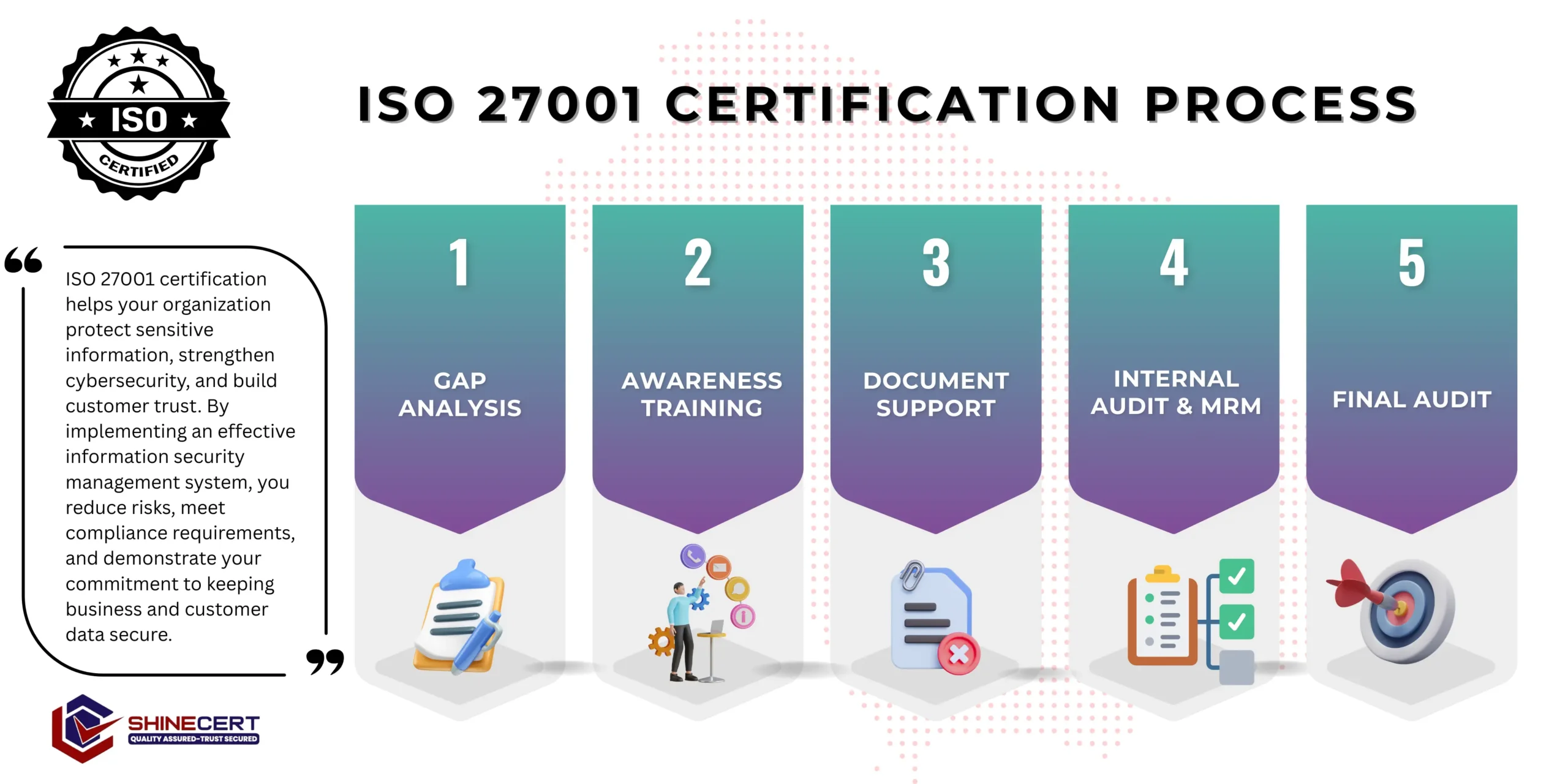
ShineCert's 5-Step ISO 27001 Certification Process
Gap Analysis and Scope Definition
ShineCert reviews current security practices and defines ISMS scope, which systems, data, locations, and business units are included, against ISO 27001 requirements.
Gap assessment report and defined ISMS scope.
Risk Assessment and Statement of Applicability
Information security risks are identified and assessed, appropriate Annex A controls are selected and justified, and the Statement of Applicability (SoA) and required procedures across Clauses 4 through 10 are developed.
Risk assessment report, Statement of Applicability, and core ISMS documentation set.
Implementation and Staff Training
Technical and organizational controls, access management, incident response, business continuity, are rolled out, and staff across departments are trained on their specific security responsibilities.
Training records and control implementation evidence.
Internal Audit and Management Review
An internal audit against ISO 27001 requirements is conducted, followed by a formal Management Review evaluating ISMS performance, risk treatment progress, and control effectiveness.
Internal audit report and management review minutes.
Certification Audit Support
ShineCert supports Stage 1 and Stage 2 audits with your chosen accredited certification body, including evidence walkthroughs for technical and procedural controls in scope.
ISO/IEC 27001:2022 certificate and surveillance audit schedule.
Gap Analysis and Scope Definition
ShineCert reviews current security practices and defines ISMS scope, which systems, data, locations, and business units are included, against ISO 27001 requirements.
Gap assessment report and defined ISMS scope.
Risk Assessment and Statement of Applicability
Information security risks are identified and assessed, appropriate Annex A controls are selected and justified, and the Statement of Applicability (SoA) and required procedures across Clauses 4 through 10 are developed.
Risk assessment report, Statement of Applicability, and core ISMS documentation set.
Implementation and Staff Training
Technical and organizational controls, access management, incident response, business continuity, are rolled out, and staff across departments are trained on their specific security responsibilities.
Training records and control implementation evidence.
Internal Audit and Management Review
An internal audit against ISO 27001 requirements is conducted, followed by a formal Management Review evaluating ISMS performance, risk treatment progress, and control effectiveness.
Internal audit report and management review minutes.
Certification Audit Support
ShineCert supports Stage 1 and Stage 2 audits with your chosen accredited certification body, including evidence walkthroughs for technical and procedural controls in scope.
ISO/IEC 27001:2022 certificate and surveillance audit schedule.
What Is ISO 27001?
ISO 27001:2022 specifies requirements for establishing, implementing, maintaining, and continually improving an information security management system, covering people, process, and technology controls that protect information assets across their lifecycle, from creation and storage to transmission and disposal. It applies equally to software companies, service providers, and organizations of any size handling sensitive data, and its Harmonised Structure makes integration with ISO 9001, ISO 22301, or ISO 42001 relatively straightforward for organizations pursuing multiple certifications.
ISO 27001 and Client Security Questionnaires
A certified ISMS gives an organization a structured internal system, but the client-facing security questionnaire or Data Processing Agreement remains a separate commercial artifact, the two need to align, since a questionnaire response promising controls the internal ISMS can’t actually evidence creates a credibility gap the moment a client audit or breach investigation happens. ShineCert reviews common client security questionnaires alongside ISMS design specifically to confirm the internal system can genuinely back up what’s being commercially represented, since a beautifully documented ISMS that doesn’t match real contractual security commitments satisfies an auditor but not a client’s vendor-risk team.
Mandatory Documented Information for ISO 27001:2022
At minimum: ISMS scope statement; information security policy and objectives; risk assessment methodology and risk register; risk treatment plan; Statement of Applicability; internal audit program and reports; management review records; a documented incident response procedure with evidence of use or testing; and records demonstrating competence and awareness training. Organizations selling to enterprise clients often also maintain a security questionnaire response pack derived directly from these documents, one of the more immediate commercial returns on the documentation effort.
ISO 27001 and Integrated Management Systems — How They Connect
ISO 27001 shares the Harmonised Structure with ISO 9001, ISO 22301, and ISO 42001, meaning organizations already certified to those standards can integrate information security requirements into an existing management system framework rather than building a parallel one. This matters practically for technology companies that often need to demonstrate quality, business continuity, and AI governance competence alongside information security to win large contracts, a single integrated audit cycle covering all applicable standards is both more efficient and more coherent for auditors evaluating the whole operation than separate, disconnected certification projects.
Cloud and Multi-Tenant Environments: The Core ISMS Challenge
- Organizations running cloud-native or multi-tenant SaaS platforms face a distinct certification challenge that traditional on-premise operations don’t: demonstrating that logical separation between customer data, access controls, and shared infrastructure genuinely holds up, not just that a network diagram claims it does.
- This requires evidence-based control testing, logging and monitoring that can reconstruct who accessed what and when, and a shared-responsibility model with cloud providers that’s clearly documented rather than assumed, a control gap in a shared infrastructure layer can affect every tenant simultaneously, and a security architecture that looks sound on a slide often reveals gaps once an auditor asks for actual access logs. ShineCert helps SaaS and platform companies design this evidence trail explicitly, since certification bodies increasingly request live demonstrations of access control and logging during Stage 2 audits specifically to test whether the architecture holds up beyond the documentation.
The Structure of ISO 27001: Clauses Explained
- Clause 4 — Context of the Organization: Requires defining ISMS scope, which systems, data types, and locations are covered, and identifying interested party requirements, including regulators, clients, and employees.
- Clause 5 — Leadership: Requires top management commitment to information security and a documented information security policy.
- Clause 6 — Planning: Requires a formal risk assessment methodology, identification of information security risks, and risk treatment planning tied to Annex A controls.
- Clause 7 — Support: Covers resources, competence of security-relevant staff, awareness training, and documented information requirements.
- Clause 8 — Operation: The technical core, covering operational planning, risk assessment execution, and risk treatment implementation across the organization.
- Clause 9 — Performance Evaluation: Requires monitoring and measurement of ISMS effectiveness, internal audit, and management review.
- Clause 10 — Improvement: Requires corrective action for nonconformities and continual improvement of the ISMS.
Annex A in ISO 27001 contains 93 security controls that help organizations manage information security risks. Based on a risk assessment, each organization selects the controls that apply to its business and documents those decisions in the Statement of Applicability (SoA).
Technology and Information Security Management Systems
- Modern information security increasingly relies on SIEM platforms, endpoint detection and response tools, and automated vulnerability scanning, and ISO 27001 certification needs to account for how these technology systems fit within the broader ISMS rather than treating them as a separate IT concern. A SIEM that ingests logs is only as valuable as the discipline behind actually reviewing alerts and closing out incidents promptly, and auditors increasingly ask to see genuine system data, mean time to detect, mean time to respond, patching cadence, rather than accepting a policy document’s description of how the tooling is supposed to work.
- Organizations investing in security technology without the underlying process discipline to use it consistently often find the technology investment doesn’t translate into the risk reduction it promised, which is exactly the gap a well-designed ISMS is meant to close by tying technology adoption to genuine operational accountability.
Benefits of ISO 27001 Certification
Faster progress through enterprise vendor-security reviews and shorter sales cycles with security-conscious buyers.
structured identification and treatment of information security risks before they become incidents.
independently verified evidence of security maturity for clients, partners, and regulators.
clearer ownership, incident response, and continuity of security practice as the organization scales
ISO 27001 Implementation Cost
- Organization size and infrastructure complexity : A multi-location business running its own data centers faces a broader control scope than a small cloud-native SaaS company.
- Existing security maturity : Organizations with an existing risk register, access controls, and documented policies move faster and at lower cost than those building an ISMS from zero.
- Number of locations and business units in scope : A wider ISMS scope covering multiple offices or subsidiaries increases both implementation and audit cost.
- Regulatory and contractual complexity : Financial services or healthcare organizations facing overlapping regulatory obligations require more integrated control design than a straightforward B2B service business.
- Certification body and audit scope chosen : Certification body fees vary by accreditation, audit duration, and number of employees/sites in the audit sample.
Third-Party and Supplier Risk Management
- Most organizations rely on a layer of third-party vendors, cloud hosting providers, payment processors, SaaS tools handling customer data, and a certified ISMS needs to extend meaningful oversight into that supplier layer rather than treating it as outside the system’s boundary. An organization can have impeccable internal controls and still suffer a breach if a subprocessor mishandles data, since the affected client experiences the overall security outcome, not the internal contractual structure behind it.
- ISO 27001 certification audits increasingly probe how supplier security is assessed before onboarding, how security requirements flow down into vendor contracts, and what happens when a supplier has an incident. ShineCert helps organizations build a supplier risk framework that’s proportionate to risk, a payment processor or cloud host warrants tighter oversight than a scheduling tool, rather than either ignoring supplier risk entirely or applying identical, resource-intensive due diligence uniformly regardless of actual data exposure. Getting this balance right is often what separates an ISMS that merely looks complete on paper from one that genuinely protects information across the full data supply chain, including the parts of it the certified organization doesn’t directly control.
Who Actually Needs ISO 27001 Certification?
Situation | Why ISO 27001 Applies |
Selling to enterprise clients | Enterprise security questionnaires and vendor due-diligence processes increasingly require a current ISO 27001 certificate as a pre-qualifying gate, shortening or replacing lengthy manual security reviews |
Handling regulated or sensitive data | Healthcare, financial services, and government-adjacent contracts frequently specify ISO 27001 (or an equivalent framework) as a contractual security requirement |
Operating as a SaaS or cloud service provider | Customers increasingly expect independent verification of security practices before trusting a cloud vendor with their data |
Building or deploying AI-driven products | ISO 27001 remains the security foundation many AI vendors pair with the newer ISO 42001 AI management standard |
Responding to a security incident or near-miss | A formal ISMS gives an organization the incident response and corrective action discipline that ad hoc security practices lack |
Very small, early-stage companies without enterprise sales pressure sometimes reasonably defer ISO 27001 in favor of documenting good security hygiene informally, the certification’s real value shows up once a sales cycle starts stalling on security questionnaires, which is the point at which the cost of certification is easiest to justify against the deals it unblocks.
Ready to scope your 27001 certification project? Book your free consultation or contact ShineCert directly.
Book Free ConsultationReady to scope your 27001 certification project? Book your free consultation or contact ShineCert directly.
Book Free ConsultationWhy Choose ShineCert for ISO 27001 Certification?
ShineCert has guided more than 10,000 organizations through ISO certification, including meaningful ISMS implementation experience across SaaS, IT services, and financial-adjacent businesses, from genuine operating offices in Riyadh, Lebanon, and India. Our consultants map Annex A controls to your actual technical environment rather than issuing a generic security template, and we’re transparent that ISO 27001 requires genuinely operating controls, not a one-time documentation exercise, a distinction that matters at your first surveillance audit even more than at initial certification.
Choosing an Accredited Certification Body
Confirm the certification body’s accreditation is current and specifically scoped to ISO/IEC 27001:2022, a body can be accredited for other standards without current ISO 27001 accreditation, and this is checkable via IAF CertSearch or the relevant national accreditation body’s public register. For ISO 27001 specifically, ask about the auditor’s technical background: an auditor without genuine information security or IT audit experience will struggle to meaningfully assess Annex A technological controls.
Factor | Why It Matters |
Current ISO/IEC 27001:2022 accreditation | Confirms audits are being conducted against the correct, currently valid edition |
Auditor technical/security background | Determines whether the Annex A technical control review is substantive or superficial |
Experience auditing cloud-hosted or SaaS organizations | Relevant given how much of Annex A now concerns cloud and technological controls |
Clear surveillance audit schedule | ISO 27001 certificates require annual surveillance audits and a three-year recertification cycle — confirm this is priced transparently upfront |
Common Implementation Challenges
- Building a Statement of Applicability that doesn’t reflect actual risk : A generic SoA that applies every control by default, without genuine justification, is a common finding auditors flag, the SoA is supposed to demonstrate risk-based decision making, not blanket compliance.
- Treating Annex A as a checklist rather than implementing genuinely operating controls : A firewall configuration screenshot from initial implementation isn’t evidence a control is still operating eighteen months later; auditors during surveillance visits specifically look for evidence of ongoing operation, not a one-time snapshot.
- Under-scoping third-party and supplier risk : Annex A 5.19–5.23 cover supplier relationships explicitly, and organizations that rely heavily on cloud infrastructure or sub processors frequently under-document this area until an auditor asks for supplier risk assessments that don’t yet exist.
- Security awareness training that isn’t role-specific : Generic annual security training satisfies the letter of Clause 7.3 poorly if development staff, for instance, receive the same training as finance staff, with no coverage of secure coding practices relevant to their actual role.
- Losing momentum on the internal audit cycle after initial certification : ISO 27001’s real value comes from the annual surveillance cycle catching drift before it becomes an incident; organizations that treat year one as the finish line rather than the baseline lose much of that value.
Start Your ISO 27001 Certification Journey
ShineCert provides end-to-end ISO 27001 implementation support, from gap analysis through Stage 1 and Stage 2 certification audits, for organizations across every sector. Book your free consultation or contact ShineCert directly, and our team will review your current security posture, scope, and target timeline before proposing a fixed-scope engagement plan.
Frequently Asked Questions
ISO 27001 certification confirms your information security management system meets an internationally recognized standard for protecting information confidentiality, integrity, and availability. It’s typically worth it once security questionnaires or contractual requirements start affecting sales cycles or regulatory standing, for organizations without that pressure yet, strong informal security hygiene can be a reasonable interim step.
It depends on headcount, the technical complexity of your ISMS scope, and existing security maturity. ShineCert provides a fixed, written quote after scoping your specific environment.
Most organizations move from kickoff to certificate in three to six months, faster for organizations with existing mature security programs.
No, the IAF-mandated transition period for existing ISO 27001:2013 certificates ended October 31, 2025. Any currently valid ISO 27001 certificate is now necessarily certified against the 2022 edition and its 93-control, four-theme Annex A structure.
No, but you do need clearly assigned ownership for the ISMS’s ongoing operation, internal audits, management review, and control monitoring, whether that’s a dedicated role or a responsibility layered onto an existing IT or operations function. Many certified organizations run this as a part-time responsibility layered onto an existing IT, compliance, or operations role rather than a standalone headcount, provided ownership is genuinely assigned rather than left ambiguous.
Both address information security, but ISO 27001 is an internationally recognized certifiable management system standard with a defined control framework (Annex A), while SOC 2 is an attestation report specific to US audit standards, more common with North American enterprise buyers. Many organizations pursue both, since much of the underlying control evidence overlaps.