
ISO 14001 Certification
Environmental Management System
Quick Answer
ISO 14001:2015 is the international standard for environmental management systems (EMS), certifying that an organization manages its environmental impact, waste, emissions, resource use, spill risk, through a structured, auditable management system, rather than isolated green initiatives or a sustainability page on the website. It follows the same Harmonised Structure as ISO 9001 and ISO 45001, making it straightforward to integrate for organizations already certified to those standards. Certification is issued by an accredited certification body after an audit, and most organizations complete implementation and certification in three to five months.
What ISO 14001 Certification Actually Certifies?
ISO 14001 certification confirms that an organization’s environmental management system (EMS) has been independently audited and found to conform to the ISO 14001 standard, the internationally recognized framework for managing environmental responsibilities: pollution prevention, resource use, waste management, and compliance with environmental law. Importantly, as of April 2026, this now means certification against ISO 14001:2026, published on April 15, 2026, following approval of its Final Draft International Standard in January of that year. Organizations currently holding an ISO 14001:2015 certificate are not affected immediately, see the migration section below, but any new certification project starting now should be scoped with the new edition in mind from day one.
ISO 14001 does not certify that an organization has zero environmental impact, and no credible consultant should suggest otherwise. It certifies a documented, functioning system for identifying environmental aspects and impacts, managing legal compliance obligations, and demonstrating continual improvement in environmental performance over time. Certification is issued by independent, accredited certification bodies operating under national accreditation bodies, UKAS, ANAB, SAAC, DAkkS, JAS-ANZ, and equivalents, within the IAF multilateral recognition framework, and is checkable via IAF CertSearch.
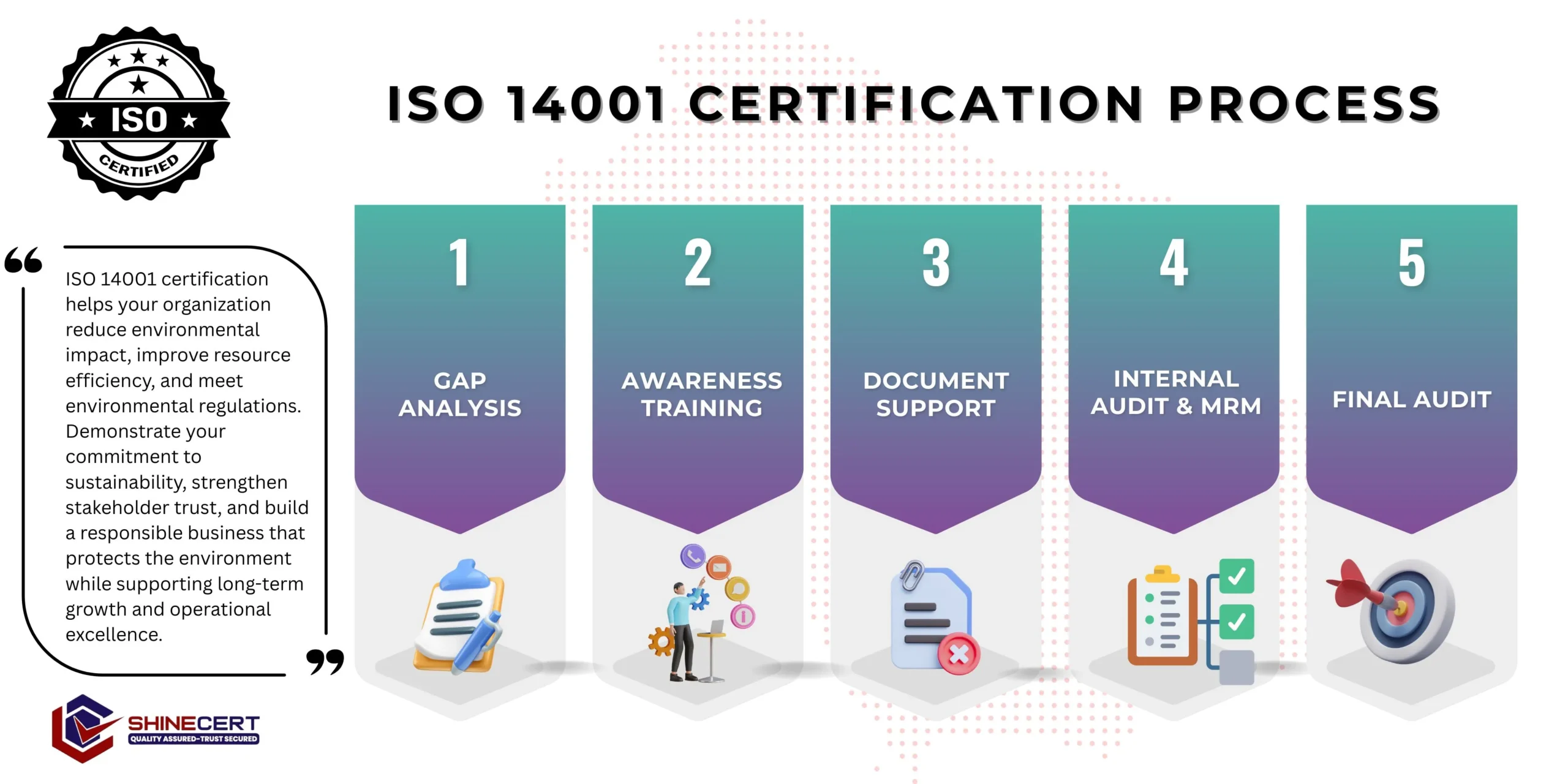
What are the steps to get ISO 14001 Certification?
our services
- ISO 9001 Certification
- ISO 14001 Certification
- ISO 27001 Certification
- ISO 22000 Certification
- ISO 45001 Certification
- ISO 13485 Certification
- ISO 20000 Certification
- ISO 17025 Certification
- CE Mark Certification
- GMP Certification
- Halal Certification
- SOC Certification
ShineCert's 5-Step ISO 14001 Certification Process
Gap Analysis and Scope Definition
ShineCert reviews current environmental practices and defines EMS scope, which sites, processes, and activities are included, against ISO 14001 requirements.
Gap assessment report and defined EMS scope.
Environmental Aspects and Impacts Assessment
The Environmental Policy, identification and evaluation of environmental aspects and impacts across all site activities, and required procedures across Clauses 4 through 10 are developed.
Complete EMS documentation set and aspects/impacts register.
Implementation and Staff Training
Operational controls, waste management, emissions monitoring, emergency preparedness for environmental incidents, are rolled out, and staff are trained on their specific environmental responsibilities.
Training records and operational implementation evidence.
Internal Audit and Management Review
An internal audit against ISO 14001 requirements is conducted, followed by a formal Management Review evaluating environmental performance and legal compliance status.
Internal audit report and management review minutes.
Certification Audit Support
ShineCert supports Stage 1 and Stage 2 audits with your chosen accredited certification body, including site visits to locations and processes in scope.
ISO 14001:2015 certificate and surveillance audit schedule.
Gap Analysis and Scope Definition
ShineCert reviews current environmental practices and defines EMS scope, which sites, processes, and activities are included, against ISO 14001 requirements.
Gap assessment report and defined EMS scope.
Environmental Aspects and Impacts Assessment
The Environmental Policy, identification and evaluation of environmental aspects and impacts across all site activities, and required procedures across Clauses 4 through 10 are developed.
Complete EMS documentation set and aspects/impacts register.
Implementation and Staff Training
Operational controls, waste management, emissions monitoring, emergency preparedness for environmental incidents, are rolled out, and staff are trained on their specific environmental responsibilities.
Training records and operational implementation evidence.
Internal Audit and Management Review
An internal audit against ISO 14001 requirements is conducted, followed by a formal Management Review evaluating environmental performance and legal compliance status.
Internal audit report and management review minutes.
Certification Audit Support
ShineCert supports Stage 1 and Stage 2 audits with your chosen accredited certification body, including site visits to locations and processes in scope.
ISO 14001:2015 certificate and surveillance audit schedule.
What Is ISO 14001?
ISO 14001:2015 specifies requirements for establishing, implementing, maintaining, and continually improving an environmental management system, covering environmental aspect identification, legal compliance obligations, operational control, and emergency preparedness across the full range of an organization’s activities, products, and services. It applies equally to office-based organizations and heavy industrial operations, and its Harmonised Structure makes integration with ISO 9001, ISO 45001, or ISO 50001 relatively straightforward for organizations pursuing multiple certifications.
ISO 14001 Certification Cost
Cost is driven primarily by the complexity and number of significant environmental aspects in scope, a single office-based business has a far simpler aspects register than a multi-site manufacturer with emissions, waste streams, and chemical storage to manage, plus site count and current environmental compliance maturity. Combining ISO 14001 with ISO 9001 and ISO 45001 as an integrated QHSE system typically reduces total cost meaningfully through shared context analysis and management review.
Mandatory Documented Information for ISO 14001
At minimum: environmental policy and objectives; environmental aspects and impacts register with life-cycle consideration; compliance obligations register; operational control procedures for significant aspects; emergency preparedness and response plans with testing evidence; internal audit program and reports; and management review records.
Aligning ISO 14001 with Client Sustainability Commitments
A certified EMS gives an organization a structured internal system, but the client-facing sustainability questionnaire or supplier code of conduct remains a separate commercial artifact, the two need to align, since a sustainability response promising environmental performance the internal EMS can’t actually evidence creates a credibility gap the moment a client audit or environmental incident happens. ShineCert reviews common client sustainability and supplier-code requirements alongside EMS design specifically to confirm the internal system can genuinely back up what’s being commercially represented, since a beautifully documented EMS that doesn’t match real site conditions satisfies an auditor but not a client’s sustainability procurement team.
The Structure of ISO 14001: Clauses Explained
- Clause 4 — Context of the Organization : Requires defining EMS scope, which sites, processes, and activities are covered, and identifying interested party needs, including regulators, communities, and clients.
- Clause 5 — Leadership : Requires top management commitment to environmental performance and a documented environmental policy.
- Clause 6 — Planning : Requires systematic identification of environmental aspects and impacts, legal compliance obligations, and setting environmental objectives tied to actual operations.
- Clause 7 — Support : Covers resources, competence of environmentally-significant roles, communication, and documented information requirements.
- Clause 8 — Operation : The technical core, covering operational planning and control, and emergency preparedness and response for environmental incidents.
- Clause 9 — Performance Evaluation : Requires monitoring and measurement of environmental performance, internal audit, and management review.
- Clause 10 — Improvement : Requires corrective action for nonconformities and continual improvement of the EMS.
ISO 14001 and Integrated Management Systems — How They Connect
ISO 14001 shares the Harmonised Structure with ISO 9001, ISO 45001, and ISO 50001, meaning organizations already certified to those standards can integrate environmental requirements into an existing management system framework rather than building a parallel one. This matters practically for manufacturing and industrial contractors who often need to demonstrate quality, safety, and environmental competence simultaneously to win large tenders, a single integrated audit cycle covering all applicable standards is both more efficient and more coherent for auditors evaluating the whole operation than separate, disconnected certification projects.
Benefits of ISO 14001 Certification
Access to supply-chain and tender lists that require certified environmental management as an entry condition.
Reduced waste and resource costs identified through systematic environmental aspect review.
A structured process that catches environmental compliance gaps before an incident or regulatory action, rather than after.
A recognized, independently audited answer to environmental due-diligence questions instead of a self-authored sustainability claim.
Migrating From ISO 14001:2015 to ISO 14001:2026
- ISO 14001:2026 was published on April 15, 2026, following approval of its Final Draft International Standard in January 2026, making ISO 14001 one of the first Harmonised Structure standards to complete its first major revision cycle. Organizations currently certified to ISO 14001:2015 have a 36-month transition period from the publication date, meaning all existing ISO 14001:2015 certificates must transition to the new edition by April 30, 2029; certificates not migrated by that date will no longer be valid.
- The 2026 revision brings substantive changes, not a light refresh. Climate change risk assessment, previously addressed through a 2021 climate change amendment layered onto the 2015 text, is now fully integrated into the standard’s structural requirements rather than treated as an add-on, organizations need to assess climate-related risks and opportunities as a core part of their context and planning analysis, not a bolt-on exercise. A new Clause 6.3 introduces explicit requirements for planning and managing organizational change in a way that could affect the EMS, a more systematic requirement than the 2015 edition’s more implicit treatment of change management. Annex A, the standard’s informative guidance annex, has been significantly expanded to provide clearer implementation guidance across these updated requirements.
- Certification bodies need their own accreditation updated to audit against ISO 14001:2026 before they can issue certificates against it, a process that typically takes national accreditation bodies several months to a year following a standard’s publication. Organizations currently pursuing first-time ISO 14001 certification should discuss with their chosen certification body whether they are certifying against the 2015 or 2026 edition and plan the underlying EMS design accordingly, building toward the 2026 requirements from the outset avoids a second implementation project within the transition window. ShineCert is tracking certification body accreditation timelines for ISO 14001:2026 and will advise every client on the most efficient path given their specific timeline and chosen certification body.
Environmental Aspects in Practice: What Auditors Actually Look For
- Clause 6.1.2’s requirement to identify environmental aspects sounds abstract until it’s applied to a specific operation, and the difference between a superficial aspects register and a genuinely useful one shows up immediately during a Stage 2 audit. A manufacturer’s aspects typically include energy consumption, water use, wastewater discharge, solid waste generation and its disposal route, air emissions from processes or vehicles, and raw material and packaging use, each assessed for significance using a documented, consistent method (commonly a scoring matrix weighing severity, likelihood, and regulatory sensitivity).
- A common failure mode is scoring every aspect as “low significance” to minimize required controls; auditors experienced with a given sector know roughly what significant aspects should look like and treat a suspiciously light aspects register as a signal to dig deeper, not evidence of genuinely low impact.
- The life-cycle perspective requirement adds a layer many organizations skip entirely: considering aspects associated with raw material extraction, supplier processes, product use by the end customer, and end-of-life disposal, not just the organization’s own four walls.
- This doesn’t mean controlling every upstream and downstream impact directly, Clause 6.1.2 requires considering it, and documenting the organization’s degree of influence, which for most businesses is limited for upstream stages and more direct for aspects like packaging design or end-of-life guidance provided to customers.
ISO 14001 and Regulatory Compliance: A Genuine Distinction
- ISO 14001 certification is not the same as regulatory compliance, and conflating the two is a common and risky misunderstanding. Certification confirms a functioning system for identifying and managing compliance obligations; it does not itself certify that every applicable environmental law is being met at every moment, and a certified organization can still face regulatory enforcement for a specific breach.
- What certification does provide is a structured compliance obligations register (Clause 6.1.3) and a periodic evaluation of compliance status (Clause 9.1.2), which meaningfully reduces the likelihood of undetected breaches accumulating unnoticed, but the legal responsibility for compliance itself remains entirely with the organization, not with the certification body or the EMS documentation.
Multi-Site and Supply Chain Environmental Impact: The Core EMS Challenge
- Organizations operating across multiple production sites, or relying on a distributed supply chain, face a distinct certification challenge that single-site, vertically integrated operations don’t: demonstrating that environmental controls, waste tracking, and emissions monitoring are genuinely consistent across every site and every process in scope, not just at the flagship facility an auditor happens to visit first.
- This requires standardized environmental monitoring protocols, common waste and emissions reporting templates, and centralized oversight that still accommodates genuine local differences, an environmental aspect profile at a chemical processing site differs substantially from a distribution warehouse, and a rigid, identical procedure applied everywhere regardless of local context often fails in practice even when it looks good on paper. ShineCert helps multi-site operators design this balance explicitly, since certification bodies increasingly sample across multiple sites during Stage 2 audits specifically to test whether consistency claims hold up beyond the site initially presented.
Who Actually Needs ISO 14001 Certification?
Situation | Why ISO 14001 Applies |
Manufacturing, construction, or industrial operations | Meaningful environmental output (emissions, waste, water use) makes formal environmental management both a compliance and reputational necessity |
Bidding for tenders requiring QHSE certification | Public and major-project tenders increasingly score ISO 14001 into technical qualification alongside ISO 9001 and ISO 45001 |
Operating under environmental regulatory scrutiny | A functioning EMS demonstrates due diligence and structured compliance tracking to regulators |
Responding to customer or investor ESG requirements | Corporate buyers and investors increasingly request evidence of structured environmental management as part of supply chain ESG due diligence |
Managing multi-site environmental consistency | Ensures the same environmental standard holds across every site, not just the ones under closest scrutiny |
Ready to scope your ISO 14001 certification project? Book your free consultation or contact ShineCert directly.
Book Free ConsultationReady to scope your ISO 14001 certification project? Book your free consultation or contact ShineCert directly.
Book Free ConsultationWhy Choose ShineCert for ISO 14001 Certification?
ShineCert has guided more than 10,000 organizations through ISO certification from genuine operating offices in Riyadh, Lebanon, and India, and is actively tracking the ISO 14001:2026 transition timeline so clients aren’t caught building toward an edition that’s about to be superseded. We build environmental aspects registers around your organization’s actual operations and life cycle, not a generic industry template.
Choosing an Accredited Certification Body
Confirm current ISO 14001 accreditation and sector-specific auditor experience relevant to your environmental risk profile, an auditor unfamiliar with your industry’s typical aspects (e.g., solvent use in manufacturing, dust and runoff on construction sites) will assess conformity less effectively.
Factor | Why It Matters |
Current IAF-recognized ISO 14001 accreditation | Ensures international recognition of the certificate |
Sector-specific environmental aspect experience | Determines whether the audit meaningfully assesses your actual environmental risk |
Multi-site audit capability | Relevant for organizations with varied environmental aspects across locations |
Confirmed readiness to audit against ISO 14001:2026 | Increasingly relevant as certification bodies complete their own accreditation to the new edition over 2026–2027 |
Common Implementation Challenges
- An aspect and impact register that ignores life-cycle perspective : Many organizations document only direct, on-site impacts and miss the upstream/downstream consideration Clause 6.1.2 explicitly requires, a finding auditors increasingly flag.
- A compliance obligations register that goes stale : Environmental law changes; a register built once at initial certification and never updated is a common and significant nonconformity found at surveillance audits.
- Operational controls that exist on paper but aren’t followed on the shop floor : A waste segregation procedure that staff don’t actually follow is worse than no procedure, since it demonstrates a gap between documentation and practice.
- Undertested emergency response plans : Environmental emergency plans (spill response, chemical release) that have never been drilled are a common gap surfaced during Stage 2 audits.
- Treating ISO 14001 as separate from business strategy : Organizations that isolate the EMS from actual operational decision-making see less genuine environmental improvement than those that integrate environmental objectives into core business planning.
Frequently Asked Questions
ISO 14001 certifies your environmental management system against an internationally recognized standard for managing environmental aspects, compliance, and performance improvement. It’s typically essential for manufacturing and industrial operations and increasingly valuable for any business facing ESG-related buyer or investor scrutiny.
It depends on the complexity and number of significant environmental aspects, site count, and current compliance maturity. ShineCert provides a fixed quote after scoping.
Most organizations move from kickoff to certificate in three to six months.
Yes. Existing certificates remain valid, but must transition to ISO 14001:2026 by April 30, 2029, the end of the 36-month transition period from the new edition’s April 2026 publication.
The most significant changes are the full structural integration of climate change risk assessment (previously a 2021 amendment), a new Clause 6.3 on managing organizational change affecting the EMS, and a significantly expanded Annex A guidance section.
Yes, this integrated QHSE approach is common and typically more cost-efficient than three separate certification projects.