
CE Marking Certification
Conformité Européenne
Quick Answer
CE Marking is a mandatory conformity mark, not a management-system certification, showing a product meets EU health, safety, and environmental protection requirements before it can be legally sold in the European Economic Area. For most low-risk products, manufacturers self-declare conformity; for higher-risk categories (medical devices, pressure equipment, machinery with certain risk classes), an independent Notified Body must assess the product first. There is no single “CE certificate” issued by one global body, conformity is demonstrated through a Declaration of Conformity backed by technical documentation, and where required, a Notified Body certificate.
Why CE Marking Matters for Manufacturers and Exporters?
For any manufacturer or importer with EU market ambitions, CE marking isn’t a quality badge you pursue for reputation, it’s a legal gate that sits directly in front of market access. Distributors and retailers across Europe generally will not stock products without valid CE documentation on file, since they carry their own liability exposure under EU market surveillance rules the moment they place a non-compliant product on shelves. That pressure shows up differently depending on what you make. Electronics manufacturers face it through the Low Voltage and EMC Directives before a single unit clears customs. Machinery builders face it through risk-based conformity assessment routes that scale with how dangerous the equipment actually is. Medical device manufacturers face arguably the strictest version of it, since the Medical Device Regulation ties conformity assessment directly to patient safety outcomes, not just electrical or mechanical hazard control.
The honest picture: CE marking without genuine underlying conformity is a legal offense with real enforcement teeth across EU member states, and market surveillance authorities have shown they will act on it, product seizure and market withdrawal are not theoretical risks, they are the standard consequence when a surveillance check finds a gap between what’s marked and what’s actually documented.
What are the steps to get CE Mark Certification?
our services
- ISO 9001 Certification
- ISO 14001 Certification
- ISO 27001 Certification
- ISO 22000 Certification
- ISO 45001 Certification
- ISO 13485 Certification
- ISO 20000 Certification
- ISO 17025 Certification
- CE Mark Certification
- GMP Certification
- Halal Certification
- SOC Certification
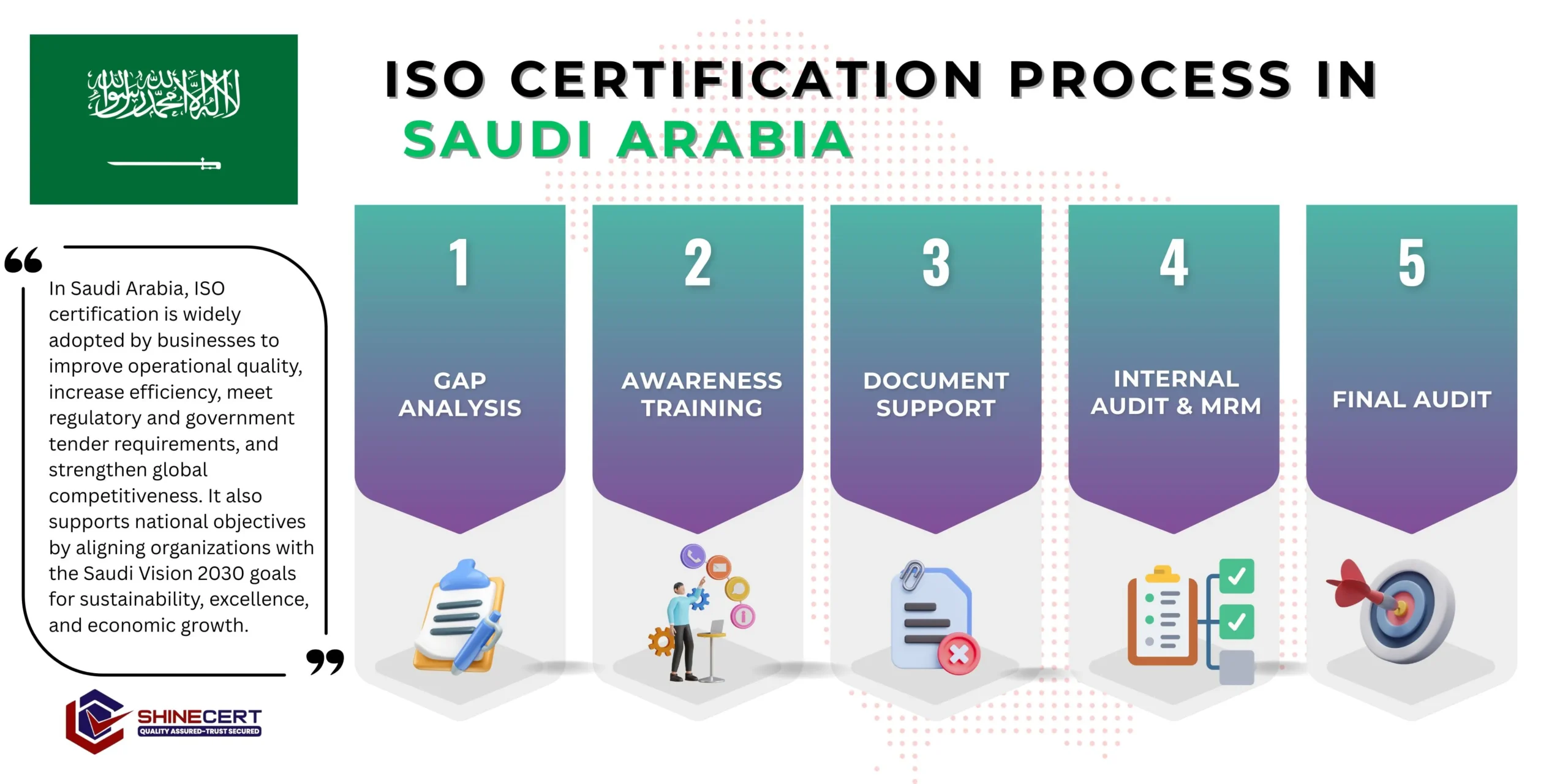
ShineCert’s 5-Step CE Marking Certification Process
We don’t just stamp a mark on your product. We build the technical file and testing evidence that actually holds up when a market surveillance authority asks to see it, because that’s the only kind of conformity assessment that protects you after the product ships.
Gap Analysis and Directive Identification
ShineCert reviews the product's intended use, technical specifications, and target markets to identify which EU directive(s) and essential requirements apply, and whether self-declaration or Notified Body assessment is the correct route.
Directive applicability report and conformity assessment route recommendation.
Documentation and Design Review
Technical documentation is developed or reviewed against the applicable essential requirements, including risk assessments, design drawings, test plans, and, for machinery, the required risk assessment methodology.
Draft technical file structure and identified design or documentation gaps.
Testing and Implementation
Required testing is carried out, in-house or via an accredited test laboratory, against the harmonized standards relevant to the product category, and any design or manufacturing gaps identified are closed.
Test reports and closed-gap evidence against harmonized standards.
Internal Verification and Technical File Compilation
The complete technical file, test reports, risk assessments, user instructions, and design documentation, is compiled and internally reviewed for completeness before submission or self-declaration.
Finalized technical file ready for Notified Body submission or self-declaration.
Notified Body Assessment and Declaration of Conformity
For higher-risk product categories, an accredited Notified Body reviews the technical file and may conduct product testing or quality system audits before issuing a certificate; for self-declaration categories, the manufacturer signs the EU Declaration of Conformity directly.
EU Declaration of Conformity, Notified Body certificate (where applicable), and authorization to apply the CE mark.
Gap Analysis and Directive Identification
ShineCert reviews the product's intended use, technical specifications, and target markets to identify which EU directive(s) and essential requirements apply, and whether self-declaration or Notified Body assessment is the correct route.
Directive applicability report and conformity assessment route recommendation.
Documentation and Design Review
Technical documentation is developed or reviewed against the applicable essential requirements, including risk assessments, design drawings, test plans, and, for machinery, the required risk assessment methodology.
Draft technical file structure and identified design or documentation gaps.
Testing and Implementation
Required testing is carried out, in-house or via an accredited test laboratory, against the harmonized standards relevant to the product category, and any design or manufacturing gaps identified are closed.
Test reports and closed-gap evidence against harmonized standards.
Internal Verification and Technical File Compilation
The complete technical file, test reports, risk assessments, user instructions, and design documentation, is compiled and internally reviewed for completeness before submission or self-declaration.
Finalized technical file ready for Notified Body submission or self-declaration.
Notified Body Assessment and Declaration of Conformity
For higher-risk product categories, an accredited Notified Body reviews the technical file and may conduct product testing or quality system audits before issuing a certificate; for self-declaration categories, the manufacturer signs the EU Declaration of Conformity directly.
EU Declaration of Conformity, Notified Body certificate (where applicable), and authorization to apply the CE mark.
What Is CE Marking?
CE Marking (“Conformité Européenne”) is a mandatory marking required under EU legislation for products sold within the European Economic Area, indicating the manufacturer has verified the product meets applicable EU directives or regulations covering health, safety, and environmental protection. It applies to a defined list of product categories, each governed by its own specific directive or regulation. CE marking is not proof of superior quality; it is a legal precondition for market access, and using it without genuine conformity carries real enforcement consequences.
Mandatory Documented Information for CE Marking
At minimum: EU Declaration of Conformity, technical documentation file (design specifications, risk assessment, test reports), user instructions and safety information in required languages, and, where applicable, the Notified Body certificate and identification number displayed alongside the CE mark.
CE Marking and Other Regional Conformity Marks — How They Connect
CE marking is EU/EEA-specific and doesn’t transfer automatically to any other market, which is a common and costly assumption among manufacturers exporting globally for the first time. Manufacturers targeting multiple regions often need UKCA for Great Britain (a distinct scheme post-Brexit, not merely a rebadge of CE), SASO/G-Mark certification for GCC markets, or other regional equivalents entirely. The underlying test data and risk assessments developed for CE marking frequently reduce the incremental work needed for these other schemes, but the conformity assessment itself, the technical file format, and the accredited body relationships are all separate processes. ShineCert helps manufacturers plan overlapping conformity assessment efficiently, sequencing test programs so evidence generated for one scheme also supports another, rather than repeating full technical file development for each region independently.
Working with Authorized Representatives and Importers
- Manufacturers based outside the EU generally need an Authorized Representative established within the EU who can act as the point of contact for market surveillance authorities and hold technical documentation on the manufacturer’s behalf. Importers bringing non-EU manufactured products into the EU market carry their own distinct legal obligations under the relevant directives, verifying the manufacturer has completed the appropriate conformity assessment, ensuring the technical documentation is genuinely available on request, and in some cases affixing their own contact details to the product packaging.
- A common and costly mistake is importers assuming CE marking on a product from an overseas supplier automatically transfers full legal responsibility away from them; in practice, EU law places meaningful due diligence obligations on the importer as well, and a superficial review of a supplied Declaration of Conformity without verifying the underlying technical file leaves the importer exposed if the product is later found non-compliant.
The Structure of CE Marking: Applicable Directives Explained
- General Product Safety Regulation : A baseline safety requirement applying broadly across consumer products, layered under the specific directives below.
- Low Voltage Directive (2014/35/EU) : Covers electrical equipment operating within defined voltage ranges, addressing electric shock and related hazards.
- EMC Directive (2014/30/EU) : Covers electromagnetic compatibility, ensuring equipment neither emits excessive electromagnetic disturbance nor is unduly affected by it.
- Machinery Directive (2006/42/EC, transitioning to Machinery Regulation 2023/1230) : Covers mechanical, safety-guarding, and control-system requirements, with higher-risk machinery categories requiring Notified Body involvement.
- Medical Device Regulation (2017/745) and IVDR (2017/746) : Govern medical devices and in-vitro diagnostics, with risk-based classification (Class I to Class III) determining the level of Notified Body scrutiny required.
- Construction Products Regulation (305/2011) : Covers construction products, requiring a Declaration of Performance alongside CE marking.
Each directive specifies its own essential requirements, conformity assessment routes (“modules”), and critically, whether self-declaration is permitted or a Notified Body must be involved. Identifying which directive(s) apply is the first real decision point in the entire process.
CE Marking and Post-Market Surveillance
- CE marking is not a one-time event that ends once the mark is applied, manufacturers carry ongoing legal obligations under EU market surveillance rules to monitor their products in the field and act on emerging safety issues. This means maintaining the technical file in a current, retrievable state for the period required under the relevant directive, often ten years, tracking field complaints and incident reports systematically rather than informally, and being prepared to cooperate with a market surveillance authority request that can arrive with limited notice and a tight response deadline.
- Organizations that treat CE marking as a one-off project milestone rather than an ongoing compliance obligation often find their technical documentation has drifted out of date by the time a surveillance authority or Notified Body asks to see it, creating exactly the kind of finding that can trigger a product withdrawal even when the underlying product itself remains safe.
Benefits of CE Marking
CE marking is the legal precondition for placing a product on the market anywhere in the EEA, without it, EU market access simply isn’t available.
Distributors and retailers across Europe generally will not stock products without valid CE documentation, given their own liability exposure.
The structured hazard analysis behind CE marking, particularly under the Machinery Directive’s risk assessment requirements, frequently surfaces design or safety issues before they become field problems or liability claims.
Products correctly CE marked with genuine supporting technical documentation signal manufacturing discipline to international buyers beyond the EU as well.
CE Marking Cost: What Actually Drives It
- Company size and production scale : Larger manufacturers with multiple product lines typically achieve lower per-product cost through shared technical documentation processes, while smaller manufacturers face proportionally higher fixed costs per product model.
- Nature of the business and product risk category : A low-risk consumer electronics product eligible for self-declaration costs substantially less than a Class IIb medical device or higher-risk machinery category requiring full Notified Body quality system audits.
- Number of product variants in scope : Each distinct product model or significant variant typically requires its own technical file and, where testing is required, its own test cycle.
- Testing and laboratory requirements : Products requiring extensive physical testing, EMC chambers, mechanical safety testing, biocompatibility testing for medical devices, carry materially higher direct cost than products relying primarily on design-stage conformity assessment.
- Existing technical documentation maturity : Manufacturers with well-organized design records and prior test data move faster and at lower cost than those starting technical documentation from scratch.
- Notified Body involvement : Where a Notified Body is legally required, its assessment and certification fees are a separate direct cost on top of internal implementation effort, varying by product risk classification and the Notified Body selected.
CE Marking Certification Timeline
Phase | Typical Duration |
Gap analysis and directive identification | 1–2 weeks |
Technical documentation development | 3–6 weeks |
Testing (in-house or accredited lab) | 2–8 weeks depending on product |
Internal verification and technical file compilation | 1–2 weeks |
Notified Body assessment (where required) | 4–12 weeks |
Declaration of Conformity and CE mark application | 1 week |
Total for a typical implementation | 2–5 months |
Who Needs CE Marking? Industries and Reverse Suitability
Sector | Why CE Marking Is Relevant |
Electronics & Electrical Equipment Manufacturers | Low Voltage and EMC Directives apply to nearly all powered consumer and industrial devices sold in the EEA |
Machinery Builders | Machinery Directive requires risk-based conformity assessment, with higher-risk categories needing Notified Body involvement |
Medical Device Manufacturers | Medical Device Regulation (MDR) and IVDR apply, with Notified Body scrutiny scaling by device risk classification |
Toy Manufacturers | Toy Safety Directive applies alongside general product safety requirements |
Construction Product Suppliers | Construction Products Regulation requires a Declaration of Performance alongside the CE mark |
Personal Protective Equipment Manufacturers | PPE Regulation requires conformity assessment scaled to the category of risk the equipment protects against |
Importers & Distributors | Carry independent legal due-diligence obligations for non-EU products entering the EU market |
The reverse question: manufacturers selling exclusively into markets outside the EEA, North America, GCC, or Southeast Asia, for instance, don’t need CE marking itself, though equivalent regional conformity marks often apply (UKCA for Great Britain, SASO/G-Mark for the GCC), and ShineCert can advise on the correct regional equivalent for your target markets.
Ready to scope your CE Mark certification project? Book your free consultation or contact ShineCert directly.
Book Free ConsultationReady to scope your CE Mark certification project? Book your free consultation or contact ShineCert directly.
Book Free ConsultationWhy Choose ShineCert for CE Marking Certification?
ShineCert has guided more than 10,000 organizations through international certification and conformity assessment from genuine operating offices in Riyadh, Lebanon, and India, with practical experience across the directive categories manufacturers most commonly need.
Common Implementation Challenges
- Misidentifying the applicable directive : Products spanning multiple categories (e.g., a machine with embedded electronics) may fall under more than one directive simultaneously, and missing one is a frequent, costly oversight.
- Incomplete technical files : A common audit and market-surveillance finding, particularly around risk assessment documentation that doesn’t match the actual production design.
- Assuming self-declaration when Notified Body assessment is required : A serious compliance gap that surfaces during market surveillance checks, sometimes after the product is already on shelves.
- Outdated harmonized standard references : Standards referenced in technical files must reflect the current version cited in the EU Official Journal, not an earlier edition.
Choosing an Accredited Notified Body
What to Check | Why It Matters |
Current designation number on the EU NANDO database | Confirms the body is genuinely accredited for your specific product category, not just generally accredited |
Scope match to your exact product category | Notified Body designations are product-category specific, a body accredited for machinery isn’t automatically accredited for medical devices |
Turnaround time and audit scheduling | Notified Body queues vary significantly and directly affect your realistic go-to-market timeline |
Sector experience with your product type | Assessors familiar with your specific technology reach informed conclusions faster and raise fewer clarifying queries |
ShineCert doesn’t issue CE certificates ourselves. Our role is to prepare your technical file and testing evidence so that any accredited Notified Body can assess it with confidence on the first attempt, without findings that delay your market access.
Start Your CE Marking Certification Journey
ShineCert provides end-to-end CE marking support, from directive identification through technical file compilation and Notified Body coordination, for manufacturers and importers exporting to the EU. Book your free consultation or contact ShineCert directly, and our team will review your product category, target markets, and existing technical documentation before proposing a fixed-scope conformity assessment plan.
Frequently Asked Questions
It’s a mandatory EU conformity mark for a defined list of product categories sold in the EEA. Whether your product needs it depends on its category and intended market.
No. It’s a legal conformity mark, sometimes self-declared and sometimes requiring independent Notified Body assessment, depending on the product’s risk category.
It depends on product risk category, testing requirements, and whether Notified Body assessment is legally required. ShineCert provides a fixed quote after directive identification.
Self-declaration routes can complete in weeks; Notified Body-assessed categories typically take two to five months.
A Declaration of Conformity, technical documentation file, and user instructions at minimum.
Only for higher-risk product categories specified under the relevant directive, ShineCert identifies this during gap analysis.