
ISO Certification for Manufacturing and Engineering
Quick Answer
Manufacturing and engineering companies most commonly pursue ISO 9001 for quality management first, frequently paired with ISO 45001 for workplace safety on the production floor and ISO 14001 for environmental management of waste, emissions, and resource use. Larger manufacturers with substantial capital equipment often add ISO 55001 for structured asset management once the core quality and safety systems are established. Certification increasingly functions as a genuine prerequisite for supplying original equipment manufacturers and larger industrial buyers, not merely a marketing credential, and ShineCert typically completes core ISO 9001 certification in four to six months.
Why Certification Matters in Manufacturing and Engineering?
Manufacturing operations sit at a genuinely exposed point in the supply chain: a quality escape here doesn’t stay contained to one factory, it travels downstream into a customer’s finished product, potentially into an end user’s hands, before anyone traces it back to its actual source. This exposure shows up differently depending on what’s being manufactured and for whom: a precision components manufacturer supplying automotive or aerospace customers faces intense pressure around process control and traceability, a heavy equipment manufacturer faces it through workplace safety given the scale of machinery and materials handling involved, and a contract manufacturer producing for multiple brand owners faces it through the reputational and contractual consequences of a quality failure affecting several customers’ products simultaneously.
The honest picture: certification doesn’t eliminate manufacturing defects entirely, no system can guarantee zero nonconformance in any sufficiently complex production environment, but it demonstrates a structured, auditable approach to preventing, catching, and correcting them systematically, which increasingly matters as much to buyers evaluating a new supplier as price and lead time do.
What are the steps to get ISO Certification?
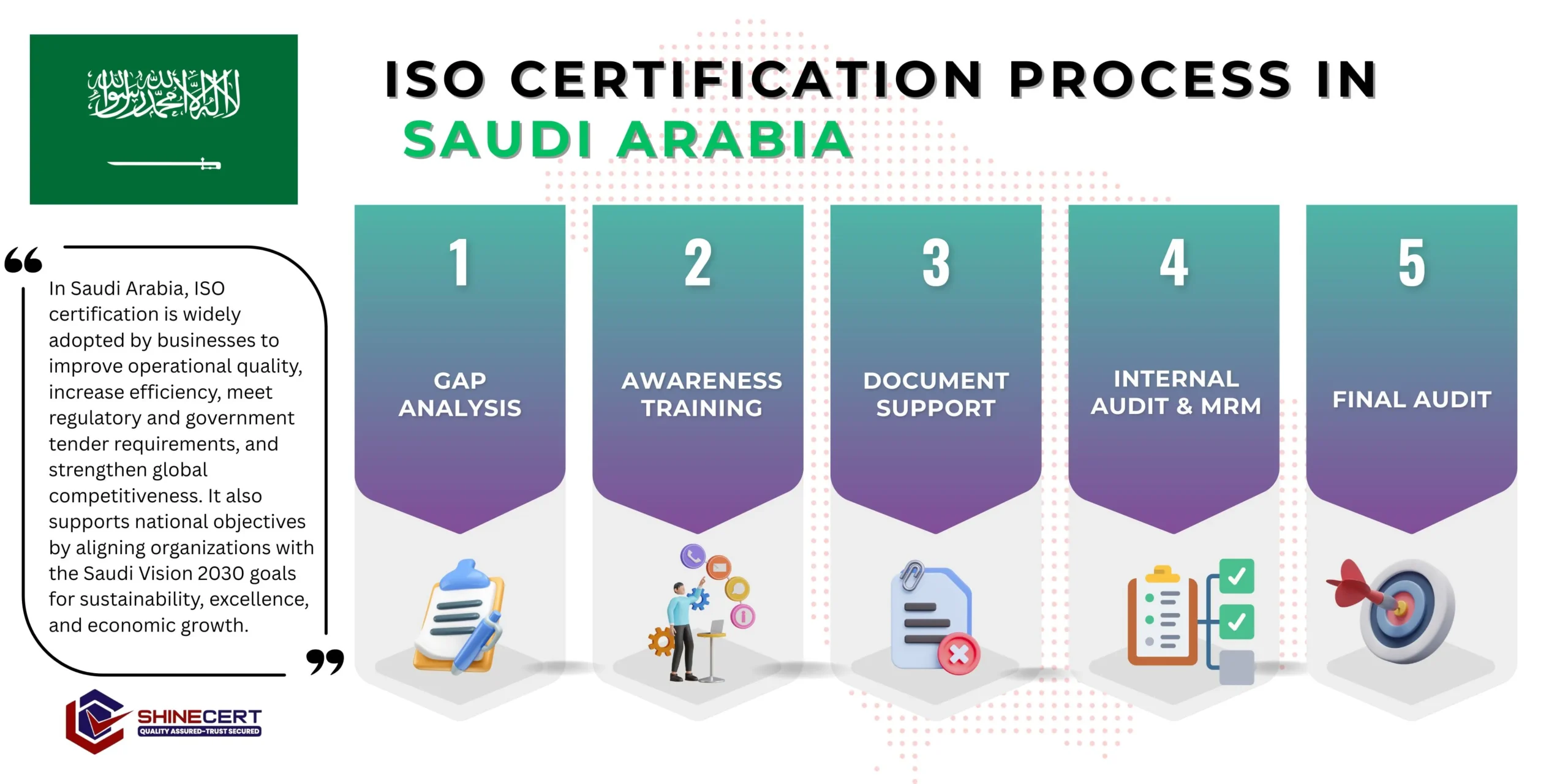
ShineCert’s 5-Step Certification Process for Manufacturing and Engineering
our services
- ISO 9001 Certification
- ISO 14001 Certification
- ISO 27001 Certification
- ISO 22000 Certification
- ISO 45001 Certification
- ISO 13485 Certification
- ISO 17025 Certification
- CE Mark Certification
- GMP Certification
- Halal Certification
- SOC Certification
Gap Analysis
ShineCert reviews current production, safety, and environmental practices against your target standards.
Gap assessment report.
Documentation Development
Quality manual, process procedures, and safety and environmental documentation are developed together.
Complete management system documentation.
Implementation and Training
Production, quality, and safety teams are trained on new procedures and controls.
Training records and implementation evidence.
Internal Audit
An internal audit and management review evaluate the system across production and support functions.
Internal audit report and management review minutes.
Certification Audit Support
ShineCert supports Stage 1 and Stage 2 audits with your chosen accredited certification body.
Certificate(s) and surveillance audit schedule.
Gap Analysis
ShineCert reviews current production, safety, and environmental practices against your target standards.
Gap assessment report.
Documentation Development
Quality manual, process procedures, and safety and environmental documentation are developed together.
Complete management system documentation.
Implementation and Training
Production, quality, and safety teams are trained on new procedures and controls.
Training records and implementation evidence.
Internal Audit
An internal audit and management review evaluate the system across production and support functions.
Internal audit report and management review minutes.
Certification Audit Support
ShineCert supports Stage 1 and Stage 2 audits with your chosen accredited certification body.
Certificate(s) and surveillance audit schedule.
Manufacturing Certification and Customer Quality Requirements, How They Connect
Many manufacturers first pursue ISO 9001 not from pure internal motivation but because a specific customer or industry sector requires it as a condition of doing business, and understanding your target customers’ actual requirements, whether they expect ISO 9001 alone, a sector-specific quality standard, or a broader QHSE combination, should shape certification scope from the outset rather than being discovered midway through implementation. Manufacturers serving multiple industries with different customer expectations sometimes need to plan for a phased certification approach, starting with the standard most immediately required and adding others as the customer base and growth strategy evolve.
Applicable ISO Standards for Manufacturing and Engineering
ISO 9001
Quality Management System
ISO 9001 — Quality Management System
ISO 9001 is the standard virtually every manufacturer encounters first, and for good reason: it establishes the foundational discipline around process control, incoming material inspection, nonconformance management, and corrective action that underlies reliable production output at any scale. For manufacturers supplying original equipment manufacturers or larger industrial buyers, current ISO 9001 certification is frequently a hard prerequisite for even being considered as a qualified supplier, and it typically forms the base layer that other, more specialized standards build upon rather than standing alone as a one-time achievement.
ISO 45001
Occupational Health & Safety
ISO 45001 — Occupational Health and Safety Management
Manufacturing floors combine heavy machinery, material handling equipment, and often hazardous materials or processes, creating injury risk that a structured occupational safety management system meaningfully reduces through hazard identification, worker involvement, and genuine incident investigation rather than reactive compliance alone. Manufacturers that certify to ISO 45001 typically see measurable reductions in lost-time injury rates over successive years, and increasingly, larger buyers evaluate a supplier's safety performance and management system maturity as part of their own supply chain risk assessment, not purely as an internal HR concern.
ISO 14001
Environmental Management System
ISO 14001 — Environmental Management System
Manufacturing processes generate waste streams, emissions, and resource consumption that carry both regulatory exposure and increasing buyer scrutiny, particularly as more industrial customers build supplier environmental performance into their own sustainability reporting and procurement criteria. ISO 14001 certification demonstrates a structured system for identifying environmental aspects specific to your processes — solvent use, metal finishing waste, packaging material, energy consumption — and driving genuine reduction over time rather than simply achieving regulatory minimum compliance and stopping there.
ISO 55001
Asset Management System
ISO 55001 — Asset Management System
Manufacturers and engineering firms managing substantial capital equipment — production lines, specialized machinery, testing equipment — increasingly find value in ISO 55001's structured approach to asset lifecycle management, balancing planned maintenance investment against unplanned failure cost and building genuine long-term capital planning discipline rather than reactive equipment replacement driven purely by breakdown. This standard tends to matter most for manufacturers with significant, long-lived physical asset bases rather than smaller operations with limited capital equipment exposure.
Right-Sized Certification Matters
The reverse question applies here too: a very small manufacturer or engineering firm producing low-volume, low-risk products for a limited local customer base may find the full standard combination disproportionate to genuine risk and buyer expectation, and ShineCert scopes recommendations against your actual customer base and growth ambitions rather than defaulting to the broadest possible certification package.
Common Implementation Challenges in Manufacturing Certification
- Documentation that doesn’t match actual shop floor practice : A quality procedure written at a desk that doesn’t reflect what actually happens on the production line is a common and serious audit finding.
- Inconsistent process control across shifts : Different shifts or operators following subtly different unwritten practices undermines genuine process consistency even when written procedures exist.
- Supplier quality management treated superficially : Incoming material and component quality directly affects finished product quality, and manufacturers that don’t extend genuine oversight to their own supply base create a persistent quality risk.
- Safety and quality systems built as entirely separate efforts : Manufacturers implementing ISO 9001 and ISO 45001 as unconnected projects miss genuine efficiency and risk-identification overlap between the two systems.
Benefits of Certification for Manufacturing and Engineering Organizations
- International business and market access benefits : Certification opens doors to original equipment manufacturer supply chains and larger industrial buyers who routinely restrict their approved vendor lists to certified suppliers, and it’s frequently the deciding factor when a manufacturer is competing for an international contract against a similarly priced but uncertified competitor.
- Trust and reputation benefits : A certified quality management system provides buyers with independently verified confidence that a manufacturer’s processes are genuinely controlled, rather than relying entirely on sample inspection or trust built purely through relationship history, which matters enormously when a new customer relationship is just beginning.
- Process improvement and operational benefits : Structured quality management frequently surfaces genuine production inefficiencies, inconsistent process parameters between shifts, rework that was quietly absorbed rather than tracked and addressed, supplier quality issues that recurred without systematic root cause investigation and manufacturers that engage genuinely with the improvement cycle typically see measurable reductions in scrap, rework, and warranty cost over time.
- Risk reduction benefits : Documented safety and environmental management reduces injury rates and regulatory exposure, while structured quality management reduces the frequency and cost of customer returns, warranty claims, and the reputational damage a serious quality escape can cause.
Manufacturing Certification Cost: What Actually Drives It
- Company size and production complexity : A manufacturer running multiple product lines or complex, multi-stage processes faces more extensive documentation and audit time than a single-product, straightforward production operation.
- Nature of the business and hazard profile : Manufacturing involving hazardous materials, heavy machinery, or complex chemical processes requires more extensive safety and environmental risk assessment than lower-risk assembly or finishing operations.
- Number of departments and sites in scope : Certification covering multiple production facilities or distinct departments as separate units costs more than a single-site certification.
- Existing management system maturity : Manufacturers with established, if informal, quality control practices typically implement faster and at lower cost than those building systems from scratch.
- Standard combination pursued : Adding ISO 45001, 14001, or 55001 alongside ISO 9001 adds distinct scope and cost beyond single-standard certification, though integrated implementation reduces the combined cost below what three separate projects would require.
Supplier Quality Management: Extending Control Beyond Your Own Walls
A manufacturer’s finished product quality depends heavily on the quality of incoming materials and components from its own supply base, and ISO 9001 implementation frequently surfaces the reality that many manufacturers have far less genuine visibility into supplier quality performance than they assumed before undergoing a structured gap analysis. Building genuine supplier quality management requires more than a signed quality agreement, it requires incoming inspection data that’s actually analyzed for trends, a real mechanism for flagging and following up on supplier nonconformances, and periodic supplier performance review that goes beyond price and delivery to include genuine quality metrics. ShineCert helps manufacturers build supplier quality management proportionate to their actual risk exposure, focusing the most rigorous oversight on suppliers of safety-critical or high-value components rather than spreading limited quality assurance resources evenly across a supply base with very different risk profiles.
Managing Quality Across Multi-Shift and Multi-Site Production
Manufacturers operating around the clock or across multiple facilities face a genuine consistency challenge that a single-shift, single-site operation doesn’t: ensuring the same process discipline, the same corrective action rigor, and the same genuine management commitment applies regardless of which shift or which facility is running at any given moment. Quality issues that seem to appear randomly often trace back to subtle differences between shifts or sites that never got formally identified and addressed, since informal workarounds tend to develop locally and don’t always surface in centralized quality reporting.
ShineCert helps multi-shift and multi-site manufacturers build genuine cross-shift and cross-site quality communication into their management system, ensuring that a corrective action identified on one shift or at one facility actually propagates to the others rather than being solved locally and then quietly recurring elsewhere.
Why Choose ShineCert for Manufacturing and Engineering Certification?
ShineCert has guided more than 10,000 organizations through international certification from genuine operating offices in Riyadh, Lebanon, and India, with practical experience across precision manufacturing, heavy equipment, contract manufacturing, and engineering services.
Choosing an Accredited Certification Body for Manufacturing and Engineering
What to Check | Why It Matters |
IAF-recognized accreditation for your target standards | Confirms certificates carry genuine recognition with your customer base |
Manufacturing sector audit experience | Auditors familiar with production process control assess your system more effectively |
Recognition by your target OEM or industrial customers | Confirms the certificate carries practical commercial weight, not just technical compliance |
Multi-site audit capability where relevant | Important for manufacturers operating more than one production facility |
Equipment Calibration and Measurement System Reliability
Manufacturing quality claims are only as credible as the measurement systems used to verify them, and ISO 9001 implementation frequently surfaces gaps in how consistently a manufacturer calibrates and maintains the gauges, testing equipment, and inspection tools its entire quality control process depends on. A dimensional inspection or performance test conducted with equipment that’s drifted out of calibration produces data that looks precise but isn’t genuinely reliable, and this kind of gap often goes unnoticed for extended periods precisely because the numbers still look plausible on paper even when they no longer reflect true measurement accuracy.
Building a genuinely reliable measurement system requires a documented calibration schedule tied to actual equipment usage and manufacturer specifications, clear procedures for what happens when a piece of equipment is found out of calibration during a routine check, and enough redundancy in critical measurement points that a single piece of failing equipment doesn’t silently compromise an entire production run’s quality data. ShineCert helps manufacturers build calibration and measurement system management into their broader ISO 9001 implementation, since a quality management system built on top of unreliable measurement data provides a false sense of control regardless of how well every other element of the system is designed and documented.
Start Your Manufacturing and Engineering Certification Journey
ShineCert provides end-to-end certification support, from gap analysis through certification audit, for manufacturers and engineering firms across precision components, heavy equipment, and contract manufacturing. Book your free consultation or contact ShineCert directly, and our team will review your production operations, target customers, and current management system maturity before proposing a fixed-scope engagement plan.
Frequently Asked Questions
Most manufacturers start with ISO 9001, adding ISO 45001 and ISO 14001 as safety and environmental exposure and customer expectations grow.
A good historical record doesn’t replace a structured, auditable system, and increasingly buyers expect the certified management system itself, not just historical outcomes.
It depends on production complexity, site count, and existing management system maturity. ShineCert provides a fixed quote after gap analysis.
Core ISO 9001 certification typically takes four to six months; adding further standards extends the timeline moderately given integrated implementation efficiency.
For most original equipment manufacturers and larger industrial buyers, current ISO 9001 certification is a hard supplier qualification requirement, not a soft preference.
It’s most valuable for manufacturers with substantial, long-lived capital equipment; smaller operations with limited fixed asset exposure typically find ISO 9001 and, where relevant, ISO 45001 sufficient.
Yes, certification scope can be defined around specific facilities or product lines, though buyers increasingly expect scope to cover the actual production supplying them specifically.