
ISO 27001 Certification in Nigeria
Quick Answer
ISO 27001 is the international standard for information security management systems, and in Nigeria it maps closely onto what the Nigeria Data Protection Act 2023 (NDPA) and the Nigeria Data Protection Commission (NDPC) genuinely expect from organizations handling personal data. The NDPC requires certain regulated entities to file annual Compliance Audit Returns, notify breaches within 72 hours, and demonstrate real technical and organizational controls, requirements that overlap substantially with what ISO 27001 certification already builds into your organization. Certification typically takes three to five months, and cost depends on genuine factors like data volume, systems complexity, and organization size, never a flat figure quoted upfront.
What Is ISO 27001, Actually?
ISO 27001 is an international standard, published by the International Organization for Standardization, that sets out requirements for an information security management system, a structured way an organization identifies information security risks, puts controls in place to manage them, and continually improves how it protects data. It covers the full range of information assets, from customer personal data and financial records to internal business systems and intellectual property, addressing people, process, and technology together rather than treating security as a purely technical IT problem. Getting certified means an independent, accredited body has formally verified your security management system meets the standard’s requirements, giving customers, regulators, and business partners real confidence your organization takes data protection seriously and systematically, not just as a policy document nobody follows.
Why ISO 27001 ISMS Matters So Much in Nigeria Right Now?
- The NDPA 2023 created genuine, enforceable data protection obligations with real financial teeth : Signed into law in June 2023 and actively enforced through the Nigeria Data Protection Commission, the NDPA requires regulated organizations, classified by the NDPC as Data Controllers and Processors of Major Importance, split into Ultra-High Level and Extra-High Level tiers based on data volume and sensitivity, to register, file annual Compliance Audit Returns through licensed Data Protection Compliance Organizations, and maintain genuine technical safeguards. Non-compliance carries fines up to ₦10,000,000 or 2% of annual gross revenue, whichever is higher, for the most significant entities.
- The NDPC’s technical expectations closely mirror ISO 27001’s actual control requirements : Current NDPC compliance guidance references encryption for data at rest and in transit, multi-factor authentication, role-based access controls, network segmentation, regular vulnerability assessments, and documented backup and recovery capabilities, genuinely the same categories of control ISO 27001’s Annex A already requires an organization to assess and implement.
- The 72-hour breach notification requirement rewards organizations with a system already built for fast, structured incident response : NDPC requires notification within 72 hours of becoming aware of a breach likely to pose high risk to individuals, a genuinely tight window that’s far easier to meet when your organization already has documented incident response procedures in place, rather than building one under real time pressure during an actual breach.
- Nigeria’s fintech, healthtech, and outsourcing sectors face client-side security expectations beyond domestic regulation alone : Businesses processing data for international clients, particularly in Lagos’s growing fintech and business process outsourcing sectors, increasingly find ISO 27001 treated as a genuine baseline expectation by international partners and investors, independent of NDPA compliance specifically.
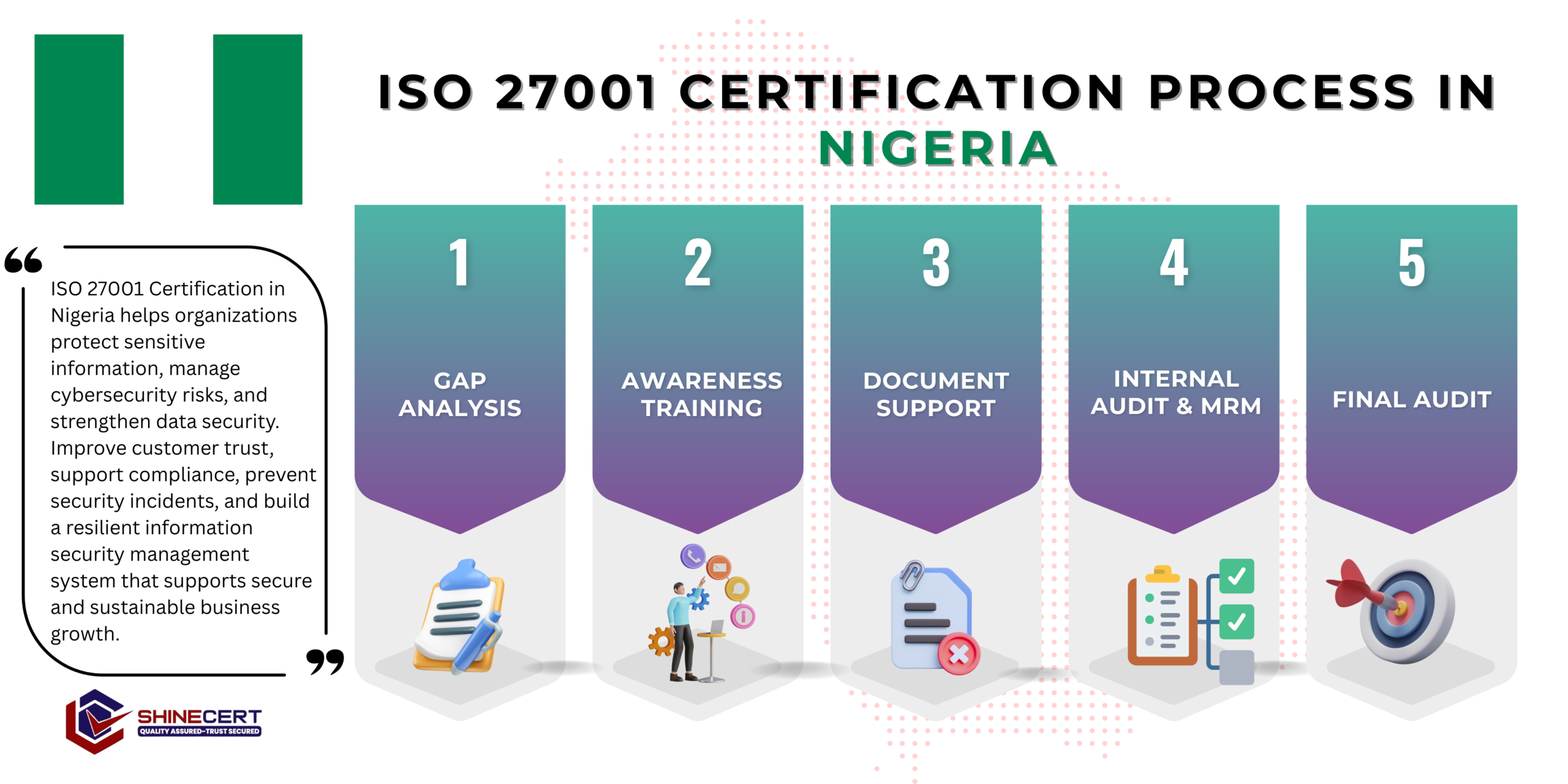
What are the steps to get ISO 27001 Certification in Nigeria?
our services
- ISO Certification Nigeria
- ISO 9001 Certification Nigeria
- ISO 14001 Certification Nigeria
- ISO 27001 Certification Nigeria
- ISO 22000 Certification Nigeria
- ISO 20000-1 Certification Nigeria
- ISO 45001 Certification Nigeria
- ISO 42001 Certification Nigeria
- ISO 13485 Certification Nigeria
- ISO 17025 Certification Nigeria
- ISO 31000 Certification Nigeria
- ISO 22301 Certification Nigeria
- ISO 27701 Certification Nigeria
- ISO 37001 Certification Nigeria
- ISO 50001 Certification Nigeria
- CE Mark Certification Nigeria
- GMP Certification Nigeria
- GDPR Certification Nigeria
- Halal Certification Nigeria
- SOC Certification Nigeria
Our Five-Step Certification Process, in Depth
Gap Assessment
We review your current systems, data flows, and existing security practices against both ISO 27001's Annex A controls and the NDPC's specific technical expectations together, since building toward both simultaneously avoids duplicated effort later.
A gap report mapping your actual security posture against ISO 27001 requirements and your NDPA compliance obligations side by side.
Documentation
We build your ISMS policy, risk assessment methodology, and Statement of Applicability around your organization's genuine data footprint and systems, a fintech handling payment data has a meaningfully different risk profile than a professional services firm handling client documents, and the documentation reflects that specifically.
A complete, version-controlled ISMS documentation set, including a Statement of Applicability with real, defensible justifications for every control decision.
Implementation
Technical controls, access management, encryption, network segmentation, and organizational controls, incident response procedures, vendor security requirements, move into genuine daily operation, with staff trained on their specific security responsibilities.
A functioning ISMS with real technical and organizational controls operating, not just documented.
Internal Audit and Management Review
We audit against every ISO 27001 clause and Annex A control, and cross-check against NDPA obligations specifically, surfacing gaps while the stakes are low. Findings go to formal management review with documented decisions on security priorities and resourcing.
An internal audit report, management review minutes, and corrective actions closed out before the certification audit.
Certification Audit
Stage 1 confirms your ISMS documentation, including the Statement of Applicability, is genuinely audit-ready; Stage 2 verifies controls are actually operating as documented, through direct observation and staff interviews. We stay engaged through both stages.
Your ISO 27001 certificate, valid for three years, plus a surveillance audit schedule.
Gap Assessment
We review your current systems, data flows, and existing security practices against both ISO 27001's Annex A controls and the NDPC's specific technical expectations together, since building toward both simultaneously avoids duplicated effort later.
A gap report mapping your actual security posture against ISO 27001 requirements and your NDPA compliance obligations side by side.
Documentation
We build your ISMS policy, risk assessment methodology, and Statement of Applicability around your organization's genuine data footprint and systems, a fintech handling payment data has a meaningfully different risk profile than a professional services firm handling client documents, and the documentation reflects that specifically.
A complete, version-controlled ISMS documentation set, including a Statement of Applicability with real, defensible justifications for every control decision.
Implementation
Technical controls, access management, encryption, network segmentation, and organizational controls, incident response procedures, vendor security requirements, move into genuine daily operation, with staff trained on their specific security responsibilities.
A functioning ISMS with real technical and organizational controls operating, not just documented.
Internal Audit and Management Review
We audit against every ISO 27001 clause and Annex A control, and cross-check against NDPA obligations specifically, surfacing gaps while the stakes are low. Findings go to formal management review with documented decisions on security priorities and resourcing.
An internal audit report, management review minutes, and corrective actions closed out before the certification audit.
Certification Audit
Stage 1 confirms your ISMS documentation, including the Statement of Applicability, is genuinely audit-ready; Stage 2 verifies controls are actually operating as documented, through direct observation and staff interviews. We stay engaged through both stages.
Your ISO 27001 certificate, valid for three years, plus a surveillance audit schedule.
Certification Validity, Surveillance Audits, and Recertification
An ISO 27001 certificate is valid for three years from the date it’s issued. During years one and two, your certification body conducts an annual surveillance audit, narrower in scope, typically sampling a portion of your controls and confirming previously identified nonconformities were genuinely closed. Before the three-year mark, a full recertification audit, comparable in depth to your original Stage 2 audit, confirms your ISMS has continued functioning throughout the cycle, including that your risk assessment and Statement of Applicability were kept genuinely current as your systems evolved. Passing recertification issues a new three-year certificate.
Cost of ISO 27001 Certification in Nigeria, What Actually Drives It
| Organization Profile | Relative Investment Level | Why |
|---|---|---|
| Small, single-system operation | Lower | Narrower asset inventory, fewer Annex A controls genuinely applicable |
| Medium, multiple-systems or NDPA EHL entity | Moderate | Broader risk assessment and control implementation scope |
| Larger, multi-department or NDPA UHL entity | Higher | Extensive systems mapping, complex access and vendor risk management |
| Bundled with ISO 27701 or ISO 9001 | Moderate-to-higher combined, lower than separate engagements | Shared implementation infrastructure reduces combined cost |
- Nature of business and data sensitivity : A fintech or healthtech handling large volumes of sensitive personal or financial data faces a genuinely more extensive risk assessment and control set than a business handling limited, low-sensitivity data.
- Number of systems and data flows : Each additional system, application, or third-party integration expands the asset inventory and the corresponding risk assessment and control implementation work.
- NDPA classification tier : Organizations classified by the NDPC as Ultra-High Level or Extra-High Level face genuinely more extensive regulatory expectations, which typically translates into a broader ISO 27001 scope as well.
- Existing security maturity : Businesses with some documented security policies and technical controls already in place aren’t starting from zero, those relying entirely on informal practice face more foundational work.
- Certification body fees, tracked separately from our consulting fees : The certification audit itself is conducted and invoiced directly by an independently accredited certification body, separate from ShineCert’s implementation work.
- Whether you’re bundling standards : Building ISO 27001 alongside ISO 27701 for privacy management, or ISO 9001, shares meaningful implementation infrastructure and reduces combined cost.
- Internal capacity to contribute : An IT manager or data protection officer who can genuinely own documentation, risk assessment logistics, and internal audit coordination reduces the consulting hours required.
ISO 27001 Benefits Nigerian Businesses Actually Get
Because ISO 27001’s control requirements substantially overlap with what the NDPC expects technically, certified organizations find annual Compliance Audit Return preparation considerably more straightforward than starting from a documentation vacuum.
ISO 27001 is understood and trusted globally, giving international clients, investors, and partners confidence in your data handling without requiring them to independently audit your systems.
Systematic risk assessment and layered technical and organizational controls meaningfully reduce the likelihood of a breach occurring in the first place, not just the ability to respond once one happens.
A documented incident response process makes meeting the NDPC’s 72-hour notification window realistic rather than a genuine scramble under pressure.
Financial services, government-adjacent, and international outsourcing contracts increasingly list information security certification as a genuine evaluation criterion, particularly for organizations handling sensitive client data.
Demonstrable, independently verified security practice is a genuine differentiator in sectors, fintech, healthtech, professional services, where clients are directly entrusting you with sensitive personal or financial data.
Once the management system is built, maintaining NDPA compliance and pursuing ISO 27001 surveillance audits together is considerably more efficient than treating each as a separate, disconnected exercise.
ISO 27001 requires genuinely identifying the specific information security risks your organization faces, not generic threats, but risks tied to your actual systems, vendors, and data flows, and building real, prioritized controls around them.
ISO 27001’s Harmonized Structure and its natural extension, ISO 27701 for privacy information management, make pursuing additional certifications considerably more efficient once the core ISMS is in place.
The standard requires assessing security risk in your supply chain and vendor relationships, an area many Nigerian organizations manage informally until a certified system forces genuine structure onto it.
Mandatory Documents Required for ISO 27001 Implementation
A documented statement defining which systems, data, locations, and business units the information security management system covers, aligned with your actual data processing footprint under the NDPA.
A documented policy, approved by top management, expressing genuine commitment to protecting information assets and complying with applicable legal requirements including the NDPA.
A documented, actively maintained process for identifying information security risks across your actual systems and data flows, assessing their genuine likelihood and impact, and recording the controls chosen to treat each one.
A document mapping every Annex A control to whether it applies to your organization and, if excluded, a genuine justification, this is one of ISO 27001’s most distinctive and closely audited documents.
A documented list of applicable requirements, NDPA obligations, sector-specific regulations, client contractual security clauses, along with evidence of how each is being met.
A documented register of information assets, systems, data stores, hardware, with assigned owners responsible for their security.
Documentation and evidence of role-based access controls, ensuring personal and sensitive data is genuinely accessible only to those with a legitimate business need.
A documented procedure for detecting, reporting, and responding to security incidents, including the internal steps needed to meet the NDPC’s 72-hour external notification window, plus records of any incidents actually handled.
Documented backup and recovery procedures, tested periodically, demonstrating your organization can genuinely restore data and operations after a disruptive incident.
A planned internal audit cycle, documented management review decisions, and evidence staff handling sensitive data have received relevant security awareness training.
Challenges Organizations Face, Implementation, Risk Management, Audit, and Ongoing Certification
- Challenges during implementation : Businesses with genuinely strong technical security sometimes underestimate how much documentation and formal risk assessment work ISO 27001 actually requires beyond the technical controls themselves, the standard audits of your management system, not just your firewall configuration.
- Challenges in risk management : A common gap is treating the risk assessment as a one-time exercise completed for certification rather than a living process, new systems, vendors, and data flows introduced after certification need to be genuinely assessed too, not left outside the original risk register.
- Challenges during internal and certification audits : The Statement of Applicability is one of the most closely scrutinized documents in an ISO 27001 audit, and auditors specifically probe excluded controls for genuine justification, a control excluded without real reasoning is a common and avoidable finding.
- Challenges maintaining certification after the initial audit : Security practice tends to drift as systems and vendors change after certification, new applications get adopted without going through the access control or risk assessment process, and the asset inventory quietly falls out of date well before a surveillance audit catches it.
Case Study
A Lagos-based fintech offering a digital lending and payments platform approached us after being classified by the NDPC as an Extra-High-Level data controller under the NDPA, triggering a genuine annual Compliance Audit Return obligation the business hadn’t previously had to navigate. Their existing security practices were reasonably solid at a technical level, the engineering team had implemented encryption and access controls already, but none of it was documented in a way that could actually demonstrate compliance to an external reviewer, and there was no formal risk assessment or incident response procedure in place.
Our gap assessment found the technical foundation was genuinely stronger than the documentation suggested, but the business lacked a Statement of Applicability, a documented risk treatment plan, and any tested incident response procedure, meaning a real breach would have found the organization improvising its 72-hour notification response rather than executing a rehearsed plan. We built the ISMS documentation directly around their existing technical controls rather than starting from scratch, which considerably shortened the implementation phase.
Certification took just under four months, and the Statement of Applicability we built became the direct backbone of their first NDPA Compliance Audit Return submission, considerably simplifying what had initially looked like a genuinely daunting regulatory obligation.
This reflects a pattern we see often, strong technical security undermined by a lack of documented, auditable structure, rather than a single specific engagement.
Industries and Sectors We Certify in Nigeria, and Which Standards Each Actually Needs
Fintech and digital payments
ISO 27001 is close to essential given the sensitive financial data these businesses handle; pair with ISO 27701 for privacy information management given direct NDPA exposure.
Read moreHealthtech and health data platforms
ISO 27001 addresses genuinely sensitive health data risk; pair with ISO 13485 if the business also manufactures or distributes medical devices.
Read moreBusiness process outsourcing and IT services
ISO 27001 is frequently a genuine client contractual requirement given the client data these businesses process on behalf of international partners; pair with ISO 9001 for service quality.
Read moreBanking and financial services
ISO 27001 addresses core information security risk; pair with ISO 22301 for business continuity given the operational disruption risk this sector genuinely faces.
Read moreTelecommunications
ISO 27001 addresses the substantial customer data these businesses process; pair with ISO 20000-1 for IT service management given the service-delivery nature of telecom operations.
Read moreProfessional services (legal, accounting, consulting)
ISO 27001 addresses genuinely sensitive client data risk; pair with ISO 9001 for overall service quality management.
Read moreWhy Choose ShineCert for ISO 27001 Certification Nigeria?
ShineCert brings 10 years of ISO consulting and certification experience to Nigeria’s market, coordinated through our Riyadh and India offices with services delivered remotely or on-site depending on what your engagement genuinely needs. We’ve guided more than 10,000 organizations through ISO certification worldwide, and we build every Nigeria information security engagement around your actual systems, data profile, and NDPA classification, not a generic template lifted from a different regulatory environment. ShineCert is the best ISO consultant in Nigeria.
Choosing a Certification Body in Nigeria?
What to Check | Why It Matters |
Accreditation under a recognized international accreditation framework | Confirms genuine, internationally recognized certification |
Genuine familiarity with the NDPA and NDPC compliance framework | Ensures the auditor understands how your ISMS connects to your actual regulatory obligations |
Experience with your specific sector’s data risk profile | Fintech, healthtech, and outsourcing involve genuinely different data sensitivity levels |
A genuine technical-controls-verification audit approach | Confirms the auditor checks real system configuration, not just documentation review |
Ready to Get Started?
Whether you’re responding to a new NDPA classification obligation or strengthening security proactively, we’ll walk through your specific systems and cost factors before proposing a fixed-scope plan, delivered remotely, on-site, or however genuinely fits your project. Book a free consultation or contact us directly to get started.
Frequently Asked Questions
Look for demonstrated experience with your specific sector’s data risk profile, genuine familiarity with the NDPA and NDPC compliance framework, and transparent scoping rather than flat package pricing. ShineCert scopes every Nigeria engagement individually.
Not automatically, but the overlap is substantial, a certified ISMS gives you most of the documentation and technical controls the NDPC expects, considerably simplifying your Compliance Audit Return preparation.
It genuinely depends on your systems complexity, data sensitivity, and NDPA classification tier, we scope every project individually.
Typically two and a half to eight months depending on organization size and systems complexity, see our detailed timeline breakdown above.
NDPC registration and Compliance Audit Return filing are separate legal obligations under the NDPA, but ISO 27001 certification gives you a genuinely stronger, internationally recognized foundation for meeting those obligations consistently.
Certification doesn’t mean breaches never happen, it means your organization has a documented, tested incident response process, meaningfully improving your ability to meet the NDPC’s 72-hour notification requirement and demonstrate genuine accountability.
Much of the documentation and risk assessment work runs effectively over remote sessions, though certain technical verification and staff interviews benefit from on-site presence, we scope the right mix per project.
ShineCert doesn’t maintain a standalone Nigeria office; we coordinate Nigeria engagements from our Riyadh and India offices, with services delivered remotely or on-site as your project requires.