
ISO Certification
Quick Answer
ISO certification is independent, third-party confirmation that an organization’s management system meets a specific International Organization for Standardization (ISO) standard. It’s earned through an accredited audit, not self-declared, and typically covers quality (ISO 9001), safety (ISO 45001), environment (ISO 14001), or information security (ISO 27001), among dozens of others. Certification usually takes three to six months and is valid for three years, subject to annual surveillance audits.
A Short History of ISO
ISO was founded in 1947 in Geneva, Switzerland, by delegates from 25 countries who wanted a common language for technical standards after a war that had made painfully clear what happens when nothing is interchangeable, parts, measurements, safety expectations, none of it aligned across borders. Nearly eighty years later, ISO counts more than 170 member countries, each represented by its own national standards body, and has published over 25,000 standards covering everything from screw threads to artificial intelligence governance.
The management-system standards most businesses actually deal with came later. ISO 9001, the quality management standard, was first published in 1987, built on earlier military and defense-sector quality frameworks. Environmental (ISO 14001) and safety (ISO 45001, successor to OHSAS 18001) followed as separate concerns matured into their own disciplines. For a long time, each standard had its own unique structure, which meant a company certifying to three standards at once was often maintaining three barely-related documentation systems.
That changed in 2012, when ISO introduced what’s known as the Harmonized Structure (originally called Annex SL), a shared skeleton of ten core clauses that every modern management-system standard now follows, from ISO 9001 to ISO 27001 to ISO 22301. This is genuinely useful, not just bureaucratic tidiness: it means a business already certified to one ISO standard can add a second with real, tangible documentation overlap instead of starting from zero. Newer standards, including ISO 42001 for AI management systems (published 2023) and the 2026 ISO 9001 clause updates, continue to be built on this same shared foundation.
What are the steps to get ISO Certification?
our services
- ISO 9001 Certification
- ISO 14001 Certification
- ISO 27001 Certification
- ISO 22000 Certification
- ISO 45001 Certification
- ISO 13485 Certification
- ISO 20000 Certification
- ISO 17025 Certification
- CE Mark Certification
- GMP Certification
- Halal Certification
- SOC Certification
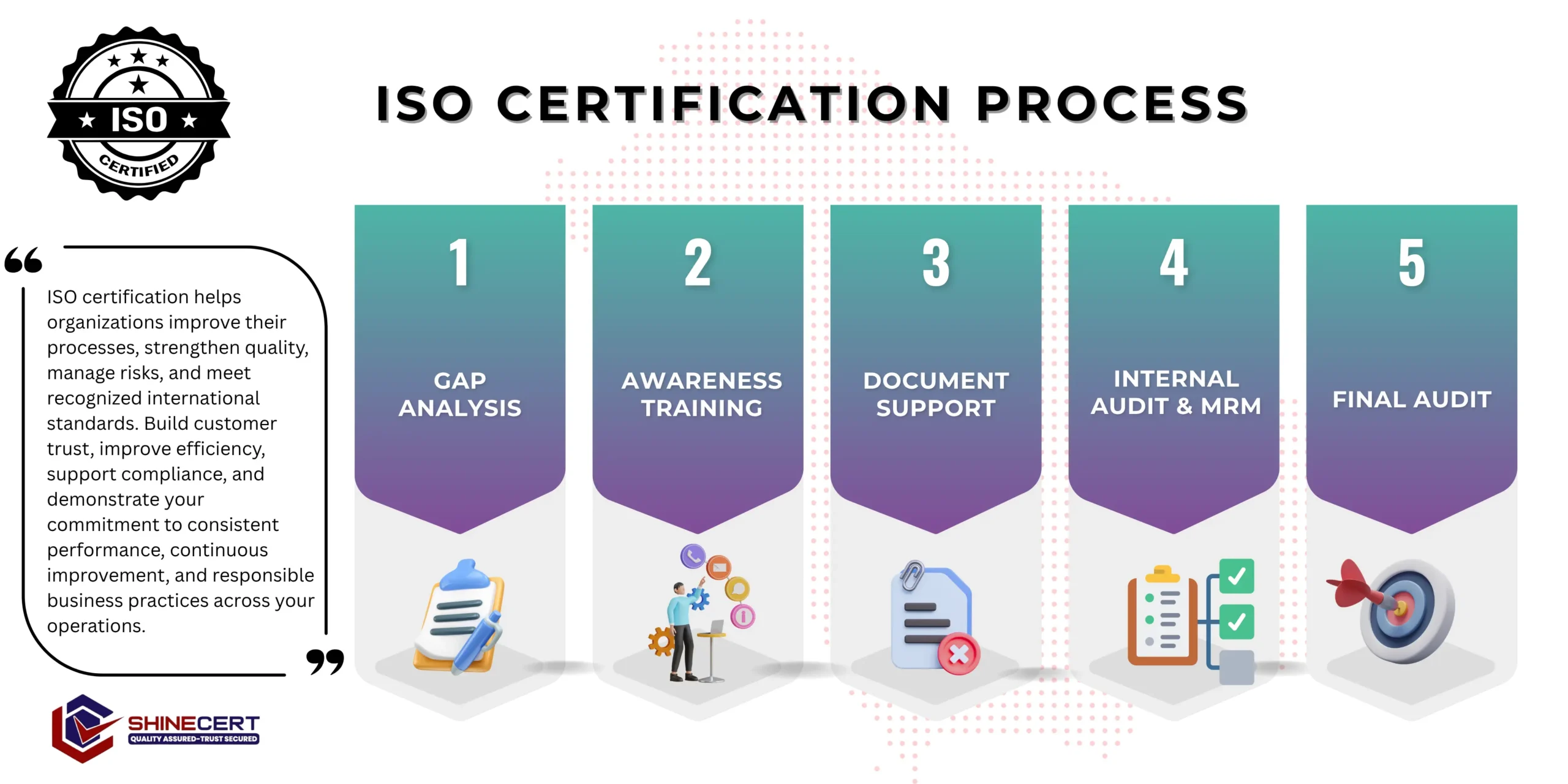
Step-by-Step Roadmap to ISO Certification
Every ISO standard, regardless of subject matter, follows roughly the same five-stage path to certification.
Gap Assessment
Your current operations get measured against every requirement of the chosen standard, producing a specific, written list of what's missing. This becomes the working plan for everything that follows.
A documented gap assessment identifying every requirement not yet met by current operations.
Documentation Development
The policies, procedures, and record templates the gap assessment flagged as missing get built, shaped around how the business actually operates, not copied from a generic template nobody will follow.
A complete set of policies, procedures, and record templates matched to the business.
Implementation & Training
Staff get trained on the new procedures, and the system moves into genuine daily operation, generating the real records an auditor will eventually review.
Trained staff and the operational records that demonstrate the system genuinely runs.
Internal Audit & Management Review
A structured internal audit checks the system against the standard, followed by a formal management review where leadership responds to what the audit found. This step catches most issues before an external auditor ever sees them.
A documented internal audit report and management review minutes showing findings were addressed.
Certification Audit
An accredited certification body conducts a two-stage external audit, reviewing documentation first, then verifying the system genuinely works in practice, before issuing the certificate.
Your certificate, issued following a two-stage external audit.
Gap Assessment
Your current operations get measured against every requirement of the chosen standard, producing a specific, written list of what's missing. This becomes the working plan for everything that follows.
A documented gap assessment identifying every requirement not yet met by current operations.
Documentation Development
The policies, procedures, and record templates the gap assessment flagged as missing get built, shaped around how the business actually operates, not copied from a generic template nobody will follow.
A complete set of policies, procedures, and record templates matched to the business.
Implementation & Training
Staff get trained on the new procedures, and the system moves into genuine daily operation, generating the real records an auditor will eventually review.
Trained staff and the operational records that demonstrate the system genuinely runs.
Internal Audit & Management Review
A structured internal audit checks the system against the standard, followed by a formal management review where leadership responds to what the audit found. This step catches most issues before an external auditor ever sees them.
A documented internal audit report and management review minutes showing findings were addressed.
Certification Audit
An accredited certification body conducts a two-stage external audit, reviewing documentation first, then verifying the system genuinely works in practice, before issuing the certificate.
Your certificate, issued following a two-stage external audit.
What Is ISO?
- Say “ISO” to most business owners and they picture a certificate on a wall, somewhere between the founder’s photo and a fire safety notice. Fair enough, that’s usually the only part of ISO a company actually sees. But the certificate is the last step of something much more practical: a system for running a business in a way that’s consistent, documented, and genuinely checkable by someone outside the company.
- ISO itself, the International Organization for Standardization, doesn’t hand out certificates. It’s an independent, non-governmental body that writes the standards: the rulebooks defining what a properly run quality system, safety system, or information-security system actually looks like.
- Separately accredited certification bodies then audit organizations against those rulebooks and issue the certificate. Two different jobs, two different organizations, and understanding that split clears up most of the confusion people have about how this actually works.
- An ISO standard is the written requirement set, what has to be true for a management system to count as compliant. ISO certification is the audited proof that it’s actually true in your organization, not just claimed on a policy document nobody reads.
- That distinction matters more than it sounds: plenty of businesses run something close to ISO 9001 in spirit without ever having it independently verified, and the moment a customer, regulator, or investor asks for proof, “we basically do this already” stops being a good enough answer.
ISO Certification Cost Guide
There’s no single number for ISO certification cost, because the real driver isn’t the standard’s name, it’s the scope of work involved for your specific organization.
- Organization size : Audit duration under accreditation rules scales directly with employee headcount, which shows up directly in the certification body’s quote.
- Number of sites : Each additional physical location adds to both the documentation scope and the audit duration, since each site typically needs to be represented in the sample the auditor reviews.
- Which standard, and how many : Some standards require deeper technical documentation and risk assessment than others, which affects consulting cost. Pursuing multiple standards together shares real overhead through the Harmonized Structure, rather than duplicating cost across separate processes.
- Existing documentation maturity : A business that already runs disciplined, documented processes spends considerably less on the documentation-development stage than one starting from informal or undocumented practices.
- DIY vs. consultant vs. end-to-end support : Handling it entirely in-house saves on fees but consumes staff time and raises the real risk of a failed first audit attempt. A consultant shifts spend toward professional fees while typically shortening the timeline and lowering that risk.
- Which certification body you choose : Fees vary by size, reputation, and auditor day rates, any accredited body is a reasonable choice, provided their accreditation genuinely covers your specific standard and scope.
Popular ISO Standards
There are thousands of ISO standards, but a relatively small set covers the vast majority of what businesses actually pursue. Here’s the practical shortlist.
ISO 9001
Quality Management System
ISO 9001 — Quality Management
The foundational standard, and the most widely certified in the world. Governs how consistently an organization delivers what it promised, the natural starting point for almost any business.
ISO 14001
Environmental Management
ISO 14001 — Environmental Management
Covers how an organization identifies, controls, and reduces its environmental impact: emissions, waste, resource use. Common in manufacturing, construction, and industrial operations.
ISO 45001
Occupational Health & Safety
ISO 45001 — Occupational Health & Safety
Requires a structured system for spotting workplace hazards and preventing injury before it happens, rather than reacting after an incident.
ISO 27001
Information Security Management
ISO 27001 — Information Security Management
Governs how a business protects data and information assets against breach, loss, or misuse. Increasingly a baseline expectation for any company handling client or customer data.
ISO 22000
Food Safety Management
ISO 22000 — Food Safety Management
Builds on HACCP principles to control hazards across the food supply chain, from raw ingredients to finished product.
ISO 13485
Medical Device Quality Management
ISO 13485 — Medical Device Quality Management
A sector-specific quality standard for organizations designing, manufacturing, or distributing medical devices, closely tied to regulatory approval in most markets.
ISO 37001
Anti-Bribery Management
ISO 37001 — Anti-Bribery Management
Documented controls preventing bribery in an organization's own operations and in dealings with third parties, agents, and partners.
ISO 22301
Business Continuity Management
ISO 22301 — Business Continuity Management
Covers how an organization prepares for, survives, and recovers from major disruption, outages, disasters, supply-chain failure.
ISO 27701
Privacy Information Management
ISO 27701 — Privacy Information Management
An extension of ISO 27001 specifically addressing personal data handling, built to align with regulations like GDPR.
ISO 42001
AI Management System
ISO 42001 — AI Management System
The newest widely adopted standard, governing how organizations develop, deploy, and govern artificial intelligence responsibly.
ISO 50001
Energy Management
ISO 50001 — Energy Management
Covers how an organization measures, tracks, and improves energy performance over time, directly tied to cost control for energy-intensive operations.
ISO 31000
Risk Management
ISO 31000 — Risk Management
A guidance standard, not certifiable in the traditional sense (no accredited body issues an "ISO 31000 certificate"), but widely used as the framework behind how organizations structure risk management generally.
Benefits of ISO Certification
Certification is frequently a stated or unstated requirement in supplier qualification, government tenders, and enterprise procurement, companies without it are often screened out before price even enters the conversation.
Building a genuine management system tends to surface inefficiencies leadership didn’t know existed: duplicated approvals, unclear ownership, inconsistent handoffs between departments. The certification is almost a side effect of fixing these.
Nearly every ISO standard requires proactive risk identification rather than reactive firefighting, plus a structured process for correcting root causes rather than symptoms, this alone tends to reduce the frequency of repeat problems.
A certificate is a fast, independently verified signal to a customer or partner who doesn’t have time to independently evaluate your operations. It replaces a lengthy trust-building process with a document they already understand.
Clear roles, documented competence requirements, and formal records reduce the fragility that comes from critical knowledge living only in one person’s head, a real risk for growing companies.
ISO Certification Requirements
Requirements vary by standard, but because most modern ISO standards share the Harmonized Structure, the core commonalities are genuinely consistent across almost every certifiable standard:
- Context and scope : Understanding the organization’s internal and external environment, and defining exactly what the management system covers.
- Leadership commitment : Top management has to demonstrably own the system, not delegate it entirely to a compliance manager.
- Risk-based planning : Identifying risks and opportunities relevant to the standard’s subject matter, with documented objectives for addressing them.
- Competence and support : Ensuring the people running the system are genuinely trained and the organization has the resources the system needs to function.
- Operational control : The actual day-to-day processes the standard is built around, quality control, safety procedures, information security controls, whatever the standard covers.
- Performance evaluation : Internal audits, management review, and ongoing monitoring to confirm the system is genuinely working, not just existing on paper.
- Continual improvement : A documented process for handling nonconformities and driving genuine corrective action, not just closing tickets.
ISO Implementation Guide
- Implementation is the internal work of actually building the management system, distinct from the certification audit itself, which is an external verification step that comes after.
- Good implementation starts with honesty about where you actually stand. A gap assessment against the real requirements, not a generic checklist, tells you what genuinely needs to be built versus what already exists in some form. From there, documentation gets written around how the business actually operates.
- This is the single most common implementation mistake: copying a template wholesale rather than adapting it, which produces a system nobody follows and an audit trail that doesn’t match reality.
- The system then needs to run for long enough to generate real operating history before the certification audit. Auditors expect to see genuine records, completed internal audits, resolved nonconformities, actual meeting minutes, not a freshly assembled binder with no operating history behind it.
- This is why most implementation timelines include a deliberate “run it for real” period between documentation and the audit, typically four to eight weeks depending on the standard.
Popular Industries and Their ISO Standards
Different industries gravitate toward different standards, largely driven by what their regulators, customers, and insurers actually ask for.
Manufacturing
Almost universally starts with ISO 9001, frequently layered with ISO 14001 for environmental compliance and ISO 45001 for factory-floor safety.
Read moreConstruction and Contracting
ISO 9001, ISO 45001, and ISO 14001 together are close to standard practice for any contractor bidding on large commercial or government projects.
Read moreHealthcare and Medical Devices
ISO 13485 for device manufacturers, ISO 9001 as a general quality baseline for clinics and providers, and increasingly ISO 27001 given how much patient data now moves digitally.
Read moreFood and Beverage
ISO 22000 is close to non-negotiable across processing, catering, and hospitality, often paired with Halal or other market-specific food certifications.
Read moreIT and Technology
ISO 27001 is close to a baseline expectation, frequently combined with ISO 22301 for uptime-sensitive platforms and, increasingly, ISO 42001 for companies building AI products.
Read moreFinancial Services
ISO 27001 for data security, ISO 22301 for operational resilience, and growing interest in ISO 37001 given tightening anti-bribery enforcement globally.
Read moreLogistics and Supply Chain
ISO 9001 as a baseline, ISO 45001 for warehouse and handling safety, and ISO 22301 given how disruption-sensitive the sector genuinely is.
Read moreProfessional and Consulting Services
ISO 9001 most commonly, since service-delivery consistency is the whole value proposition, with ISO 27001 increasingly required by enterprise clients handling sensitive information.
Read moreReady to scope your ISO certification project? Book your free consultation or contact ShineCert directly.
Book Free ConsultationReady to scope your ISO certification project? Book your free consultation or contact ShineCert directly.
Book Free ConsultationInternal Audit Guide
- An internal audit is the organization checking its own management system before an external auditor does, and it’s not optional. Every certifiable ISO standard requires at least one internal audit cycle covering the full scope of the system before the certification audit takes place.
- A genuine internal audit examines whether documented procedures are actually being followed, whether records exist to prove it, and whether the system is producing the outcomes it’s supposed to. The most common internal audit failure is one that finds nothing wrong, which is itself a red flag to an external auditor, since it suggests the audit wasn’t looking closely enough rather than that the system is flawless. A useful internal audit surfaces real, if minor, findings that get logged and corrected before the external audit arrives.
- Internal audits should be conducted by someone with genuine independence from the process being audited, not necessarily an outside party, but not the person who owns and runs the process day to day either. Findings get documented, assigned an owner, and tracked to closure, feeding directly into the management review that follows.
Documentation Requirements
Documentation requirements vary by standard, but a consistent core set applies across nearly every certifiable ISO standard:
- Policy statement : top management’s documented commitment to the standard’s objectives.
- Scope statement : exactly which sites, products, services, or processes the certification covers.
- Objectives and targets : measurable goals tied to the standard’s subject matter.
- Risk and opportunity register : the documented output of risk-based planning.
- Operational procedures : the actual working procedures covering the standard’s core subject matter.
- Competence and training records : evidence relevant staff understand their responsibilities.
- Internal audit reports : records of the organization checking its own system.
- Management review minutes : documented evidence leadership reviews system performance on a defined schedule.
- Nonconformity and corrective action records : proof problems get fixed at the root, not just patched.
Risk-Based Thinking
- Risk-based thinking is the concept sitting underneath nearly every modern ISO standard’s planning clause, and it’s a genuine mindset shift for organizations used to reacting to problems after they happen.
- Instead of waiting for a nonconformity, a safety incident, or a data breach to occur and then responding, risk-based thinking asks an organization to systematically identify what could realistically go wrong, and what could realistically go right, since “opportunity” is treated as the flip side of risk in the standard’s language, before it happens, and build controls proportionate to that likelihood and impact.
- In practice, this means a documented risk register isn’t a compliance formality; it’s the working list that should genuinely shape where an organization invests its attention. A well-built risk assessment identifies the handful of risks that actually matter to a specific business, rather than a generic industry list copied from a template, and ties each one to a concrete action or control. Auditors consistently probe this area, because a risk register that hasn’t changed in three years is a strong signal the exercise was done once for the initial audit and then forgotten.
Why Choose ShineCert?
ShineCert has guided more than 10,000 organizations through ISO certification over 10 years, working from genuine operating offices in Riyadh, Jeddah, Lebanon, and India, with clients supported across the Middle East, Africa, Asia, Europe, and North America.
We are not a certification body, we never conduct audits or issue certificates ourselves. That separation is deliberate: it means our only real incentive is making sure your management system is genuinely ready to pass with your chosen accredited certifier, the first time. We build documentation sized to how your business actually operates, not lifted wholesale from a template, and we stay involved through the certification audit itself rather than handing you a binder and disappearing.
Frequently Asked Questions
It’s independent, third-party proof that your organization’s management system genuinely meets a specific ISO standard’s requirements, verified through an audit rather than self-declared.
It depends mainly on organization size, number of sites, which standard (or standards) you’re pursuing, and how mature your existing documentation already is. There’s no fixed number that applies across every business.
Most organizations move from kickoff to certificate in three to six months, depending on the standard and organizational complexity. Pursuing multiple standards together doesn’t multiply the timeline proportionally, since documentation and audit work overlap.
ISO is the organization that writes the standards. ISO certification is the audited confirmation, issued by a separately accredited certification body, that your organization meets one of those standards in practice.
No, it’s possible to pursue certification entirely in-house. A consultant typically shortens the timeline and reduces the risk of a failed first audit, but the choice comes down to available internal expertise and how much staff time can realistically be dedicated to the project.
ISO 9001 is the most common starting point for most businesses, since it’s the most broadly applicable and shares the most documentation overlap with almost every other ISO standard you might pursue later.
No, ISO 31000 is a risk management guidance standard, not a certifiable one. No accredited body issues an “ISO 31000 certificate.” Organizations use it as a framework, and independently verify their risk management practices through a conformity review instead.
Certificates are typically valid for three years, with annual surveillance audits in between and a full recertification audit at the three-year mark.
Yes. Cost scales down meaningfully for smaller, single-site operations with simpler processes, and many national SME support schemes offer training or subsidized certification pathways.
A “failed” audit usually means specific nonconformities were identified, not an outright rejection. Most organizations resolve findings within an agreed correction window and receive certification once those are closed, without needing to restart the entire process.