
ISO Certification for Information Technology
Quick Answer
Technology companies most commonly pursue ISO 27001 first, since information security management is the certification enterprise customers and procurement teams ask for most consistently during vendor due diligence, followed by ISO 20000 for organizations providing managed IT services with formal service level commitments, and increasingly ISO 42001 for companies building or deploying AI systems as part of their product. ISO 9001 remains relevant for technology companies with significant hardware, integration, or project delivery components. ShineCert typically completes ISO 27001 certification in four to six months, largely driven by how mature existing security controls already are.
Why Certification Matters in Information Technology?
Technology companies face a distinctive trust problem: customers are being asked to hand over sensitive data, critical business processes, or entire IT operations to a vendor whose internal security and service management practices are largely invisible from the outside, and enterprise procurement teams have responded by making independently verified certification a standard part of vendor risk assessment rather than an optional nice-to-have. This pressure shows up differently across the sector: a SaaS company faces it through customer security questionnaires that increasingly require ISO 27001 as a baseline answer, a managed service provider faces it through service level commitments that ISO 20000 formalizes into an auditable framework, and an AI product company faces it through emerging customer and regulatory expectations around demonstrable AI governance that ISO 42001 is specifically designed to address.
The honest picture: certification doesn’t make a technology company’s systems unbreachable or its service delivery flawless, and no credible security or service management framework claims otherwise, but it demonstrates a structured, independently audited approach to managing information security and service risk that a self-declared security policy document simply can’t replicate in the eyes of a skeptical enterprise buyer.
What are the steps to get ISO Certification?
our services
- ISO 9001 Certification
- ISO 14001 Certification
- ISO 27001 Certification
- ISO 22000 Certification
- ISO 45001 Certification
- ISO 13485 Certification
- ISO 17025 Certification
- CE Mark Certification
- GMP Certification
- Halal Certification
- SOC Certification
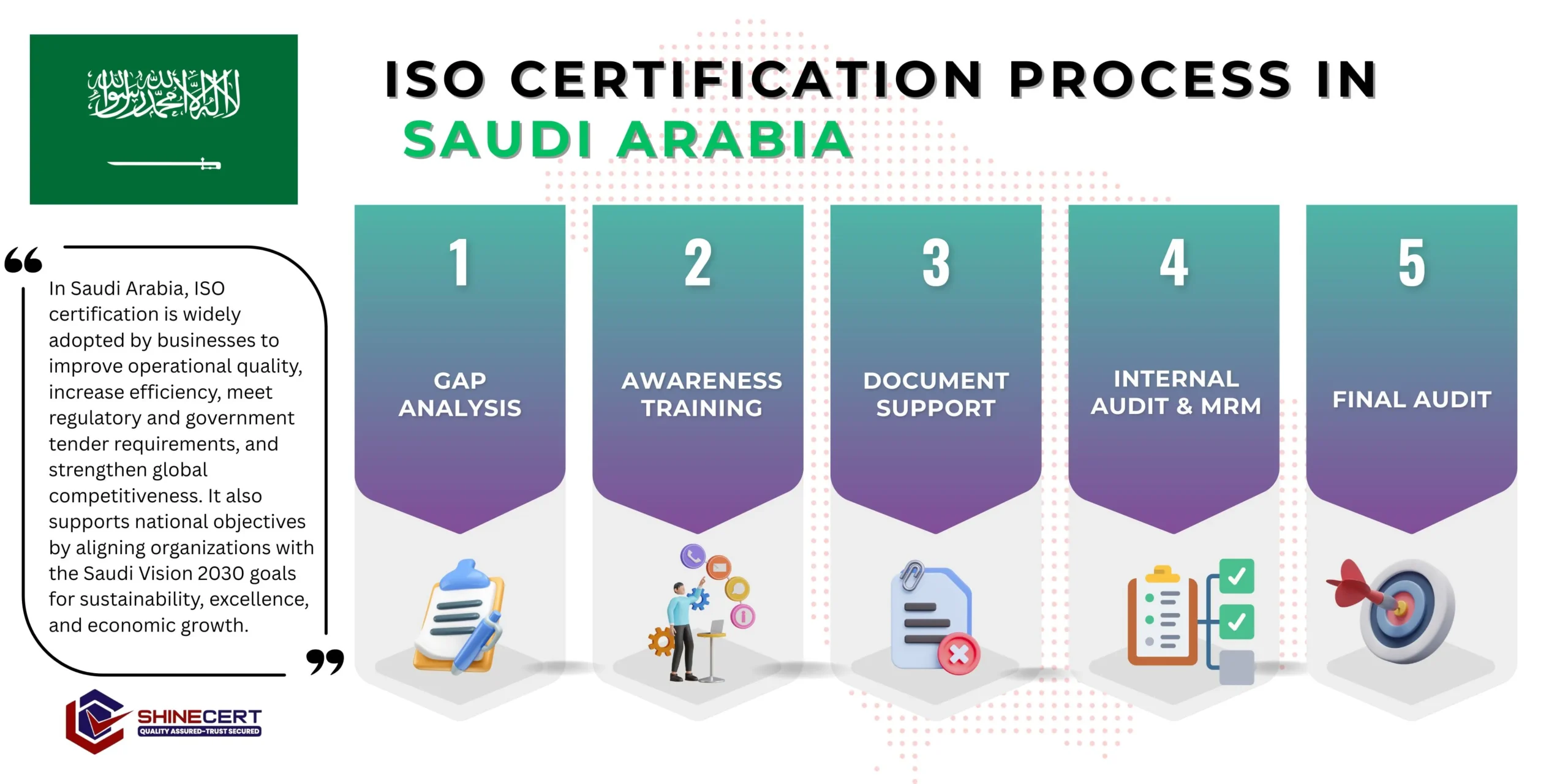
ShineCert’s 5-Step Certification Process for Information Technology
Gap Analysis
ShineCert reviews current security controls, service management practices, and documentation against your target standard's requirements.
Gap assessment report.
Documentation and Control Development
Information security policy, risk assessment, Statement of Applicability, and required procedures are developed.
Complete management system documentation.
Implementation and Team Training
Technical and administrative controls are implemented, and engineering and operations teams are trained on new procedures.
Training records and control implementation evidence.
Internal Audit
An internal audit and management review evaluate the system, often including a simulated incident response test.
Internal audit report and management review minutes.
Certification Audit Support
ShineCert supports Stage 1 and Stage 2 audits with your chosen accredited certification body.
Certificate(s) and surveillance audit schedule.
Gap Analysis
ShineCert reviews current security controls, service management practices, and documentation against your target standard's requirements.
Gap assessment report.
Documentation and Control Development
Information security policy, risk assessment, Statement of Applicability, and required procedures are developed.
Complete management system documentation.
Implementation and Team Training
Technical and administrative controls are implemented, and engineering and operations teams are trained on new procedures.
Training records and control implementation evidence.
Internal Audit
An internal audit and management review evaluate the system, often including a simulated incident response test.
Internal audit report and management review minutes.
Certification Audit Support
ShineCert supports Stage 1 and Stage 2 audits with your chosen accredited certification body.
Certificate(s) and surveillance audit schedule.
Information Technology Certification and Customer Security Questionnaires — How They Connect
Enterprise customer security questionnaires and ISO 27001 certification overlap substantially but aren’t identical, since a specific enterprise customer’s questionnaire may probe areas the standard’s Annex A controls address only at a general level, or ask about practices specific to that customer’s own regulatory context. Technology companies that treat certification purely as a questionnaire-answering shortcut sometimes discover gaps when a sophisticated enterprise customer’s security team conducts its own deeper review beyond accepting the certificate at face value, which is why ShineCert builds certification programs designed to hold up under genuine customer due diligence, not just the certification audit itself.
Applicable ISO Standards for Information Technology
ISO 27001
Information Security Management System
ISO 27001 — Information Security Management System
ISO 27001 has become the single most commonly requested certification across enterprise technology procurement, since it demonstrates a structured, risk-based approach to protecting customer data, intellectual property, and operational systems rather than relying on ad hoc security practices that vary by engineer or team. For SaaS companies, software vendors, and any technology business handling customer data at scale, certification frequently determines whether an organization even clears initial vendor security review before a sales conversation can meaningfully progress, and its Annex A controls give customers a genuine, comparable framework for evaluating security maturity across competing vendors.
ISO 20000
IT Service Management
ISO 20000 — IT Service Management
Technology companies providing managed services, outsourced IT operations, or formal service level agreements find ISO 20000 provides a structured framework for incident management, service level monitoring, and change control that directly maps to the service commitments they're contractually making to clients. Unlike ISO 27001's security focus, ISO 20000 addresses the operational discipline behind actually delivering the service reliably day to day, and organizations combining both standards find genuine efficiency in integrated implementation given their shared management system structure and overlapping incident and change management processes.
ISO 9001
Quality Management System
ISO 9001 — Quality Management System
Technology companies with significant hardware components, systems integration work, or formal project delivery methodologies often find ISO 9001 valuable alongside security-focused standards, since it addresses the broader quality management discipline around project delivery, customer requirement management, and continual improvement that pure information security standards don't specifically cover. Pure software or SaaS companies without significant hardware or project delivery components sometimes find ISO 9001 adds less direct commercial value than ISO 27001 alone, making it worth scoping carefully against actual customer expectations rather than pursuing by default.
ISO 42001
AI Management System
ISO 42001 — AI Management System
As more technology companies build products incorporating machine learning or generative AI capabilities, ISO 42001 has emerged as the standard specifically addressing AI governance, risk assessment for AI-specific harms, data quality management for training data, and human oversight mechanisms, that customers, particularly in regulated sectors, increasingly expect demonstrated rather than simply asserted in marketing material. Technology companies building AI features into an existing product should evaluate ISO 42001 based on how central AI capability genuinely is to their offering and how much regulatory or customer scrutiny that specific capability attracts, rather than pursuing it reflexively for every AI-adjacent feature.
Right-Sized Certification Matters
The reverse question matters here too: very early-stage technology companies without enterprise customers yet, or those serving exclusively small business or consumer markets with limited formal security review, sometimes find full ISO 27001 certification premature relative to their actual commercial need, and ShineCert helps early-stage companies assess genuine readiness and timing rather than pursuing certification purely because competitors have it.
Common Implementation Challenges in Information Technology Certification
- Access controls that accumulated inconsistently over time : Fast-growing technology companies often find access permissions granted ad hoc over years don’t reflect current, least-privilege access needs, requiring genuine remediation before certification.
- Incident response processes that exist but were never tested : A documented incident response plan that hasn’t been exercised through a genuine simulation often reveals significant gaps when finally tested under audit or, worse, a real incident.
- Shadow IT and unmanaged cloud services : Engineering teams provisioning cloud services or SaaS tools outside formal IT governance creates security blind spots that a genuine risk assessment needs to surface and address.
- Documentation that lags behind actual engineering practice : Fast-moving technology companies often find security documentation quickly becomes outdated relative to actual current infrastructure and practices, requiring a genuine maintenance discipline, not just a one-time documentation project.
Benefits of Certification for Information Technology Organizations
- International business and market access benefits : ISO 27001 certification is frequently the deciding factor in enterprise sales cycles, since it satisfies vendor security review requirements that would otherwise require lengthy custom questionnaire responses for every prospective enterprise customer, and it opens doors to international markets and regulated industries that specifically require independently verified security management.
- Trust and reputation benefits : In a market where technology buyers can’t directly inspect a vendor’s internal security practices, certification provides genuine independent verification that reduces the trust gap between vendor claims and buyer confidence, particularly valuable for smaller or newer technology companies competing against more established brand names.
- Process improvement and operational benefits : Implementing ISO 27001 or ISO 20000 frequently surfaces genuine operational gaps — access controls that had accumulated inconsistently over time, incident response processes that existed informally but had never been tested, change management that varied significantly between engineering teams — and technology companies that engage genuinely with the improvement cycle typically see measurably fewer security incidents and service disruptions over subsequent years.
- Competitive differentiation benefits : In crowded technology markets where product features are frequently comparable between competitors, demonstrated security and service management maturity increasingly provides genuine differentiation in enterprise buying decisions where security and reliability carry real commercial weight.
Information Technology Certification Cost: What Actually Drives It
- Company size and infrastructure complexity : A technology company running complex multi-cloud infrastructure or numerous distinct products faces a larger security scope than a single-product company with simpler infrastructure.
- Nature of the business and data sensitivity : Companies processing highly sensitive data, health records, financial information, government data, face more rigorous risk assessment expectations than those handling lower-sensitivity business data.
- Number of departments and products in scope : Certification covering multiple product lines or business units as distinct entities costs more than a narrowly scoped single-product certification.
- Existing security control maturity : Companies with established access control, logging, and incident response practices typically implement faster and at lower cost than those building security controls from scratch.
- Standard combination pursued : Adding ISO 20000 or ISO 42001 alongside ISO 27001 adds distinct scope, though shared management system structure reduces combined implementation cost below three separate projects.
Balancing Security Rigor with Engineering Velocity
- Technology companies, particularly those with agile development practices and frequent deployment cycles, sometimes worry that ISO 27001’s structured change management and risk assessment requirements will meaningfully slow engineering velocity, and this concern is understandable but often overstated when the standard is implemented thoughtfully rather than as a rigid, bureaucratic overlay.
- The genuine goal is building security and change management discipline into existing engineering workflows, code review, deployment pipelines, incident response, rather than creating a parallel compliance process engineers route around because it doesn’t fit how they actually work. ShineCert works specifically with engineering leadership to design controls that integrate into existing development practices, since a security program that engineers experience as pure friction tends to get circumvented in practice, undermining the very protection the certification is meant to demonstrate.
ISO 42001: A New Certification Category
- ISO 42001 addresses a distinctly newer set of risks that traditional information security standards weren’t designed around: AI-specific harms like biased or unreliable model outputs, training data quality and provenance, and the human oversight mechanisms needed when AI systems make or influence consequential decisions. Technology companies building AI features increasingly face customer and, in some jurisdictions, regulatory questions about AI governance that a general ISO 27001 certification doesn’t specifically answer, since data security and AI system reliability are related but genuinely distinct concerns.
- ShineCert helps technology companies assess whether ISO 42001 is proportionate to how central AI capability is to their actual product and customer base, since the standard’s genuine value depends on AI being a meaningful part of what a company delivers, not a peripheral feature added mainly for marketing purposes.
Why Choose ShineCert for Information Technology Certification?
ShineCert has guided more than 10,000 organizations through international certification from genuine operating offices in Riyadh, Lebanon, and India, with practical experience across SaaS, managed IT services, and AI-enabled technology companies.
Information Technology Certification Timeline
Phase | Typical Duration |
Gap analysis | 2–3 weeks |
Documentation and control development | 5–8 weeks |
Implementation and team training | 5–8 weeks |
Internal audit and management review | 1–2 weeks |
Certification body Stage 1 + Stage 2 audit | 2–4 weeks |
Total for ISO 27001 certification | 4–6 months |
Choosing an Accredited Certification Body for Information Technology
What to Check | Why It Matters |
IAF-recognized accreditation for ISO 27001 (and other target standards) | Confirms certificates carry genuine recognition with enterprise customers |
Technology sector audit experience | Auditors familiar with cloud infrastructure and software development practices assess your system more effectively |
Recognition among your target enterprise customer base | Confirms the certificate satisfies the specific vendor security review processes you’re targeting |
Familiarity with relevant data protection regulatory context | Relevant for companies serving customers under GDPR, HIPAA, or similar data protection regimes |
Start Your Information Technology Certification Journey
ShineCert provides end-to-end certification support, from gap analysis through certification audit, for SaaS companies, managed service providers, and AI-enabled technology businesses. Book your free consultation or contact ShineCert directly, and our team will review your infrastructure, customer base, and current security maturity before proposing a fixed-scope engagement plan.
Frequently Asked Questions
Most pursue ISO 27001 first, since information security is what enterprise customers ask about most consistently; ISO 20000 matters most for companies with formal managed service commitments.
ISO 27001 satisfies most enterprise vendor security review, though some sophisticated buyers conduct additional due diligence beyond the certificate itself.
It depends on infrastructure complexity, data sensitivity, and existing security maturity. ShineCert provides a fixed quote after gap analysis.
Implemented thoughtfully, it integrates into existing engineering workflows rather than creating parallel bureaucracy that gets circumvented.
Typically four to six months, depending on existing security control maturity.
Not necessarily, it’s most valuable when AI capability is genuinely central to your product and attracts real customer or regulatory scrutiny.
Certification scales to any size, though very early-stage companies without enterprise customers yet sometimes find the timing premature relative to genuine commercial need.