
ISO 13485 Certification
Medical Devices Quality Management System
Quick Answer
ISO 13485 is the international quality management standard for medical device organizations, published by ISO Technical Committee 210. Unlike ISO 9001, it prioritizes regulatory compliance and risk management over general continual improvement, reflecting the medical device sector’s regulatory context. Certification is issued by an accredited certification body (or, in many markets, a regulator-recognized Notified Body) after an on-site audit, and it is frequently a genuine market-access prerequisite rather than a purely voluntary quality mark. Most organizations complete implementation and certification in four to seven months.
Introduction
Medical device organizations researching ISO 13485 usually need three questions answered clearly: what does the standard actually require, what will it cost, and is it a regulatory necessity or a nice-to-have for our specific market. This page answers all three, plus the clause-by-clause detail, the real certification process, and which parts of the medical device supply chain actually need it. ShineCert has supported medical device manufacturers, distributors, and contract suppliers through this process from our operating offices in Riyadh, Lebanon, and India, and what follows reflects how the standard functions in practice, including its regulatory overlaps that generic ISO consultancy content tends to skip.
What Is ISO 13485? Understanding the Standard
ISO 13485:2016 is a standalone quality management system standard specifically for organizations involved in the design, production, installation, and servicing of medical devices, and for organizations providing related services (distribution, contract manufacturing, sterilization) that are critical to device safety or performance. It does not follow ISO’s newer Harmonised Structure used by ISO 9001:2015 or ISO 27001:2022, it retains an earlier structure with its own clause numbering, which matters because organizations implementing both ISO 9001 and ISO 13485 will find real, not superficial, structural differences between the two.
Certification is issued by third-party accredited certification bodies. In many regulatory markets, ISO 13485 certification is also directly assessed by, or forms a documented part of, a Notified Body’s conformity assessment under that market’s medical device regulation, meaning the certificate can simultaneously serve a quality-marketing purpose and a hard regulatory requirement, depending on where you sell.
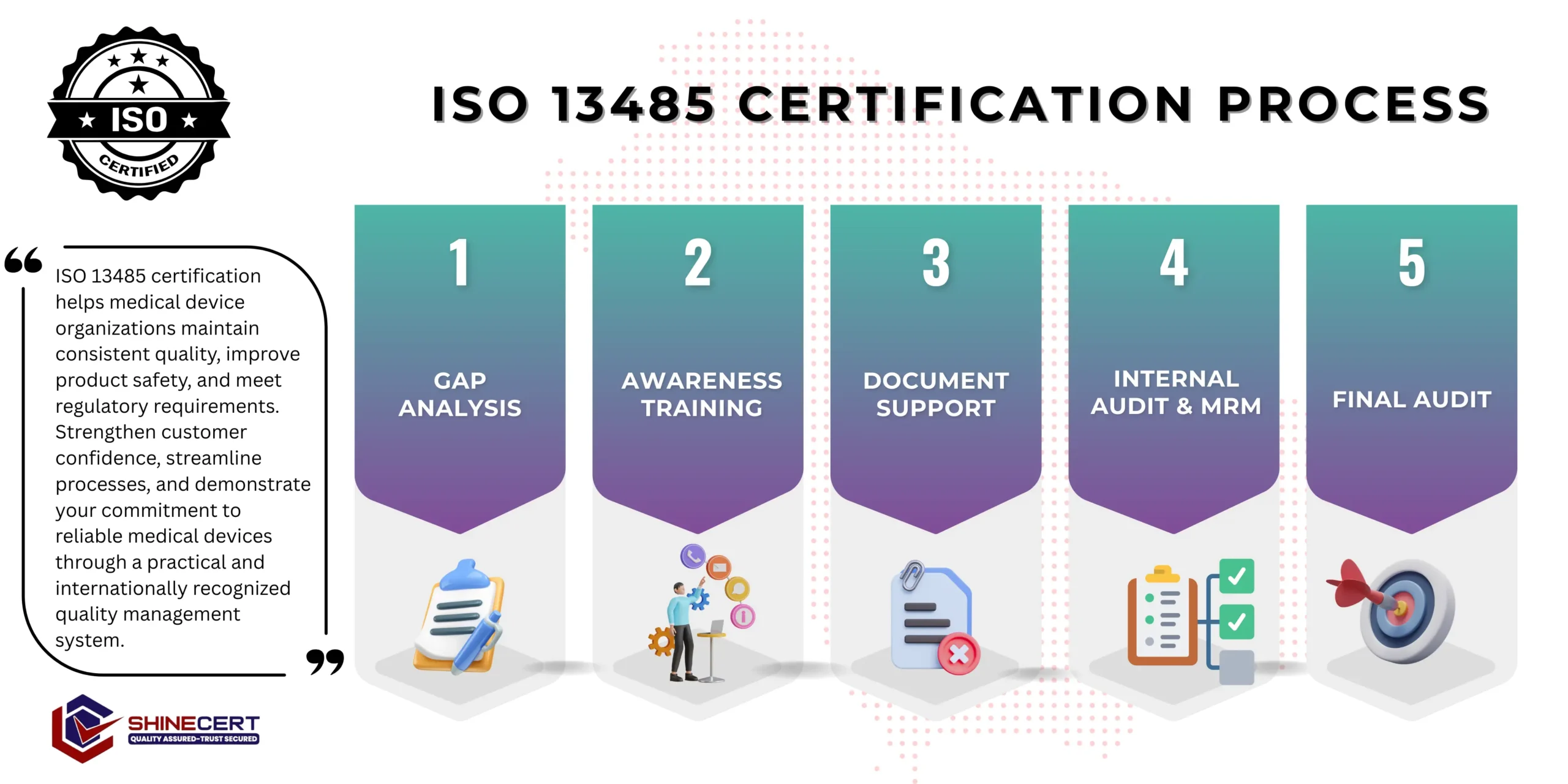
What are the steps to get ISO 13485 Certification?
our services
- ISO 9001 Certification
- ISO 14001 Certification
- ISO 27001 Certification
- ISO 22000 Certification
- ISO 45001 Certification
- ISO 13485 Certification
- ISO 17025 Certification
- CE Mark Certification
- GMP Certification
- Halal Certification
- SOC Certification
The ISO 13485 Implementation Process
This covers the internal work of building the QMS, distinct from the clause requirements explained above and the external certification process below.
Gap Assessment and Regulatory Scoping
Assess current practices against all four operative clauses, and separately map the regulatory requirements of every target market, since device classification and regulatory pathway vary by country.
Gap assessment report and regulatory pathway map.
Risk Management Integration
Build or formalize ISO 14971-aligned risk management files per device, integrated into design and post-market processes rather than treated as a standalone document.
Per-device risk management files.
Design Controls and Documentation
Build Design History Files with genuine input-output-verification-validation-transfer traceability for each device in scope.
Complete Design History Files per device.
Production, Traceability, and Post-Market Systems
Implement production controls, device traceability appropriate to classification, and a functioning post-market surveillance and complaint-handling system.
Production records, traceability system, and PMS/complaint procedures.
Internal Audit and Management Review
Complete at least one internal audit cycle across all clauses and a documented management review before the certification audit.
Internal audit report and management review minutes.
Gap Assessment and Regulatory Scoping
Assess current practices against all four operative clauses, and separately map the regulatory requirements of every target market, since device classification and regulatory pathway vary by country.
Gap assessment report and regulatory pathway map.
Risk Management Integration
Build or formalize ISO 14971-aligned risk management files per device, integrated into design and post-market processes rather than treated as a standalone document.
Per-device risk management files.
Design Controls and Documentation
Build Design History Files with genuine input-output-verification-validation-transfer traceability for each device in scope.
Complete Design History Files per device.
Production, Traceability, and Post-Market Systems
Implement production controls, device traceability appropriate to classification, and a functioning post-market surveillance and complaint-handling system.
Production records, traceability system, and PMS/complaint procedures.
Internal Audit and Management Review
Complete at least one internal audit cycle across all clauses and a documented management review before the certification audit.
Internal audit report and management review minutes.
The ISO 13485 Certification Process
This is the external, third-party process that leads to the certificate itself, separate from the internal implementation work above.
Stage 1 Audit
The certification body (or Notified Body, depending on market) reviews QMS documentation, regulatory scope, and readiness for Stage 2.
DocumentationStage 2 Audit
An on-site audit assessing whether the QMS is genuinely implemented, sampling Design History Files, risk management files, production records, and post-market surveillance evidence against every operative clause.
Evidence sampledCertification Decision
Once nonconformities are resolved, certification is issued, typically valid for three years subject to surveillance.
Certificate issuedSurveillance and Recertification
Annual surveillance audits confirm ongoing conformity, with full recertification every three years, and in many regulated markets, certification maintenance is directly tied to continued market authorization.
Ongoing / every 3 yearsWhy ISO 13485 Certification Matters?
Medical devices carry patient safety consequences that most other product categories don’t, which is why regulators worldwide have built device approval pathways around a certified quality management system rather than relying on one-time product testing alone. A device manufacturer without a functioning QMS is structurally more likely to ship devices with undetected design flaws, uncontrolled production variation, or unaddressed field safety issues, and regulators, hospital procurement teams, and distributors treat ISO 13485 certification as baseline evidence that these risks are being systematically managed, not left to chance.
ISO 13485 Certification Cost Explained
Cost depends heavily on device risk classification (higher classifications require more extensive design control and risk documentation), the number of device families in scope, and whether target markets require additional scheme-specific certification (such as MDSAP participation) beyond base ISO 13485, all of which combine to influence the overall time, effort, and resources needed to complete the certification process successfully across different regulatory environments and market entry points.
Mandatory Documented Information for ISO 13485
At minimum: QMS scope tied to device classification and regulatory requirements per market; device-specific risk management files aligned with ISO 14971; Design History Files; production and traceability records; post-market surveillance and complaint-handling procedures; internal audit records; management review records; and a CAPA log with documented root-cause analysis.
The Structure of ISO 13485: Clauses Explained
- Clause 4 — Quality Management System, including regulatory requirements. Requires establishing, documenting, implementing, and maintaining the QMS, including a defined scope tied to device classification, control of documented information, and — distinctively — identification of the applicable regulatory requirements for each market the organization sells into.
- Clause 5 — Management Responsibility. Requires top management commitment specifically to regulatory compliance as a QMS objective (not just customer satisfaction), a documented quality policy, defined organizational responsibilities, and a designated management representative for regulatory and quality matters.
- Clause 6 — Resource Management. Covers human resources (competence and training specific to device-related roles), infrastructure, and work environment controls, including contamination control where relevant to device safety.
- Clause 7 — Product Realization. The most extensive clause: planning of product realization, customer-related processes, design and development (including design controls and the Design History File), purchasing and supplier controls, production and service provision (including sterile device requirements and traceability), and control of monitoring and measuring equipment. This is also where ISO 14971 risk management integration lives structurally.
- Clause 8 — Measurement, Analysis and Improvement. Covers customer feedback and complaint handling, internal audit, monitoring of processes and product, control of nonconforming product, data analysis, and corrective and preventive action (CAPA) — plus, distinctively, post-market surveillance obligations that extend beyond what a generic quality standard requires.
Each clause becomes a specific audit line item, and Clause 7’s design control and risk management requirements combined with Clause 8’s post-market surveillance and CAPA requirements are where ShineCert sees the most audit findings in organizations that haven’t genuinely built out these areas.
Post-Market Surveillance: The Requirement Most New Manufacturers Underestimate
Post-market surveillance isn’t satisfied by a passive complaint log, it needs a systematic process for actively gathering field performance data, analyzing trends across the installed base, and feeding findings back into risk management files and, where warranted, corrective or field safety action. A genuine system also needs a clear escalation path from a single complaint to a broader trend investigation, and from there to a decision about updating risk files, organizations that build this escalation path thoughtfully catch emerging device issues meaningfully earlier.
Benefits of ISO 13485 Certification
In many jurisdictions, certification is a documented component of medical device registration, meaning it directly enables market access rather than simply supporting it. It’s also frequently a prerequisite for coverage under national health insurance and hospital procurement.
Genuine integration of ISO 14971 risk management throughout the device life cycle catches design and production risks earlier and more systematically than ad hoc quality control, reducing the likelihood of costly post-market corrective actions or recalls.
Distributors, hospital systems, and OEMs increasingly require ISO 13485 certification from suppliers and contract manufacturers as a qualification condition, particularly for components or services deemed critical to device safety.
Design History Files and traceability records built to genuine audit standard also function as valuable internal knowledge assets, reducing the institutional risk of losing design rationale or production history when key staff leave.
Who Needs ISO 13485? Industries and Reverse Suitability
- Medical device manufacturers across every risk classification are the core adopters, but certification also extends meaningfully down the supply chain: distributors and importers (increasingly required to demonstrate quality management over storage and post-market surveillance), contract manufacturers and component suppliers (where the component is critical to device safety or performance), and Software as a Medical Device (SaMD) developers, whose software meets the regulatory definition of a device in their target market.
- The reverse question matters too: organizations manufacturing devices that are not classified as medical devices in their target markets, or manufacturing general industrial or consumer products with no device classification, should look at ISO 9001 instead, ISO 13485’s regulatory-compliance-first structure adds real cost and complexity that isn’t justified without an actual device classification driving it.
Regulatory Frameworks ISO 13485 Supports Around the World
ISO 13485 rarely stands alone, it operates as the quality backbone underneath a country’s medical device regulatory framework. In the European Union, manufacturers generally need both CE marking under the MDR or IVDR and ISO 13485 certification, often assessed together by the same Notified Body. In the United States, the FDA’s Quality Management System Regulation has been harmonizing with ISO 13485, narrowing the gap with the older, more distinct 21 CFR Part 820 framework. Health Canada requires MDSAP certification or equivalent as a licensing prerequisite, and MDSAP allows one audit to satisfy multiple participating countries’ requirements (Canada, the US, Australia, Brazil, Japan). For manufacturers in the Gulf and broader Middle East, national regulators increasingly reference ISO 13485 directly in registration dossiers, with local representative requirements varying by country, an area where ShineCert’s regional presence provides direct, practical guidance.
Ready to scope your ISO 13485 certification project? Book your free consultation or contact ShineCert directly.
Book Free ConsultationReady to scope your ISO 9001 certification project? Book your free consultation or contact ShineCert directly.
Book Free ConsultationChoosing an Accredited Certification Body
Confirm current IAF-recognized ISO 13485 accreditation, and specifically whether your target markets require a Notified Body arrangement or MDSAP participation beyond base certification, this determines which certification bodies are actually eligible to serve you.
ISO 13485 Certification Timeline
Phase | Typical Duration |
Gap assessment and regulatory scoping | 2–3 weeks |
Risk management and design control documentation | 6–12 weeks |
Implementation and traceability setup | 4–8 weeks |
Internal audit and management review | 3–4 weeks |
Stage 1 and Stage 2 audits | 2–3 days combined |
Certificate issuance | 3–8 weeks after Stage 2 |
Why Choose ShineCert for ISO 13485 Certification?
ShineCert has guided more than 10,000 organizations through ISO certification from genuine operating offices in Riyadh, Lebanon, and India, with meaningful medical device sector experience navigating both ISO 13485 certification and the regulatory context it typically sits within. We build risk management files and Design History Files that are genuinely defensible under regulatory scrutiny, not just ISO audit-ready.
Common Implementation Challenges
- Design History Files assembled retroactively : DHFs built after design work is complete are frequently incomplete in ways that surface during regulatory audits years later.
- Risk management is treated as a one-time exercise : ISO 14971-aligned files need ongoing maintenance as post-market data accumulates.
- Post-market surveillance that’s passive rather than systematic : A complaint log alone doesn’t satisfy the requirement for active field data gathering and trend analysis.
- Underestimating multi-market regulatory complexity : Selling into multiple regulatory jurisdictions adds real complexity beyond base ISO 13485 compliance.
Frequently Asked Questions
ISO 13485 certifies a medical device quality management system against the industry-specific international standard. For device manufacturers and critical suppliers, it’s typically a regulatory necessity rather than an optional choice.
It depends on device risk classification, device family count, and target market regulatory requirements. ShineCert provides a fixed quote after scoping.
Most organizations move from kickoff to certificate in four to seven months.
No, it diverges structurally, prioritizing regulatory compliance and risk management over general continual improvement.
Yes, if the software meets the regulatory definition of a medical device in the target market.
QMS scope, device-specific risk management files, Design History Files, production and traceability records, post-market surveillance procedures, internal audit and management review records, and a CAPA log.
Medical device manufacturers, distributors, importers, contract manufacturers, and SaMD developers. Non-device manufacturers should consider ISO 9001 instead.